
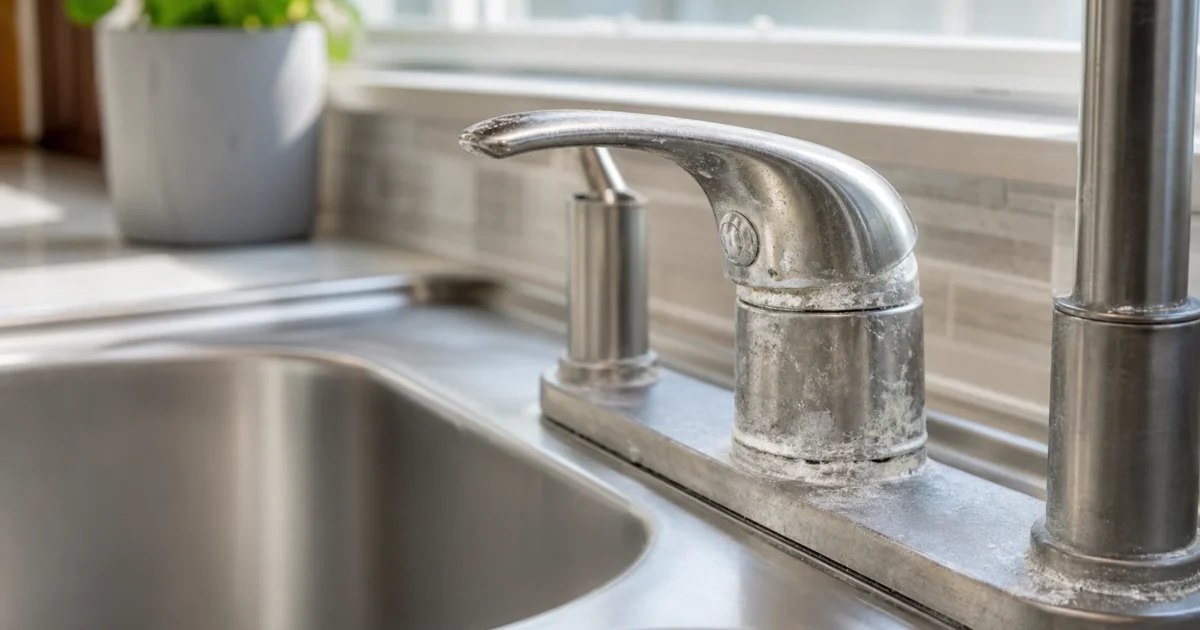
A faucet handle hard to turn is one of those repairs homeowners put off because it doesn’t seem urgent — water still flows, nothing is obviously broken. But the underlying cause usually gets worse over time, and the fix is often a $5 tube of grease or a $30 cartridge.
This article covers the five most common causes of a stiff faucet handle, how to diagnose which one you’re dealing with, and what each repair actually costs. The guidance applies to kitchen and bathroom sink faucets, shower faucets, and most name-brand single- or two-handle designs from Moen, Delta, Kohler, and American Standard.
Quick answer: Most stiff faucet handles trace to one of five things — mineral buildup around the handle base, dried or worn O-rings, a worn or failing cartridge, over-tightened hardware, or mechanical damage to the handle adapter or stem. Start with the easiest fix (mineral cleaning) before reaching for a wrench.
Why Is My Faucet Handle Hard to Turn? Start With the Motion Pattern
Before taking anything apart, watch how the handle moves. The motion pattern narrows the diagnosis faster than any disassembly.
Uniformly stiff through the whole range — if the handle has gotten harder and harder to turn over months or years, you’re almost certainly looking at mineral buildup, dried lubrication, or slowly deteriorating seals. Moen identifies sediment or debris in the cartridge, mineral buildup, and damaged cartridge seals as the causes of difficult handle operation. American Standard separately names mineral buildup, worn or dry cartridges, debris, over-tightened mounting hardware, and corrosion as reasons a faucet handle may be hard to turn. Uniform stiffness is the most common pattern — and the cheapest to fix.
Catches, grinds, or binds in one spot — a handle that turns freely in most positions but snags or grinds at the hot or cold extreme points toward mechanical damage: a broken plastic guide part, a cracked handle adapter, mineral crystals packed into one area, or a mis-seated cartridge. Do not force past a grinding sensation. Forcing can crack the handle, strip the adapter, or break the cartridge stem.
Water still responds correctly — if flow and temperature still track handle movement smoothly, the internal valve parts are probably functional. The stiffness is friction at the cartridge, stem, O-rings, or handle base — not a cartridge failing internally.
Water flow is erratic or shutoff is unreliable — if the handle moves but water behavior no longer tracks it (temperature unpredictable, won’t fully shut off, no flow at some positions), the cartridge is failing internally, not just stiff on the surface. Use this motion-pattern guide to narrow down why your faucet handle hard to turn before reaching for tools.
Cause 1: Mineral Buildup and Hard-Water Scale
The most common cause of a faucet handle hard to turn in U.S. homes is mineral buildup — hard-water calcium and scale that accumulate around the handle base, bonnet, skirt, or stem area over time.
Kohler says hard-water calcium or mineral buildup can make faucet parts such as handles, bonnets, skirts, and aerators difficult to remove and recommends targeted treatment for that buildup. If you see white or tan deposits around the faucet base, on the aerator screen, or on the showerhead nozzles, mineral buildup is a strong candidate.
How to confirm it: Visible white crust around the handle base, aerator, or trim ring — especially in high-mineral-content water areas. Stiffness has gotten gradually worse over months, not suddenly.
The fix: Kohler recommends wrapping a towel soaked in a 50/50 white-vinegar and warm-water solution around the affected bonnet or handle skirt for about five to ten minutes, then attempting removal using rubber gloves, a rubber jar opener, or a strap wrench for grip. Moen allows 50/50 vinegar/water on dried water spots when rinsed thoroughly and dried afterward. Delta also supports 50/50 vinegar/water for difficult mineral deposits in appropriate finish-safe contexts.
A few caveats: five to ten minutes is the treatment window for installed trim, not overnight. Leaving acid on finished trim longer than manufacturer guidance can harm the finish and void warranty coverage. Check your faucet brand’s finish-care instructions before applying vinegar — some specialty and living finishes should not contact acidic cleaners at all. Moen warns that abrasive pads and harsh cleaners can scratch finishes or void warranty coverage, so stick to soft cloths after the rinse.
After cleaning, if the handle still feels stiff, shut off the supply valves, remove the handle, and inspect for mineral crystals around the stem or cartridge area. A soft nylon brush or toothbrush clears loose deposits — no abrasive pads.
Cost: Essentially $0 if you have vinegar at home. DIY difficulty: easy. This is the most common reason a faucet handle hard to turn worsens gradually over months.
Cause 2: Dry or Worn O-Rings and Seals
If you have a faucet handle hard to turn with clean exterior trim and no visible mineral deposits, dried or impaired O-rings and seals are the next branch. This cause appears most often in the rotating spout of kitchen faucets, at the base of single-handle faucets where the spout pivots, and in some two-handle bathroom designs.
Moen says a difficult-to-rotate spout is caused by debris and/or an impaired O-ring and recommends cleaning the spout interior and valve body exterior, replacing the O-ring if damaged, and lubricating with silicone-based grease if the O-ring is intact. Moen also warns against petroleum-containing lubricants — they can react with rubber seals and actually make the faucet handle harder to turn. This rules out WD-40 and most general-purpose sprays.
The fix: Shut off the supply valves. Remove the handle and spout assembly per your model’s instructions. Clean the stem and interior surfaces, inspect the O-rings, and replace any that are cracked, flat, or compressed. Lubricate with silicone faucet grease — the Danco 88693 silicone faucet grease runs about $4.50 to $5.50 at most hardware retailers and is designed for faucet stems, valves, cartridges, and rubber O-rings.
Cost: $5 to $20 for grease and an O-ring kit. DIY difficulty: easy to moderate.
Cause 3: A Worn or Failing Cartridge
A faucet handle hard to turn often points to the cartridge — the internal valve mechanism that controls water flow and temperature. In cartridge-style faucets — which covers most modern single- and two-handle designs — the cartridge does most of the work every time you operate the handle. After thousands of cycles, internal seals wear, the body may corrode, and the cartridge becomes stiff or starts to fail.
How to confirm it: If the handle is hard to turn AND the faucet drips when off, or if temperature control has become unpredictable, the cartridge is almost certainly the cause. If uniform stiffness remained after exterior cleaning and O-ring lubrication, the cartridge has worn beyond what surface service can restore.
Which cartridge? This matters before ordering parts — compatibility traps are common. Moen distinguishes between families: the 1225 and 1255 Duralast are not the same part. According to Moen’s cartridge overview, the 1225 appears in many single-handle faucets produced before 2009, while the 1255 Duralast appears in many newer single-handle kitchen and lavatory faucets launched since 2009. The Moen 1224 and 1234 cartridges can both appear in two-handle centerset faucets but are not interchangeable. The Moen Posi-Temp 1222 is a different shower-only family again.
On the Delta side, the RP50587 is a specific 36 mm DIAMOND Seal motion cartridge for compatible Delta kitchen and lavatory models — not a generic Delta replacement. Delta’s RP50587 instruction sheet warns not to disassemble the cartridge itself. Delta shower cartridges vary further by valve generation, with older Monitor 1300/1400 valves using different cartridges than later MultiChoice Monitor T13/T14 valves.
Before you buy, use our free Repair Finder to confirm the exact cartridge for your faucet model — a wrong cartridge that won’t seat correctly is a common and expensive mistake.
Moen 1225 treatment note: Moen’s general troubleshooting page allows removing and lubricating a 1225 cartridge with silicone-based grease in some one-handle faucet applications. However, Moen’s kitchen hard-handle FAQ recommends replacing the 1225, 1255, or 4000 cartridges when a one-handle kitchen faucet is hard to operate. Both are official Moen guidance — for a kitchen faucet, replacement is the safer call; a bathroom or bar faucet with the same cartridge may respond to lubrication first.
A word on older Delta ball-type faucets: worn seats and springs on certain older Delta ball or compatible seat-spring faucets can contribute to stiffness when it’s paired with dripping. The Delta RP4993 seats-and-springs kit runs about $6 to $8 and applies to ball-valve families — not all Delta faucets.
Cost: Moen 1225 or 1225B: about $30 to $35 at Home Depot, Lowe’s, and SupplyHouse. Delta RP50587: about $43 to $63 depending on retailer. DIY time: 30 to 60 minutes. DIY difficulty: moderate.
Cause 4: Over-Tightened Hardware
A faucet handle hard to turn that appeared suddenly after a repair often has a simple cause: a set screw, retaining nut, bonnet nut, or mounting nut tightened too far presses down on the cartridge stem, handle adapter, or valve body and creates resistance throughout the handle arc. This is more common after a recent DIY repair than in a faucet that’s never been serviced.
Moen’s spout troubleshooting notes that an overly tightened retainer nut or mounting nut can make a spout or spout receptor difficult to rotate. American Standard also includes over-tightened mounting hardware in its stiff-handle causes.
How to confirm it: Stiffness started suddenly after a recent repair, not gradually over months. The handle may feel slightly canted or uneven, or movement is uniformly resistant rather than smooth.
The fix: Remove the handle, back off the retaining or bonnet nut one-quarter to one-half turn, reinstall, and test. Cost: $0. DIY difficulty: easy.
Cause 5: Mechanical Damage — Bent, Cracked, or Mis-Seated Parts
A faucet handle hard to turn due to mechanical damage is less common than the other causes — it shows up as grinding, catching, or binding in one portion of the handle arc, or as a handle that will not come off even with the set screw removed. Causes include a cracked handle adapter, a bent stem, a mis-seated cartridge, broken plastic guide parts, or a stripped handle socket.
How to confirm it: The handle grinds or catches at one specific position in its arc, or there’s a discernible wobble that wasn’t there before. Motion feels mechanically rough, not just stiff.
The fix: Identify and replace the damaged part. If the handle will not come off even with the set screw removed, use a handle puller — This Old House recommends a handle puller for stuck handles rather than uncontrolled prying against finished trim.
If the cartridge is mis-seated, remove it and reseat it with the tabs aligned to the valve-body cutouts before reinstalling the retaining clip. Moen says not to force the retaining clip if there is resistance — resistance means the cartridge is not yet correctly seated, and forcing can cause leaks or unsafe cartridge retention.
Cost: Varies by brand and part. Handle kits for common brands are typically $10 to $30 if available. DIY difficulty: moderate — escalate if the handle will not come off or if shutoff valves do not fully close.
When a Stiff Handle Signals Something Worse
A faucet handle hard to turn is usually a $5-to-$60 DIY repair. Certain symptom combinations, though, point to a more serious problem.
Escalate beyond cleaning or lubrication when: – Handle rotates or lifts but no water comes out at any position (with shutoffs open and other fixtures normal) — internal cartridge failure, a broken stem, or blockage. Moen’s 1225 cartridge page underscores that the cartridge controls both volume and temperature, so internal failure can cut off both. – Grinding, popping, or crunching sensation during movement — mineral grit inside the cartridge, broken plastic guide, or cracked stem. – Handle will not move at all despite correct disassembly attempts — seized cartridge in a corroded valve body. – Visible rust, pitting, cracked metal, or cracked plastic on the stem or valve body — replacement of the part or the whole faucet.
When to replace the faucet rather than repair it: HomeGuide notes that faucets 15-plus years old with corrosion, persistent dripping, weak flow, or multiple failing parts may cost nearly as much to service as to replace — especially when the faucet body is corroded and replacement parts are hard to source. For shower valves, cartridge replacement is usually the better path even on older fixtures because replacing the valve body requires wall access and significantly higher labor.
When to call a plumber: – Shutoff valves under the sink are stuck or do not fully close — address that first. – The faucet is a pressure-balance shower valve with significant mineral buildup (Kohler K-304 Rite-Temp guidance recommends replacing the pressure-balancing unit rather than cleaning alone in those cases). – Parts are unavailable — no-name imports or discontinued fixtures.
Professional cartridge replacement for showers typically runs $150 to $350 in parts and labor, per Angi’s range for shower cartridge replacement.
Symptom-to-Cause Quick Reference
| Symptom | Most likely cause | First step |
|---|---|---|
| Uniformly stiff, worsened over months | Mineral buildup or dried seals | 50/50 vinegar wrap, 5–10 min |
| Stiff after a recent repair | Over-tightened hardware | Back off retaining nut ¼ turn |
| Grinds or catches at one position | Mechanical damage or mis-seated cartridge | Inspect after handle removal |
| Stiff + drips when off | Worn cartridge | Identify and replace correct cartridge |
| Stiff + temperature control erratic | Cartridge failing internally | Identify and replace correct cartridge |
| Spout hard to rotate at pivot point | Impaired O-ring or debris at spout base | Clean + silicone-grease O-ring |
| Handle won’t come off | Mineral seizure or stripped adapter | Handle puller; escalate if needed |
What to Do Next
If exterior mineral cleaning improved your faucet handle hard to turn but stiffness returned within weeks, the cartridge is the likely next step. The sequence:
- Shut off both supply valves under the sink (or the main shutoff for shower faucets without individual shutoffs).
- Identify the exact cartridge for your faucet model using the documentation on the faucet body, the packaging, or the manufacturer’s support site.
- Order the OEM cartridge from your brand’s store or a trusted supplier — Home Depot, Lowe’s, and SupplyHouse all carry common Moen and Delta cartridges.
- For Moen 1225 replacement: Moen says to flush the valve body before inserting the new cartridge and not to force the retaining clip.
- For Delta RP50587 replacement: align guide pins with faucet-body openings and do not disassemble the cartridge itself.
For more on faucet types, cartridge families, and when DIY makes sense, see The Complete Guide to Faucet Repair. If you’re not sure which brand or valve type you’re working with, start with How to Identify Your Faucet Brand and Model before ordering any parts.
Can I fix a faucet handle hard to turn without taking it apart?
Sometimes. If the stiffness is from exterior mineral buildup, a 50/50 vinegar/water towel wrap around the handle base or bonnet for five to ten minutes — per Kohler’s guidance — may restore enough movement without disassembly. If stiffness is internal (worn O-rings, failing cartridge), disassembly is necessary.
What lubricant is safe to use on a faucet handle?
For a faucet handle hard to turn due to dry seals: silicone faucet grease only — never WD-40, petroleum jelly, or general-purpose spray lubricants. Moen specifically warns that petroleum-based lubricants can react with rubber cartridge seals and make the handle harder to operate. The Danco 88693 silicone faucet grease runs about $5 and is designed for stems, valves, cartridges, and O-rings.
How do I know if I need to replace the cartridge or just clean it?
If the handle is stiff and the faucet also drips when off, has erratic temperature control, or won’t fully shut off — replace the cartridge. If the faucet still controls water correctly and the stiffness is gradual and uniform, try cleaning and lubrication first. Moen’s kitchen hard-handle FAQ recommends replacement — not cleaning — for hard-to-operate 1225, 1255, and 4000 kitchen faucet cartridges.
Will any Moen cartridge fit my faucet?
No — Moen cartridges are not interchangeable across families. The 1225 and 1255 Duralast are different parts. The 1224 and 1234 both fit some two-handle centerset faucets but are not interchangeable with each other. The 1222 Posi-Temp is a shower-only family. Always verify the exact cartridge using your faucet’s model documentation or Moen’s support site before ordering.
How much does it cost to fix a faucet handle hard to turn?
For a faucet handle hard to turn, the range is wide. Mineral cleaning costs essentially nothing. Silicone faucet grease is about $5. An O-ring kit adds $5 to $15. A Moen 1225 cartridge runs about $30 to $35 in parts; a Delta RP50587 runs $43 to $63. Professional labor for a cartridge swap adds roughly $100 to $200 for sink faucets and $150 to $350 for showers.
When should I just replace the whole faucet instead of repairing it?
For sink faucets: when the body is corroded, multiple parts are failing, replacement parts are unavailable, or the faucet is 15-plus years old and repair quotes approach the cost of a new fixture. For shower valves, cartridge replacement is almost always the better path — replacing the valve body requires wall access and significantly higher labor cost.
Sources
- Moen — Handle is Difficult to Operate
- Moen — Kitchen Faucet Handle Hard to Operate FAQ
- Moen — Spout is Difficult to Rotate
- Moen — 1225 Kitchen Cartridge Replacement
- Moen — Faucet Cartridge Overview
- Moen — 1224 or 1234 Cartridge Guide
- Moen — Bathroom Cartridge Guide
- Moen — Shower Cartridge Guide
- Moen — Faucet Finish Care and Cleaning
- Kohler — Hard-Water Calcium or Mineral Buildup on Faucet
- American Standard — Stiff Handle FAQ
- Delta — RP50587 Cartridge Instruction Sheet
- Delta — RP4993 Seats and Springs Instruction Sheet
- Lowe’s — Danco Silicone Faucet Grease
- SupplyHouse — Danco 88693 Silicone Faucet Grease
- This Old House — How to Repair a Leaking Faucet
- The Plumbing Directory — How to Replace a Faucet Cartridge
- Angi — Shower Cartridge Replacement Cost
- HomeGuide — Faucet Installation Cost
Educational content only. Not a substitute for licensed professional advice. Local plumbing codes vary by jurisdiction. Use of any guidance from this guide is at your own risk.
Get the homeowner’s plumbing repair toolkit checklist — the tools, parts, and decisions every homeowner should have on hand. [Free download — enter your email]
Parts for this repair
As an Amazon Associate, plumbingbythebook earns from qualifying purchases. Links below are affiliate links — they cost you nothing extra.
- Danco Silicone Faucet Grease — Silicone-based grease approved for cartridges and O-rings. About $5 at most hardware stores.
- Moen 1225 Replacement Cartridge — OEM Moen cartridge for many single-handle faucets. About $30–$35.
- Delta RP4993 Seats and Springs Kit — Low-cost repair kit for older Delta ball-type faucets. About $6–$8.
Related guides
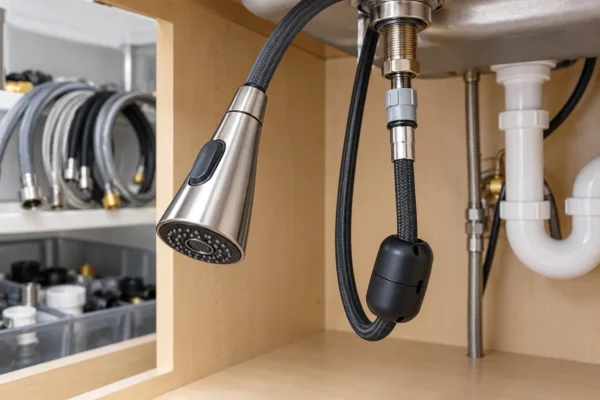
Replacement Hose for Pull-Down Kitchen Faucet: How to Tell Which Fits
You have a pull-down kitchen faucet that won’t retract, drips under the sink, or has a cracked hose,…
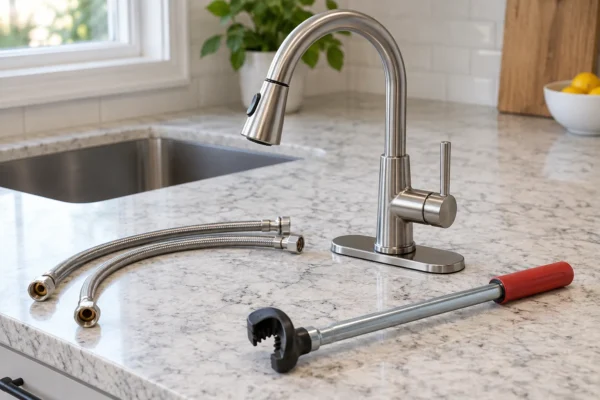
Cost to Install a Faucet: What the Labor Actually Runs [2026]
The cost to install a faucet with a professional is usually a low-hundreds job: Home Depot lists an…
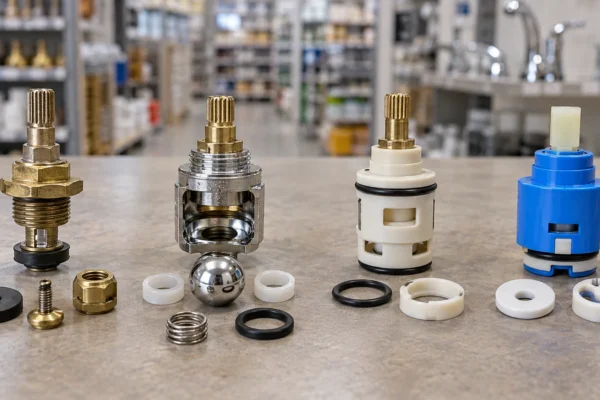
Faucet Valve Type Identification Chart: Cartridge, Ball, Compression, and Ceramic Disc [2026]
This faucet valve type identification chart covers the four mechanisms hiding inside almost every residential sink faucet —…