
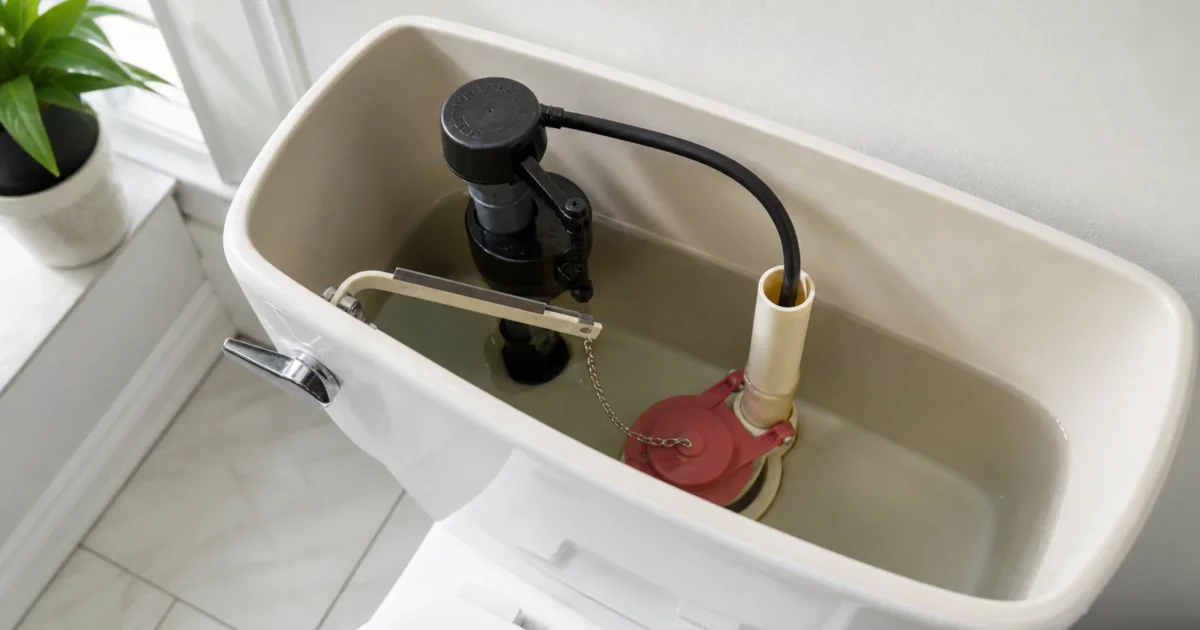
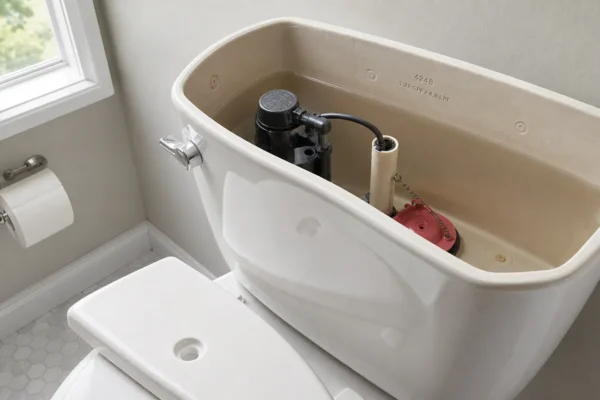
Pull off the tank lid to fix a running toilet and you’ll find one of two very different things: a rubber flapper hinged over a hole, or a tall plastic canister with no flapper in sight at all. How to identify your toilet flush valve starts with figuring out which of those you’re actually looking at, because the flapper aisle at the hardware store won’t help you if your toilet uses a Kohler canister, a Mansfield tower, or an American Standard Champion valve with a 4-inch opening.
The fix is usually cheap – a universal flapper runs $4 to $10 – but only if it’s the right size and the right style. This guide walks through where to find your toilet’s model number, how to read the flush valve itself for visual clues, and what to do when both come up blank.
How to Identify Your Toilet Flush Valve: Start With the Tank, Not the Valve
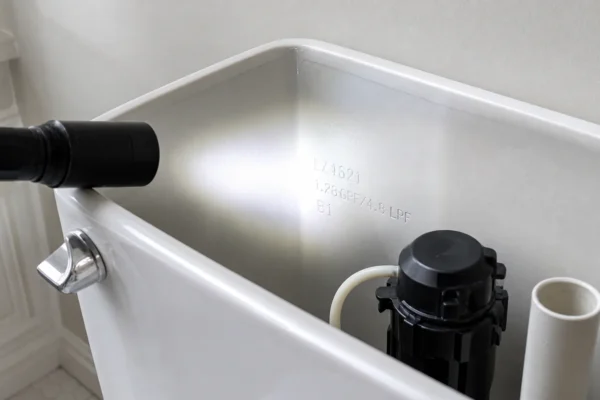
Korky’s compatibility lists go by toilet brand, model and tank number Korky. The fastest path to the right part is identifying the toilet itself first. Lift the tank lid, set it aside carefully, and shine a flashlight across the inside back wall of the tank – Gerber, for one, puts its tank model number there, near the water line, with the cast date, bar code and serial number Gerber.
Kohler tank numbers commonly use a K- prefix, such as K-4418 or K-4708-AA, embossed into the porcelain – easy to mistake for a generic casting mark if you don’t know to look for it Kohler support. TOTO’s own numbering system uses a letter prefix to separate part types: bowl model numbers start with C, ceramic tank numbers start with S, resin tank numbers may start with TCF or CES, and any number starting with # is a color code, not the model TOTO. Photograph every inside-tank marking – the model number, the gpf rating and any date stamp – before shopping for a flush valve.
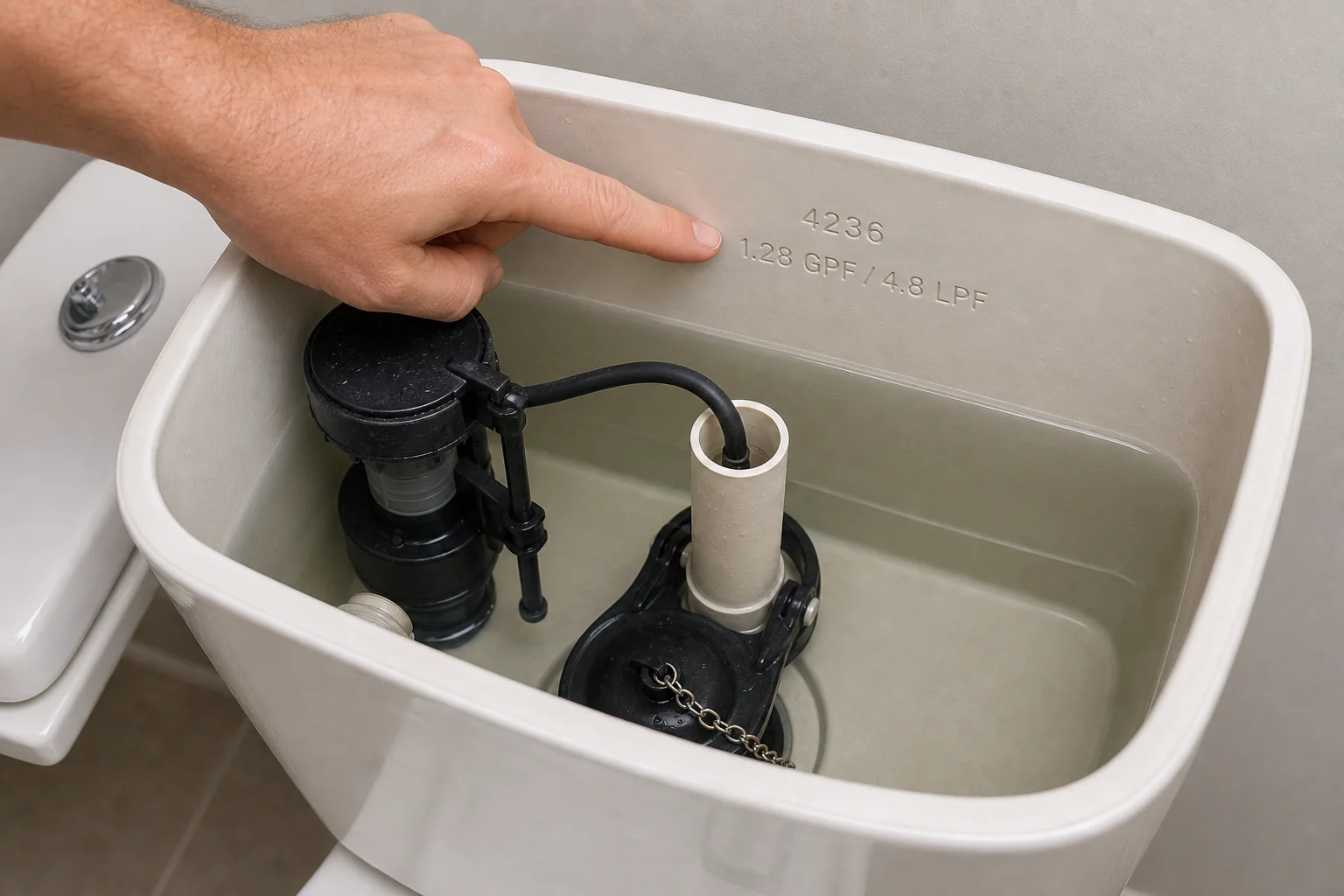
If the back wall is blank or hidden behind hardware, check the right and left interior side walls next – TOTO in particular sometimes places its model number on the wall opposite the trip lever PlumbingSupply. A damp cloth and a flashlight held at an angle can reveal a number that looks blank at first glance.
Check the Tank Lid, the Exterior, and Any Loose Parts
If the tank interior is a dead end, flip the tank lid over. Some manufacturers use a paper or adhesive label on the underside rather than an embossed number, and Korky’s identification diagram points homeowners to exactly three spots in this order: the lid underside, the tank interior, and the exterior brand name Korky. One caution: trust the tank’s own markings over a lid that might not be original.
The exterior brand logo narrows the search but rarely finishes it, since a single brand often sells several incompatible flush-valve families Korky. TOTO notes its bowl mark and product-number label may sit on the lower side of the bowl, and Gerber says its two-piece bowl model numbers can be found under the bowl rim, readable with a mirror or phone camera without removing the toilet TOTO Gerber.
Don’t confuse a flapper’s own size with the toilet’s tank model number – a 2-inch or 3-inch universal flapper fits many brands but doesn’t tell you which brand you own Korky. If the tank contains a sealed black pressure vessel instead of an open flapper or canister, you’re looking at a pressure-assist system, and Gerber notes those model numbers are still found inside the tank – it still needs to be opened and photographed before you order parts Gerber.
Visual ID by Flush Valve Type
Once you’ve got a model number (or even without one), the physical shape of the valve tells you a lot on its own.
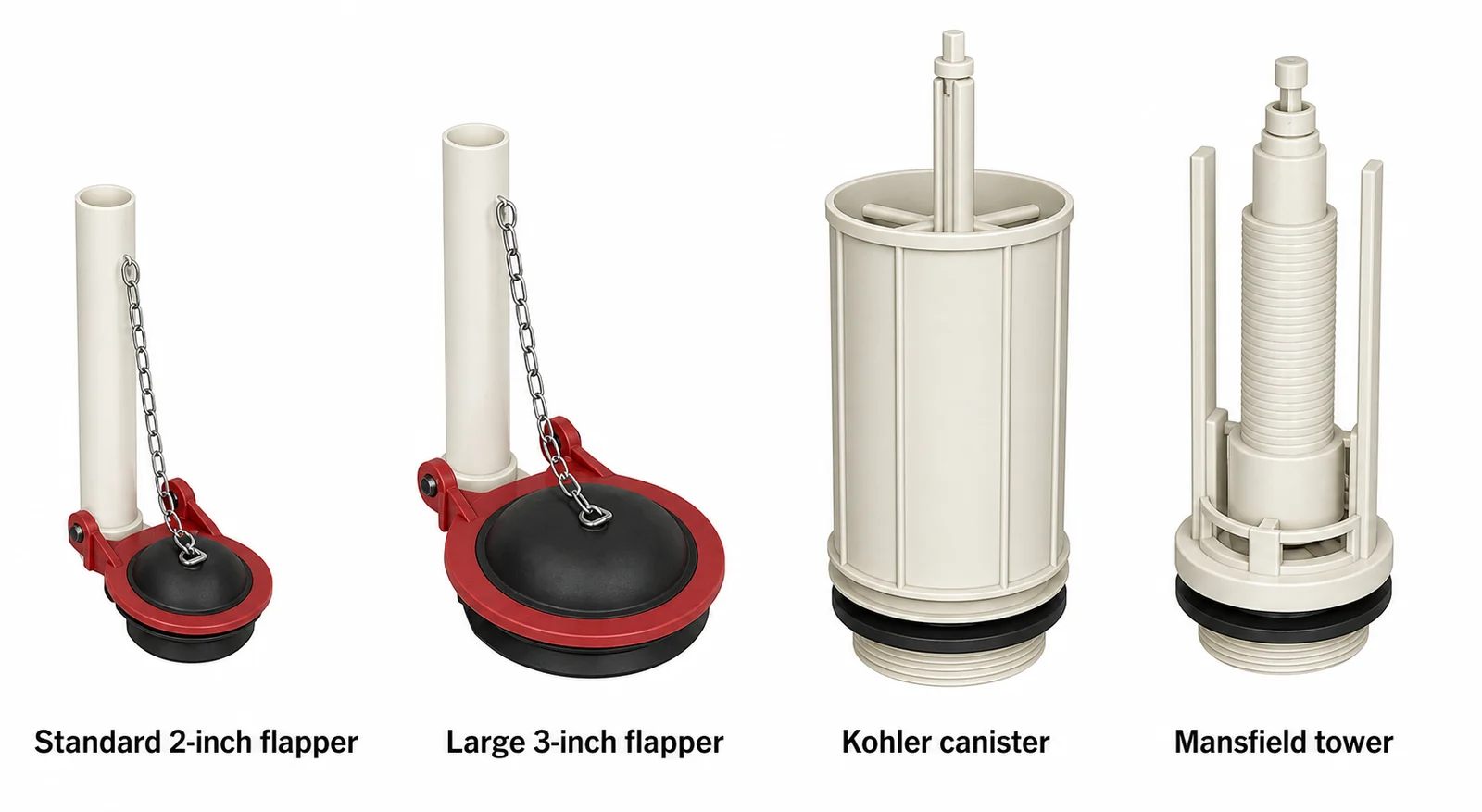
Standard 2-inch flapper. A hinged rubber or plastic flapper sits over an overflow tube with a chain running to the trip lever. Korky says most toilets built before 2000 use this standard 2-inch size, and the drain opening is roughly orange- or baseball-sized Korky. A 2-inch universal flapper from Korky is sold to fit many Kohler, Glacier Bay, and American Standard models built to this spec Lowe’s.
Large 3-inch flapper. Visually wider – grapefruit- or softball-sized rather than baseball-sized – and, Korky says, popular since the year 2000 Korky. Korky’s 3-inch universal flapper lists compatibility across Kohler, TOTO, American Standard, Gerber, and Mansfield model families built to this larger opening Lowe’s.
Kohler canister (AquaPiston-style). Kohler sells the valve as a canister flush valve assembly, such as its kit for Cimarron toilets SupplyHouse. For a leaking Kohler canister toilet, Kohler’s yellow GP1059291 is a replacement seal for single-flush canister toilets that replaces the red seal – not a flapper Lowe’s.
Mansfield tower. A vertical tower mechanism instead of a hinged flapper. Korky’s Mansfield-specific kit is built to fit the 208, 209, 210, and 211 tower-style valves and adjusts to cover both 1.6 gpf and 3.5 gpf versions Korky. Home Depot also carries a dedicated 1.6 gpf replacement valve for the Mansfield 211, which is one of the more commonly searched Mansfield part numbers Home Depot.
American Standard Champion. The Champion 4 line uses a very large flush-valve opening – Home Depot’s listing for the Champion 4 Max tank states it ships with a full 4-inch flush valve, which means a standard 3-inch universal flapper is the wrong assumption for this family Home Depot.
TOTO with an Eco suffix. TOTO’s identification is mostly model-number driven, but a letter E appended to a familiar tank number – such as ST743E versus the original ST743 – flags an Eco version with a different flush volume (1.28 gpf instead of 1.6 gpf), which can mean a different flapper or flush valve is needed even though the base model number matches PlumbingSupply.
Dual-flush retrofit. A push-button handle instead of a side lever usually signals a retrofit kit rather than an original part. Danco’s HydroRight kit, for example, is an aftermarket cylindrical valve body with a push-button handle that converts a standard toilet to dual-flush – treat it as an add-on unless the tank’s own label confirms the toilet shipped that way originally Home Depot.
| Valve family | Fastest visible clue | Size or feature cue | Parts warning |
|---|---|---|---|
| Standard flapper | Hinged rubber flapper on an overflow tube | About baseball-sized opening (2 in.) Korky | Common on toilets built before 2000 |
| Large flapper | Hinged flapper, visibly wider | About softball-sized opening (3 in.) Korky | Popular since the year 2000, Korky says |
| Kohler canister | A canister valve | Kohler’s canister flush valve assembly SupplyHouse | Needs a canister seal (e.g. GP1059291), not a flapper Lowe’s |
| Mansfield tower | Vertical tower mechanism | Fits Mansfield 208/209/210/211 families Korky | Needs a tower-style kit, not a hinged flapper |
| American Standard Champion | Very large valve opening | 4-inch flush valve on Champion 4 Home Depot | A 3-inch universal flapper will not seal it |
TOTO Eco (E suffix) |
Same base tank number plus E |
1.28 gpf vs. 1.6 gpf original PlumbingSupply | Confirm the suffix before ordering a flapper |
Identified your flush valve type above? Confirm the size and the family against your own tank before you buy — a 2-inch flapper will not seal a 3-inch valve:
As an Amazon Associate, plumbingbythebook earns from qualifying purchases. Links below are affiliate links — they cost you nothing extra.
- Korky 3-Inch Rubber Universal Toilet Flapper
- Fluidmaster Super Flapper (2-Inch or 3-Inch, Adjustable)
- Kohler GP1059291 Yellow Canister Flush Valve Seal
- Korky 4033BP Flush Valve and Seal Kit for Mansfield 210/211
Not sure which part you have? The faucet & valve finder narrows it to the exact part in a few questions.
Manufacturer and Retailer Lookup Tools
Korky’s Toilet Genius tool is built for exactly this problem – it asks whether your valve is a flapper, tower, Kohler-style, Mansfield-style, Champion 4, Champion 3, or dual-flush design, then narrows to a compatible part Korky. It’s strong for aftermarket flappers and visual matching, but it can’t replace a manufacturer’s service-parts diagram for a proprietary OEM-only valve Korky.
PlumbingSupply’s TOTO picture-reference tool is useful once you have a tank number like ST743E, since it links straight to a parts schematic PlumbingSupply. Gerber’s support page is the strongest single reference for where model numbers, cast dates, barcodes, and serial codes appear across bowls, tanks, and pressure-assist tanks Gerber, and Kohler’s own identification article covers tank numbers, access-panel labels, and shell markings Kohler support.
Retailer product pages can be a useful cross-check. They’re weakest wherever “universal” is the pitch: Fluidmaster’s Super Flapper, for one, is sold as fitting both 2-inch and 3-inch flush valves Lowe’s. Once you’ve matched a valve family from the table above, our free Repair Finder can help confirm the exact part before you make a trip to the store.
What to Do If You Still Can’t Identify the Valve
Start with photos, not measurements alone: the tank interior, the flush valve from above, the trip lever, the lid underside, and any stamped numbers on the bowl or tank. For a standard flapper design, measure the drain opening – or compare the old flapper – before buying anything Korky. If you’re unsure of the size, Fluidmaster’s Super Flapper can be converted into a 2-inch or a 3-inch flapper Lowe’s.
A tower, canister, Champion or dual-flush design needs its own family of parts – generic flapper logic won’t get you there Korky. A Kohler canister with a bad seal needs a canister seal, not a flapper Lowe’s; a Mansfield tower needs a Mansfield-compatible tower kit Korky; a Champion tank with a 4-inch opening needs Champion-compatible parts Home Depot.
Replace the toilet when The Spruce’s signs apply, such as cracks in the toilet bowl or tank, or repairs that cost more than a new toilet The Spruce. Treat that as a last resort for missing IDs or discontinued parts – not the first answer for an ordinary worn flapper.
When to Call a Plumber for ID
Some identification problems aren’t worth solving yourself. Call a plumber when reaching the markings requires removing the tank, the tank bolts are corroded, the shutoff valve won’t close, the toilet is pressure-assist, there’s an active tank-to-bowl leak, or a one-piece/skirted toilet hides its markings behind an access panel or shell. Kohler’s own support images show some model information sits behind an access panel or under the shell on certain designs – a reasonable stopping point if disassembly risks cracking anything Kohler support.
A short plumber visit can also be the cheaper option when the symptom could be the flapper, the valve body, the tank-to-bowl gasket, or the fill valve, and you genuinely can’t narrow it down. Plumber rates commonly run $75 to $150 per hour The Spruce. A 30-minute identification call often costs less than two or three wrong parts orders on a proprietary valve – a much smaller job than full toilet installation, so don’t let ID trouble alone push you toward replacing the whole fixture.
What to Do Next
Once you know whether you’re dealing with a flapper, a canister, a tower, or a Champion-style valve, our guide to replacing a toilet flush valve walks through the swap step by step. If you’ve confirmed you need a flapper but aren’t sure which size, What Size Flapper Do I Need? covers the 2-inch versus 3-inch measurement in more depth. For identifying the toilet itself – brand, model, and bowl/tank numbers beyond just the flush valve – see How to Identify Your Toilet. And if the toilet is running and you haven’t confirmed the flush valve is the cause, start with Why Is My Toilet Running? 6 Common Causes to rule out the fill valve first. For the rest of the tank and bowl, the Toilet Repair Guide is the Pillar 2 hub and index for every article in this cluster.
Where’s the fastest place to find my toilet’s model number?
The inside back wall of the tank, just above the water line – Gerber, for one, puts its tank model number, cast date, bar code and serial number there. If it’s not readable, check the side walls, the underside of the tank lid, and finally the exterior brand marks.
How do I know if I have a 2-inch or 3-inch flapper?
Measure the drain opening or compare the old flapper against a ruler. A roughly baseball-sized opening is the standard 2-inch size, common on toilets built before 2000; a roughly softball-sized opening is the larger 3-inch size, popular since the year 2000.
My toilet has a tall canister instead of a flapper – what is that?
That’s a Kohler-style canister (or AquaPiston) flush valve. A leaking canister needs a canister seal replacement, not a universal flapper.
Does the tank brand always match the installed flush valve brand?
Not necessarily.
What if the valve and the tank are both unmarked?
Photograph the flush valve style and measure the drain opening. For a standard flapper toilet, a dual-size universal flapper (2-inch or 3-inch) covers most cases. For a tower, canister, Champion, or pressure-assist system, generic flapper logic won’t work – match the valve family visually instead, or call a plumber.
When should I stop identifying it myself and call a plumber?
Call a plumber if reaching the markings requires removing the tank, the bolts are corroded, the shutoff valve won’t close, the toilet is pressure-assist, or you’re dealing with a one-piece/skirted design that hides its labels behind an access panel.
Sources
- Korky: Toilet Genius Visual Parts Assistant
- Korky: What Size Flapper Do I Need?
- Korky: Mansfield 210/211 Flush Valve and Seal Kit
- Korky: 2x Long-Life Universal Complete Kit (identification diagram)
- Kohler: Identifying Your Toilet Model
- SupplyHouse: Kohler Canister Flush Valve Assembly Kit for Cimarron Toilets
- Lowe’s: Kohler Yellow Canister Flush Valve Seal (GP1059291)
- TOTO: Product Number Support
- PlumbingSupply: TOTO Toilet Parts Finder
- Gerber Support: Where to Find Your Model Number
- Home Depot: American Standard Champion 4 Max Tank
- Home Depot: Mansfield 211 Replacement Flush Valve
- Home Depot: Danco HydroRight Dual-Flush Retrofit Kit
- Lowe’s: Fluidmaster Super Flapper (2-Inch/3-Inch)
- The Spruce: Toilet Installation Cost Guide
Educational content only. Not a substitute for licensed professional advice. Local plumbing codes vary by jurisdiction. Use of any guidance from this guide is at your own risk.
Parts for this repair
As an Amazon Associate, plumbingbythebook earns from qualifying purchases. Links below are affiliate links — they cost you nothing extra.
- Korky 3-Inch Rubber Universal Toilet Flapper — Fits oversized 3-inch flush valves, which Korky says have become popular since the year 2000 — confirm your drain opening is grapefruit-sized before ordering.
- Fluidmaster Super Flapper (2-Inch or 3-Inch, Adjustable) — Configures for either a 2-inch or 3-inch flush valve, which reduces size-guessing risk when you didn’t measure the old flapper before removing it.
- Kohler GP1059291 Yellow Canister Flush Valve Seal — The replacement seal for Kohler single-flush canister toilets — a canister system doesn’t take a flapper, so don’t substitute one for a leaking Kohler seal.
Related guides
Cost to Repair a Toilet Flange: DIY vs. Plumber [2026]
The cost to repair a toilet flange runs about $145 to $350 with a plumber, according to Angi,…
How to Identify Your Toilet Flapper by Brand [2026]
Pop the tank lid to replace a leaking flapper and you’re staring down a hardware-store aisle of red…
How to Find Your Toilet Model Number [2026]
Pop the tank lid to fix a running toilet or order a new flapper, and the part you…