
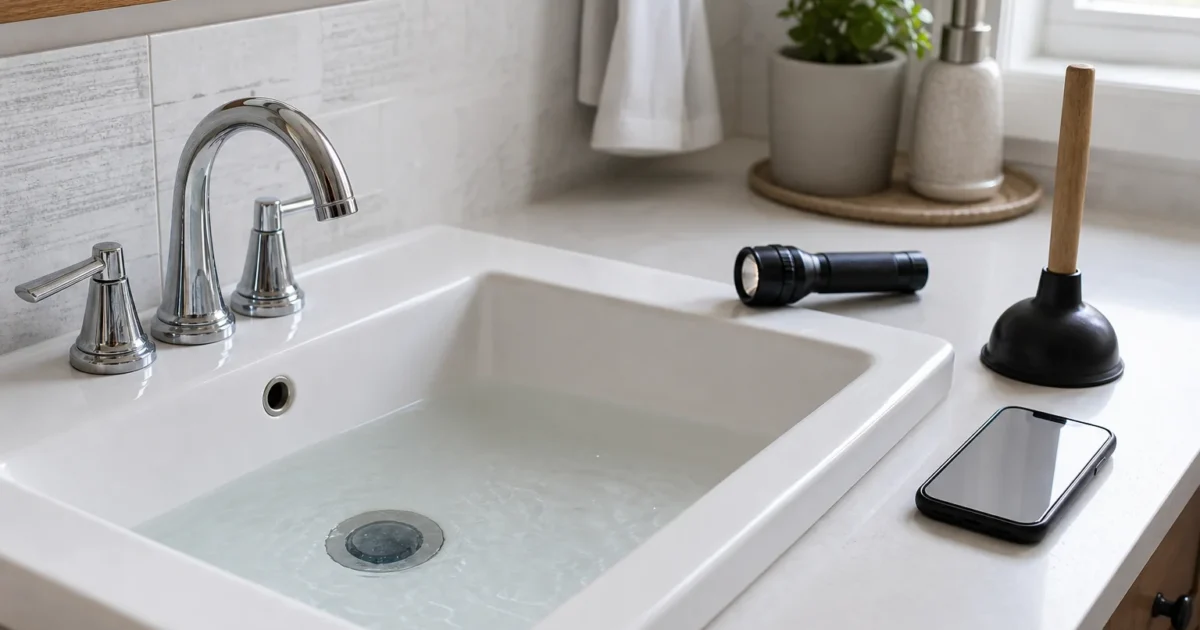
Knowing when to call a plumber for drain problems comes down to a short checklist: is it one fixture or several, is there any sewage smell or backup, and has it happened before? A single slow bathroom sink is usually a $5 tool and ten minutes. Two or more slow drains or a sewage odor is a different situation (This Old House) – one where a DIY attempt can put you in contact with sewage, which the EPA says to avoid because it may contain harmful pathogens. This guide draws that line plainly, with what professional drain service actually costs so you can weigh both sides before you pick up a plunger or the phone.
Our Drain Repair Guide covers the full clog-clearing toolkit if you have already confirmed this is a DIY job.
When to Call a Plumber for Drain Problems: The Quick Answer
Call a plumber now if more than one drain is affected, if you smell sewage or see sewage-colored water, or if the same drain has clogged before after a professional cleaning. This Old House lists multiple affected drains and persistent sewer odors as reasons to call a professional, and the EPA warns that sewage may contain harmful pathogens homeowners should avoid touching. Everything short of those signs – one slow sink, one clogged toilet that isn’t overflowing – is reasonable to try yourself first.
| Situation | Typical cost | Source |
|---|---|---|
| DIY plunger or plastic hair tool | $3.88-$15.98 (October 2026) | Lowe’s plastic tool, Lowe’s plunger |
| DIY toilet auger or hand auger | from $20.98 (October 2026) | Lowe’s toilet auger |
| Standard pro drain cleaning/snaking | $147-$352 (avg. $246) | Angi |
| Sewer camera inspection | $150-$600 standard, avg. $995 for a full-line job | Angi |
| Hydro jetting | $350-$600 standard, up to $2,000 for severe blockages | HomeAdvisor |
| Sewer line repair or replacement | $1,390-$5,320 (avg. $3,320), or $50-$250 per linear foot | This Old House / Angi |
These are planning ranges, not quotes – what you actually pay depends on access, pipe material, and how many trips it takes to solve it.
What Drives the Cost (the Honest Spread)
The biggest cost driver is how many fixtures are affected and how many visits it takes. A single local clog that clears on the first pro visit lands at the low end of Angi’s $147-$352 range. A clog that returns, or one that turns out to be a main-line problem, adds a camera inspection (average $995) and possibly hydro jetting ($250-$800) on top of the original cleaning Angi, Angi.
Pipe material and access matter too. PVC is straightforward to inspect, while cast iron, clay, and Orangeburg pipe need more careful handling during a camera inspection Angi. A home without a properly placed cleanout can mean a longer job, since the 2024 International Plumbing Code requires cleanouts at set intervals – no more than 100 feet apart on smaller building sewers, and one near the building drain/sewer junction – and a house built before that access existed can cost a plumber more time to reach the blockage ICC. Timing adds its own premium: after-hours, weekend, or holiday service typically carries premium pricing on top of the standard rate HomeAdvisor.
Repair vs. Replace – the Honest Math
Repeated professional cleanings are not free, and the running total can sneak up on you. Ten annual cleanings at Angi’s average $246 add up to $2,460 over a decade – and if that decade also includes one average camera inspection at $995, the total climbs to about $3,455 Angi, Angi. That number is already higher than This Old House’s average sewer-line replacement cost of $3,320 This Old House. In other words, once a drain problem is recurring rather than a one-time event, indefinite cleaning is not obviously the cheaper path – a camera-confirmed diagnosis is what tells you whether you are paying to manage a symptom or actually solving the cause.
Hydro jetting and standard snaking both have a hard limit here: neither corrects a collapsed pipe, a major offset, or a pipe with the wrong slope. Angi is explicit that trenchless methods aren’t suitable for pipes with major problems, such as collapse or improper sloping Angi. If a camera inspection shows root intrusion through a cracked joint, a sagging belly that holds waste, or a collapsed section, repair or replacement is the financially rational move, not another round of cleaning.
Should You DIY It or Hire a Pro?
DIY is strongest for a single fixture with a local, visible cause: hair and soap scum near a bathroom sink stopper (This Old House), or a toilet that responds to plunging (Home Depot). This Old House lists hair, soap scum, and hard-water sediment as the common bathroom-sink culprits, and a basic kit – a plastic barbed tool, a plunger, and maybe a toilet auger – covers most of those jobs for well under $100 combined Lowe’s, Home Depot.
The honest catch is how often DIY plumbing goes sideways. In Angi’s homeowner survey, 70% of people who tackled a DIY project ran into a problem, a quarter of them ended up hiring a pro to finish the job anyway, and those who did paid an average of $862 in additional fees on top of whatever they had already spent Angi. That is the real cost comparison: an auger that works is a clear win, but a failed DIY attempt that ends in a pro visit costs more than calling a plumber at the start would have.
If your toilet is at risk of overflowing, shut off the supply valve or hold the flapper down before you do anything else – don’t keep flushing to test it Home Depot.
Camera inspection and hydro jetting are effectively pro-only in practice. Homeowner camera rental runs $100-$200 a day and DIY units cost $300-$1,000 to buy outright, but interpreting what the camera shows has a real learning curve, and misdiagnosing a repairable line as a total loss (or vice versa) is an expensive mistake Angi. Forbes allows that an experienced do-it-yourselfer can rent a water jetter and do the work. For everyone else, hydro jetting is a plumber’s job.
When to Call a Pro
This is the section that actually decides the cost, because catching these signs early is what keeps a $147 cleaning from turning into a $3,000+ repair. Call a plumber when:
- More than one drain is slow or backing up at the same time. Home Depot notes that a single slow fixture usually points to a local trap or fixture drain, while simultaneous problems in different areas point to a branch or main-line issue Home Depot.
- You smell sewage, see sewage-colored water, or a floor drain is backing up. The EPA says to avoid contact with sewage because it may contain harmful pathogens EPA.
- The same drain clogs again after you’ve already cleared it. A repeat clog can point to roots or a sagging pipe, both causes of blockages that This Old House describes.
- A chemical drain cleaner didn’t work. Don’t follow it with a plunger or a snake – Drano’s own product directions warn against plunging during or after use because leftover product can splash back, and Drano Max Gel and Liquid-Plumr are not labeled for toilets at all Drano, Liquid-Plumr.
- You suspect roots or a damaged pipe. Lowe’s says not to use a drain snake on clogs caused by roots or on damaged pipes.
- You’re on a septic system and see slow drains, gurgling, damp spots near the drainfield, or unusually lush grass over it. The EPA lists these as failing-septic signs, not routine clog symptoms EPA.
- You’re selling or renting the property soon. A documented camera inspection is worth more than repeated undocumented snaking; on a septic system, the EPA warns that one in disrepair will lower your property value and can pose a costly legal liability EPA.
One prevention note that avoids the call in the first place: fats, oils, grease, and “flushable” wipes are common causes of blockages the EPA specifically flags, and none of them belong in a drain or toilet regardless of the label EPA.
How to Choose and Vet a Plumber
Describe the actual symptoms – “two drains are slow and there’s a gurgling sound,” not just “clogged drain” – so the quote reflects the real scope instead of a worst-case guess. Ask whether the estimate includes a camera inspection if the clog is recurring, since that is the step that tells you whether you’re paying for a repeat cleaning or an actual repair. Confirm the plumber is licensed and insured, and get the price in writing before work starts.
For anything beyond a standard cleaning – camera work, hydro jetting, or sewer repair – get two or three quotes. A wide spread usually means the plumbers are assuming different things about pipe access or condition, so ask each one what they’re assuming.
If the diagnosis points to sewer-line repair, ask about permits up front. Municipalities often require a permit and inspection before the pipe is covered back up – Portland’s guide, for example, requires permit approval before covering repaired sewer line, and permit costs nationally run roughly $100-$1,000 depending on the municipality Portland.gov, This Old House.
For the full escalation path from a plunger to a professional snake, see our Drain Repair Guide, and if slow drainage rather than a full stoppage is the issue, Why Are My Drains Slow? walks through the most common causes first.
Is it worth trying to unclog a drain myself before calling a plumber?
Yes, for a single slow fixture with no sewage smell and no backup elsewhere – a plunger or plastic drain tool costs a few dollars and often clears it in minutes. But if a chemical cleaner already failed, stop there rather than following it with a plunger or snake.
How much does a plumber charge to unclog a drain?
Standard professional drain cleaning runs $147-$352, averaging $246 (Angi). A camera inspection adds $150-$600 for a standard job, or an average of $995 for a full-line inspection, and hydro jetting runs $350-$600 for typical residential service.
How do I know if my drain problem is a bigger sewer issue?
The clearest signs are more than one drain acting up at the same time, gurgling sounds, a clog that returns after professional cleaning, or any sewage odor or backup. A single slow sink with no other symptoms is usually local, not a sewer-main issue.
Is it ever okay to use a chemical drain cleaner?
Some products are labeled for specific uses – Drano Max Gel is labeled for kitchen and bathroom drains but explicitly not for toilets, and manufacturers warn against plunging after use. Read the label for your exact fixture, and never assume one product works everywhere.
How often should I get my drains professionally cleaned or inspected?
There’s no fixed schedule for a healthy system with no symptoms. But once a drain has clogged more than once, a camera inspection is worth the cost to find out whether you’re dealing with buildup, roots, or a structural problem before you pay for another cleaning.
Should I repair or replace my sewer line instead of continuing to have it cleaned?
Once repeat cleanings and camera inspections start approaching a few thousand dollars over several years, that total is already in the range of an average sewer-line replacement ($3,320). If a camera confirms a collapsed, cracked, or badly sloped section, repair is the more rational long-term move.
Sources
- Angi – Drain Cleaning Cost
- Angi – Sewer Camera Inspection Cost
- Angi – Sewer Line Replacement or Repair Cost
- Angi – Is a DIY Project Costing You More?
- HomeAdvisor – Hydro Jetting Cost
- This Old House – Sewer Line Replacement Cost
- This Old House – How to Diagnose Drain Problems
- EPA – Resolving Septic System Malfunctions
- Home Depot – How to Unclog a Toilet
Educational content only. Not a substitute for licensed professional advice. Local plumbing codes vary by jurisdiction. Use of any guidance from this guide is at your own risk.
Related guides
When to Repipe vs Repair Galvanized, Polybutylene, and Cast Iron [2026]
Knowing when to repipe vs repair is a big-ticket decision, and the honest answer depends on which pipe…
Drains and Pipes Guide: The Complete Homeowner’s Overview of What’s Behind Your Walls [2026]
Drains and Pipes Guide: The Complete Homeowner’s Overview of What’s Behind Your Walls [2026] Water disappears down the…
Why Are My Drains Slow? Causes, Diagnosis, and 3 DIY Fixes [2026]
If you’re asking why are my drains slow, the answer almost always starts with one question: is it…