
Delta Cartridge Identification: Shower + Faucet Chart [2026]
The single biggest mistake homeowners make when fixing a Delta shower or sink is buying the wrong cartridge. Delta cartridge identification sounds straightforward — pull the old one, match it at the hardware store — but Delta has manufactured at least eight residential cartridge families since the 1980s, and several of them look nearly identical from the outside while being completely incompatible underneath. A homeowner who says “I have a single-handle Delta shower” could need any one of four different cartridges, and choosing wrong means a $70 part that doesn’t seat, a leak that returns the same week, or — worst case — a hot/cold reversal that scalds someone.
This guide walks through Delta cartridge identification in three ordered steps. It also flags the three wrong-part pairs that catch the most homeowners and explains when the problem isn’t a cartridge at all.
How to Identify Your Delta Cartridge: The 3-Step Method
The full method in brief – each step is expanded in detail further down, and the identification chart maps every family to its part number.
Find your model number
Check your installation paperwork, the underside of the handle or trim plate, and any saved packaging, then look the number up on Delta’s parts site. If you have it, you can skip straight to the right cartridge.
Identify the valve family
No model number? Match your faucet to a valve family – single-handle pressure-balance (13/14 series), dual-control (17 or thermostatic 17T), older Monitor, two-handle stems, or a single-handle kitchen ball-valve-versus-DST cartridge. Each family maps to one specific cartridge.
Visually confirm before you buy
Use cap color, cartridge length, and the “Hot Side” marking to confirm the exact part – a look-alike cartridge in the wrong valve will not seat or seal, and a reversed pressure-balance cartridge can swap hot and cold.
Delta Cartridge Identification Chart
Find the row that matches your shower or sink, then use the steps below to confirm the exact part before you buy:
Linked part numbers in this chart open an Amazon search for that exact number; if the shower or sink has to work today, take the number to a local plumbing supply counter instead. As an Amazon Associate, plumbingbythebook earns from qualifying purchases. Links below are affiliate links — they cost you nothing extra.
| What you have | Likely family | Cartridge to check |
|---|---|---|
| Single-handle Delta shower, valve made before March 2006, no separate volume control | Older Monitor 1300/1400 | RP19804 |
| Single-handle Delta shower, valve made after March 2006, MultiChoice rough-in | Newer MultiChoice 13/14 | RP46074 |
| Dual-control Delta shower (separate volume + temp), older home, pre-MultiChoice | Older Monitor 1700/1800 (Delta dates it “04/2006 and earlier” in its title and “produced before March 2007” in its text), or a 1500 made after 1995 | RP32104 |
| Dual-control Delta shower (separate volume + temp), current generation, pressure-balanced | MultiChoice 17 | RP46463 |
| Dual-control Delta shower marked 17T, TempAssure, or thermostatic | MultiChoice 17T thermostatic | RP47201 |
| Two-handle Delta bathroom sink, dripping at spout | Stem; seats/springs on some models | Model-specific stem, plus RP4993 seats and springs only if your model has them (Delta: “not used with DST models”) |
| Single-handle Delta kitchen/sink, older ball valve | Ball valve + seats/springs | RP70 (lever) / RP212 (knob) |
| Diamond Seal one-handle Delta sink, dripping at base | Diamond Seal Technology sink | RP50587 |
Verify any of these against Delta’s parts page for your specific model before ordering.
Found your row in the chart? Get the exact cartridge — verify the part number against your valve generation first:
As an Amazon Associate, plumbingbythebook earns from qualifying purchases. Links below are affiliate links — they cost you nothing extra.
- Delta RP19804 Monitor 1300/1400 Series Shower Cartridge
- Delta RP46074 MultiChoice Universal Shower Cartridge
- Delta RP77737 Seats and Springs Kit
Not sure which part you have? The cartridge finder narrows it to the exact part in a few questions.
Why Delta Cartridge Identification Is Harder Than It Looks
“Delta single-handle shower” describes roughly four different cartridge families. “Delta two-handle bathroom faucet” points to a separate category entirely (stems and seats, not cartridges). And “Delta dual-control shower” can mean either the standard pressure-balance 17 Series or the thermostatic 17T Series — two cartridges that cost different amounts and behave differently, despite looking similar from the trim plate.
The Delta-specific trap is generation overlap. Delta sells both the older Monitor 1300/1400 cartridge (RP19804) and the newer MultiChoice 13/14 cartridge (RP46074) at every major retailer right now. Homes built before March 2006 typically need the older one. Homes built after that date typically need the newer one. The trim looks similar from outside the wall. The cartridges are not interchangeable, and Delta support has reportedly fielded countless calls from homeowners who bought the wrong generation and could not seat the cartridge.
Add in the 17 versus 17T confusion (different cartridges for what looks like the same dual-control shower) and the two-handle stem assemblies that get mislabeled as “Monitor cartridges,” and Delta cartridge identification becomes the kind of thing where getting it 90 percent right still means buying the wrong part. Hence the three-step procedure.
Step 1 — Find Your Model Number
Where is my Delta model number? Check, in order: the original installation paperwork, the underside of the handle or trim plate (sometimes stamped or on a sticker), and Delta’s own packaging if you saved it – then look the number up with Delta’s “Find Parts and Identify Your Product” tool. No number? Step 2 identifies the part by valve family instead.
The fastest path to correct Delta cartridge identification is the model number. If you can find it, you can skip the diagnostic work and look up the exact cartridge on Delta’s parts page.
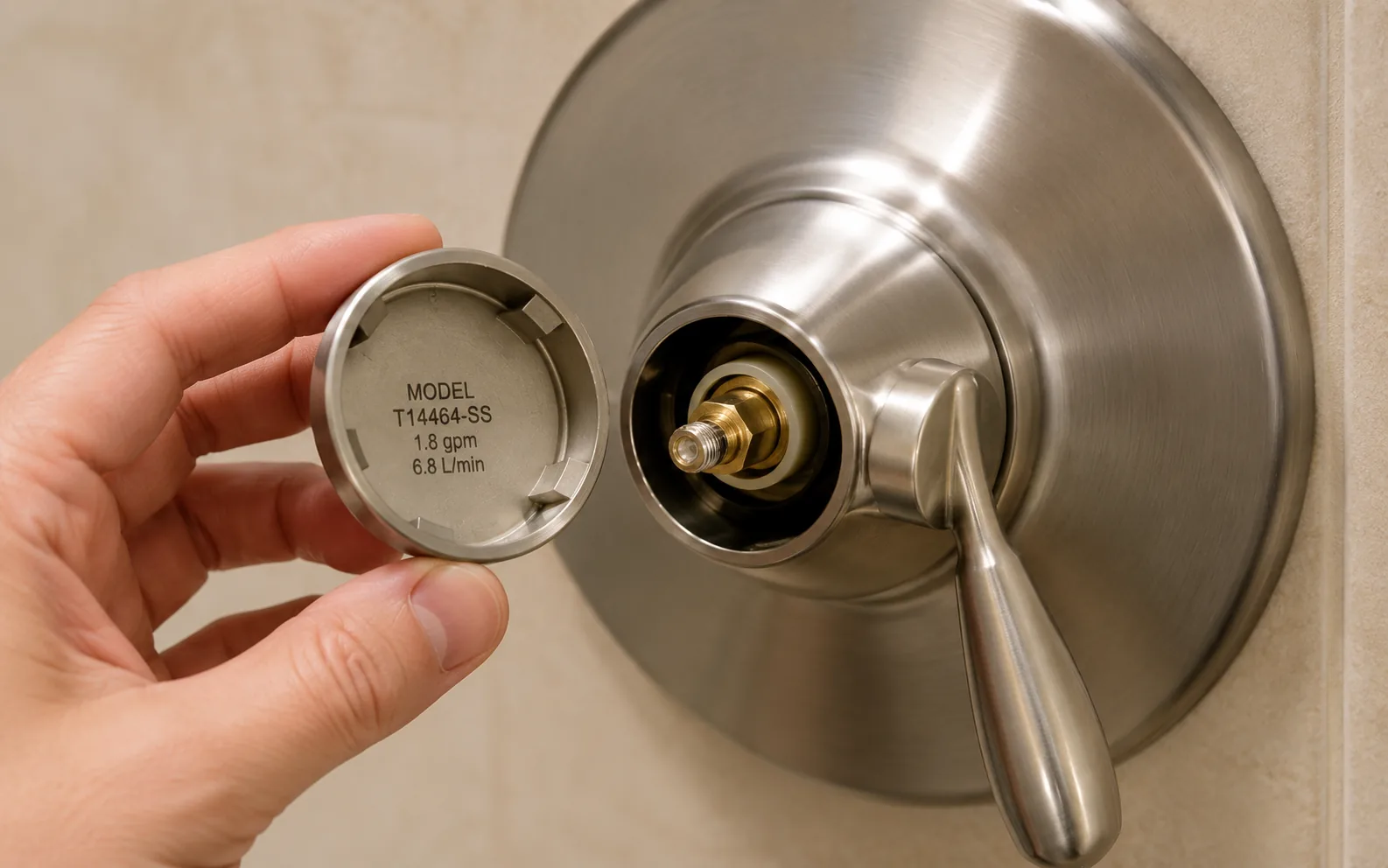
Check these locations in order: the original installation paperwork (often in a kitchen drawer or with the home’s closing documents), the underside of the handle or trim plate (sometimes stamped or sticker-applied), and Delta’s own packaging if you saved any boxes. Delta also runs a “Find Parts and Identify Your Product” tool that lets you search by model number, browse by product category, or use an identification wizard that narrows by room and product description. If you have any documentation at all, start there.
When the model number is gone — which is typical for homes 10+ years old or homes that have changed owners — Step 2 becomes the main delta cartridge identification path. Don’t guess by appearance alone, and don’t buy “a Delta shower cartridge” off Amazon based on a photo. The visual cues in Step 3 are useful for confirmation, not for identification on their own.
Step 2 — Identify the Valve Family
This is where most of the real delta cartridge identification work happens. Delta organizes its residential repair parts around valve families. Each family has its own cartridge or repair kit. The four shower families that matter for most homeowners:
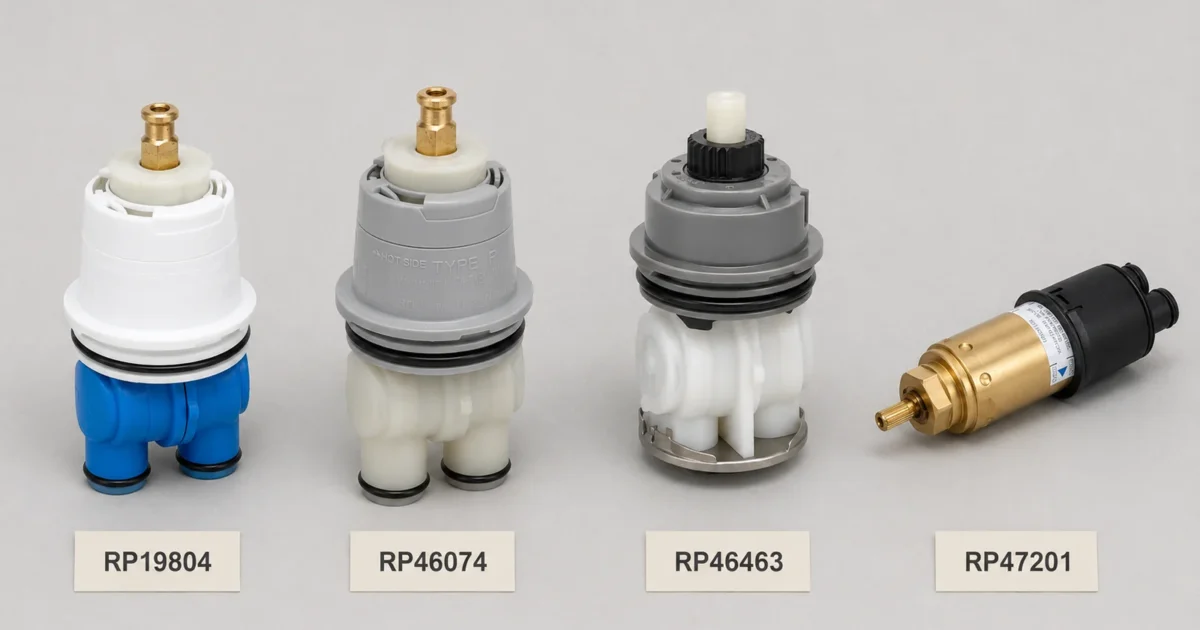
Older Monitor 1300/1400 (pre-March 2006) → RP19804. This is the single-handle pressure-balanced shower without separate volume control. If your home was built before about 2006 and you have a Delta single-handle shower with a single trim handle controlling both temperature and flow, this is likely your family. Delta confirms RP19804 for Monitor 1300 and 1400 tub-and-shower valves produced before March 2006.
Newer MultiChoice 13/14 (post-March 2006) → RP46074. Same general “single-handle Delta shower” appearance from the outside, but the underlying rough-in valve is the MultiChoice platform. Cartridge is RP46074, not RP19804. The two cartridges have different lengths, different inlet geometry, and different cap colors — they will not substitute for each other.
Older Monitor 1500/1700/1800 (dual-function, pre-MultiChoice) → RP32104. If your Delta shower has two separate controls (typically a smaller knob for volume and a larger lever for temperature) and the home is older, this is likely your family. Delta identifies RP32104 for Monitor 1700/1800 tub-and-showers produced before March 2007 and for some 1500 Series after 1995. Big-box retailers still sell it.
Newer MultiChoice 17 (current dual-function, pressure-balanced) → RP46463. Current generation of dual-control Delta showers. Separate volume and temperature, but pressure-balanced (not thermostatic). Cartridge is RP46463. This is the part that gets confused with RP47201 most often.
MultiChoice 17T thermostatic → RP47201. Looks like a 17 Series shower from the trim side, but uses a thermostatic cartridge instead of pressure-balance. If your trim or paperwork says 17T, TempAssure, or “thermostatic,” this is your part — and it is NOT interchangeable with RP46463.
Two-handle faucets are a separate world. Parts like RP1740 and RP25513 are stem assemblies, not Monitor shower cartridges, despite their numbering. RP4993 is a seats-and-springs kit used in many washerless and older two-handle repair contexts. If you have a two-handle Delta sink or roman tub, your repair almost certainly involves stems and seats, not a sealed shower cartridge — and you should confirm the exact stem against your specific model on Delta’s parts site.
Single-Handle Kitchen and Sink Cartridges
Single-handle kitchen and sink faucets are a third world from the shower families above, and the first branch is ball valve versus cartridge. Pop the handle and look at the mechanism. An older non-DST single-handle Delta uses a ball valve with seats and springs; a newer single-handle Delta uses a DST (Diamond Seal) ceramic-disc cartridge instead. The DST cartridges are the ones people mix up: several look alike and are told apart only by diameter and stem-top shape. When you are staring at two look-alike DST cartridges, measure the body diameter and check the stem top – that is exactly how the supply desk disambiguates them.
| Mechanism | How to tell | Part(s) to order |
|---|---|---|
| Ball valve (older, non-DST) | Pop the handle – a rotating metal/plastic ball over seats and springs | Lever handle RP70; knob handle RP212 |
| DST ceramic-disc cartridge (newer) | Ceramic-disc cartridge; identify by body diameter + stem-top shape | Diamond Seal sink RP50587 (~1-27/64 in. across); Euro-Motion and collar-body DST run narrower (~1-17/64 in.) |
Step 3 — Visual Confirmation Before You Buy
Once Step 2 narrows the family, visual confirmation is the final layer of delta cartridge identification. Use these cues as a sorting check, not as primary identification.
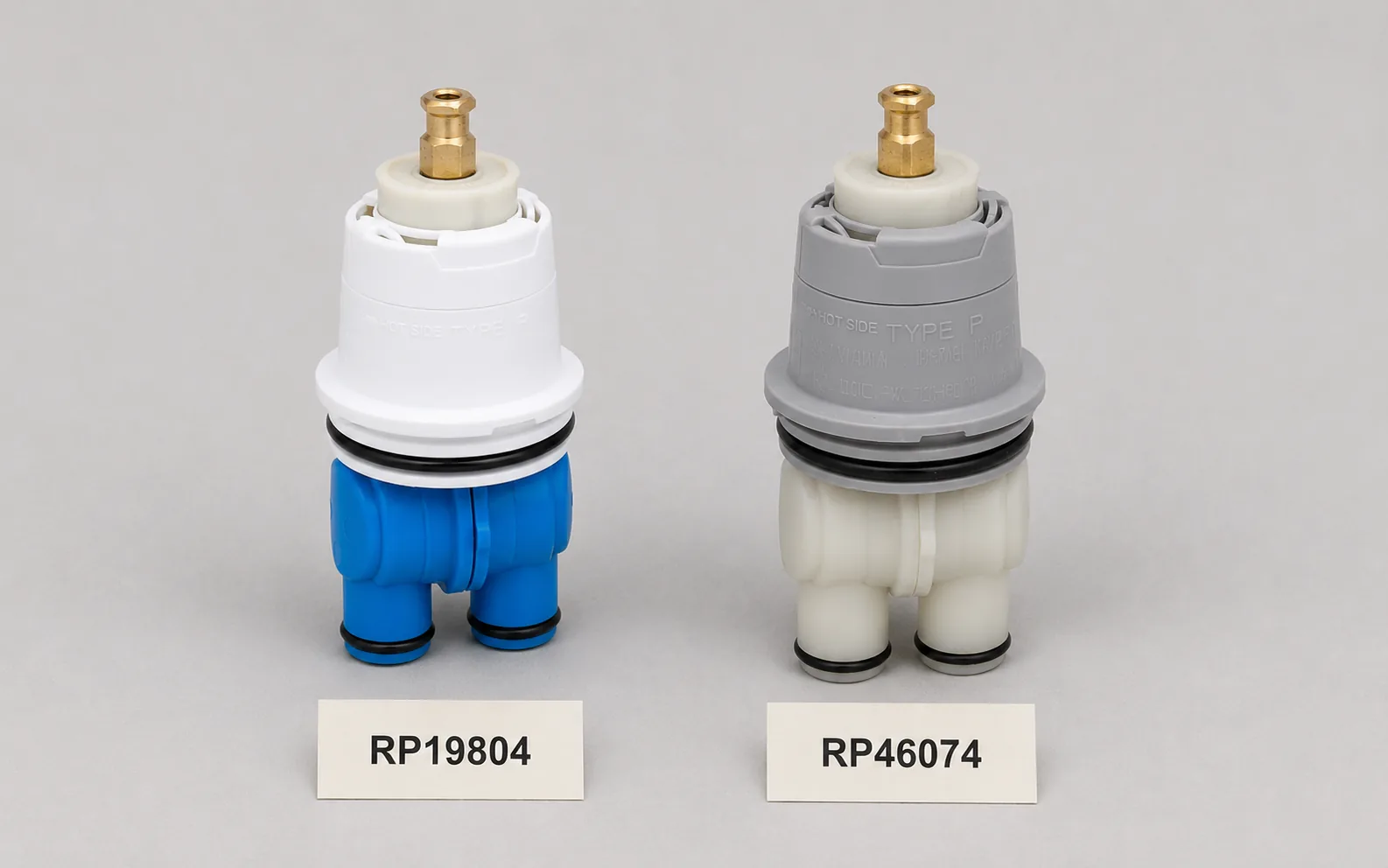
The clearest visual cue is cap color on the 13/14 family. Older RP19804 typically has a white or white-and-blue top. Newer RP46074 has a gray top. Cartridge length and the geometry of the lower inlet legs also differ — Delta’s own Q&A archive includes cases where an RP46074 was simply too long to fit an older valve, sending the customer back to RP19804.
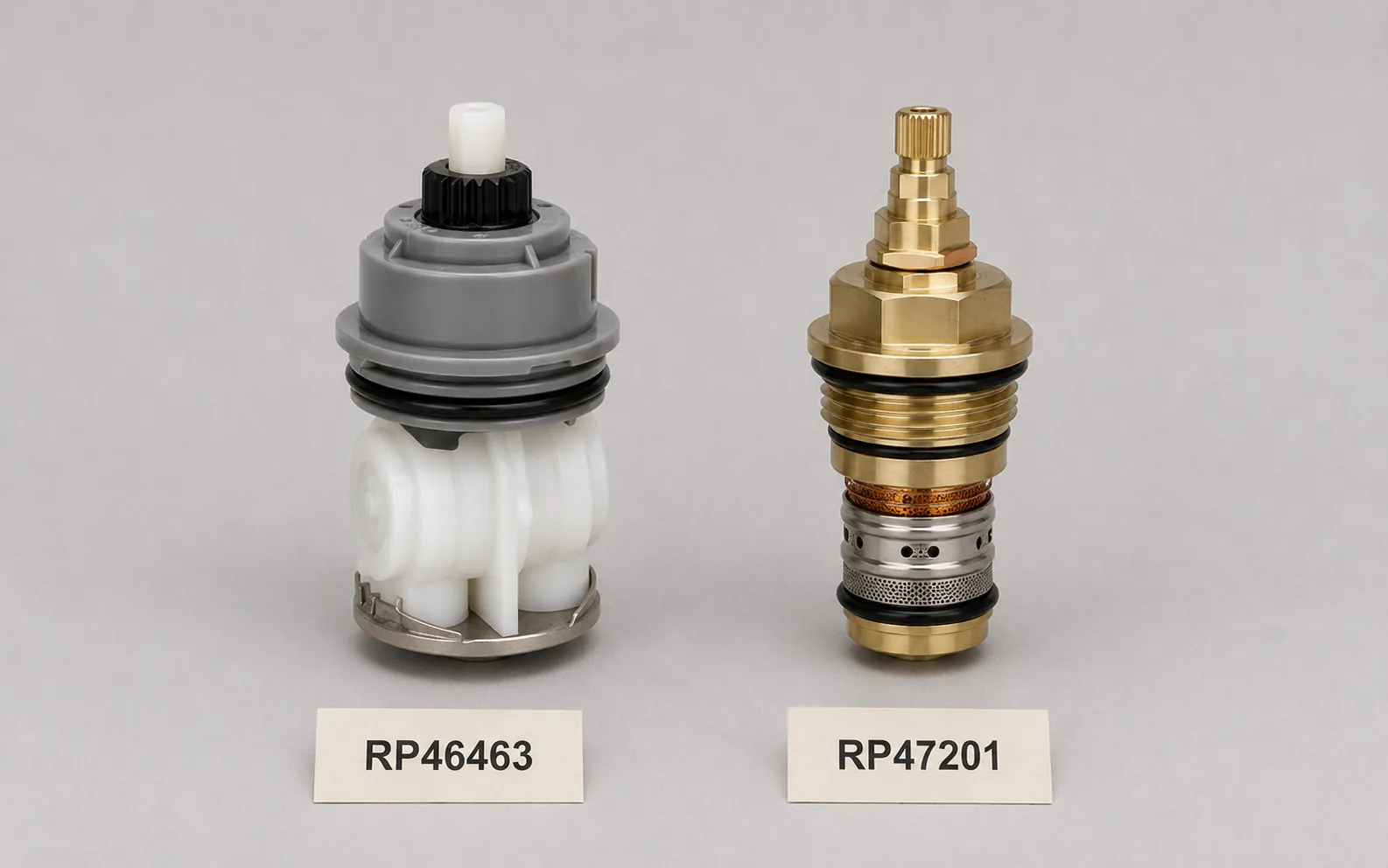
For the 17 Series, dual-function trim with separate volume and temperature controls is a starting cue, but it does not distinguish between older RP32104, current pressure-balance RP46463, and thermostatic RP47201. You still need the rough-valve generation and the pressure-balance-versus-thermostatic distinction from Step 2.
One safety-critical visual: RP46074 and similar pressure-balanced cartridges have a “Hot Side” marking on the gray plastic portion. Installing the cartridge reversed can swap hot and cold or create unsafe temperature behavior. Check the marking before tightening anything.
For sink cartridges like the Diamond Seal RP50587, bottom guide pins must align with openings in the faucet body during installation — a visual cue specific to sink applications, not showers. And for two-handle stems, ceramic stems like RP47422 do not use seats and springs the same way older Delta stem units do, so don’t assume every Delta two-handle drip needs the RP4993 seats-and-springs kit.
The Three Wrong-Cartridge Pairs That Trip Homeowners Up
Most failed Delta cartridge identification reduces to three confusion pairs. If you remember these three delta cartridge identification pitfalls, you sidestep the most common $70 mistakes.
RP19804 versus RP46074 is the headline delta cartridge identification confusion. Older Monitor 1300/1400 versus newer MultiChoice 13/14. Cap color differs, length differs, inlet geometry differs. Buying by generic “Delta 1400” description is the single most common wrong-part scenario.
RP32104 versus RP46463 is the dual-control generation confusion. Older 1700/1800-family valves take RP32104; current MultiChoice 17 takes RP46463. They look similar from outside the wall.
RP46463 versus RP47201 is the 17 versus 17T confusion. Both are current-generation dual-control cartridges. Both look like they fit the same Delta shower. One is pressure-balanced; the other is thermostatic. If you’re not sure, find documentation — the cost difference and the behavior difference both matter.
When Delta Cartridge Identification Isn’t the Whole Problem
Delta cartridge identification answers the part-number question, but it doesn’t catch every leak. Not every Delta shower leak is a cartridge problem. Delta’s own tub-and-shower troubleshooting separates leaks at the shower head or tub spout, the handle, the trim plate, the diverter, the supply connection, and behind the wall. Each has a different repair path. A drip from the shower head when the handle is off usually does point to the cartridge. A leak from the trim plate seal points to a different fix entirely. A leak behind the wall is plumber territory, not DIY.
Seized parts are another stop-and-think moment. If the bonnet nut, sleeve, or cartridge will not loosen with normal hand-tool force, escalate. Excessive twisting can damage the rough valve behind the wall, and the cost of fixing that is dramatically higher than the cartridge replacement was going to be. Professional opinions vary on exactly how far a homeowner should push before stopping, but the consistent advice is: do not move the rough valve.
Cartridge seized and won’t come out? Before you buy a tool: Delta — unlike Moen — makes no OEM cartridge puller, so every Delta puller on the market is unbranded aftermarket at roughly $75-$105 with thin review histories. And as above, forcing a stuck cartridge can damage the rough valve behind the wall, which costs far more than the cartridge ever would.
Which cartridge puller you actually need — and when to skip it walks the 60-second check that tells you whether a tool is even the answer, what the Delta options actually cost, and the cheaper things to try first.
For two-handle Delta sinks and roman tubs, a drip often requires both stem inspection AND seat-and-spring inspection. Replacing only the cartridge-equivalent without checking the seats can leave the leak in place. The repair path is different from the shower cartridge flow, and that distinction is part of correct Delta cartridge identification too.
What Replacement Cartridges Cost (and What They Don’t Cover)
Once delta cartridge identification points you to the right part, the next question is what it costs. Cartridge prices vary sharply by part family and seller, so the article-safe approach is to think in ranges, not single prices.
Seats and springs (RP4993) are inexpensive — typically about $5 to $15 from major sellers. Common pressure-balance shower cartridges (RP19804 and RP46074) are midrange, with practical retail running from the high-$40s through the low-$70s depending on whether you buy at Home Depot, Lowe’s, or a plumbing-supply distributor. MultiChoice 17 (RP46463) is usually more expensive, often around $80 to $130 at major sellers. Thermostatic 17T (RP47201) costs noticeably more than the standard pressure-balance options, and the spread between manufacturer-direct pricing and retail can be wide — compare Delta, Home Depot/Lowe’s, and plumbing suppliers before buying.
Two other things to know about delta cartridge identification cost. First, professional installation is a separate line item. According to Angi’s 2026 data, a full shower cartridge replacement service call runs roughly $150 to $350 with an average around $275 — which is why the DIY math is so favorable when the cartridge identification is correct. Second, Delta’s limited warranty may cover replacement parts for qualifying original consumer purchasers, but it does not cover labor for repair, replacement, installation, or removal. Save your purchase paperwork; the warranty path requires the model number and proof of purchase unless registration applies. The actionable route: once you have the model number, request the free part directly from Delta at 1-800-345-DELTA (3358) or through the online warranty form with your purchase date — for many homeowners the right cartridge ships free, and you only supply the labor.
One more buying note tied to identification: lean genuine Delta over aftermarket, especially on the DST and pressure-balance cartridges. Aftermarket look-alikes often differ slightly in diameter or stem broach, and a near-miss cartridge that won’t seat or leaks turns a $70 part into a redo. Delta also recommends genuine parts to keep the warranty intact.
What to Do Next
If Delta cartridge identification confirms your shower needs a cartridge replacement, the next step is the procedure itself — shutting off water, removing trim, pulling the old cartridge with a puller (not pliers, and definitely not a screwdriver), installing the new one in the correct hot-side orientation, and verifying temperature behavior before reassembling. We’re publishing a Delta-specific cartridge replacement walkthrough soon; until it lands, the broader faucet repair flow at the Pillar 1 hub and the diagnostic guide at Why Is My Faucet Leaking cover the supporting steps.
Not sure which path you’re on? If you have a shower valve, work through the valve families in Step 2; if you have a single-handle kitchen or sink faucet, jump to the kitchen and sink cartridge section.
If you’re still upstream of delta cartridge identification — you know it’s a Delta, but you’re not sure of the model or generation — start with How to Identify Faucet Brand and Model. It covers the model-number hunt across all major faucet brands, not just Delta.
And if the problem turns out not to be a cartridge at all, the diagnostic guide walks through the six common causes of faucet leaks, including the non-cartridge paths that are easy to miss.
How can I tell what Delta shower cartridge I have?
Start with the rough-valve generation, not the cartridge’s looks. A single-handle Delta shower built before about March 2006 is usually a Monitor 1300/1400 taking RP19804; built 2006 or later it is usually MultiChoice 13/14 taking RP46074 (gray cap versus the older white/blue cap). A dual-control shower is either the current pressure-balance 17 Series (RP46463) or the thermostatic 17T (RP47201) – confirm by cap color, cartridge length, and the trim markings before you buy.
Where can I find the Delta shower valve model number?
Check, in order: your original installation paperwork, the underside of the handle or trim plate (sometimes stamped or on a sticker), and any saved packaging – then look it up with Delta’s “Find Parts and Identify Your Product” tool. If the number is gone (typical on homes 10+ years old), identify the cartridge by valve family instead, as Step 2 describes.
Are all Delta cartridges the same?
No – and assuming they are is the costliest mistake. Delta cartridges vary by single- versus dual-handle, by diameter and stem-top shape, and by series (14 versus 17). Several look nearly identical from outside but will not seat or seal in the wrong valve, so identify the family and confirm the part number before buying.
How do I tell a Delta ball valve from a cartridge?
Pop the handle and look at the mechanism. An older non-DST single-handle Delta uses a ball valve with seats and springs (the lever-handle assembly is RP70, the knob-handle RP212); a newer single-handle Delta uses a DST ceramic-disc cartridge. They are different repair paths, so this is the first branch to settle.
What’s the difference between the Delta 14 and 17 series?
A 14 Series shower is pressure-balanced with temperature control only – one motion. A 17 Series adds a separate volume control, so you can identify it by behavior before you ever open the wall: two independent controls points to 17 (cartridge RP46463), and if it’s marked 17T or thermostatic it’s RP47201 instead.
Can I get a Delta cartridge free under warranty?
Often yes. Delta’s limited warranty supplies replacement parts free of charge to the qualifying original consumer purchaser (labor excluded). Once you have the model number, request the part at 1-800-345-DELTA (3358) or through Delta’s online warranty form with your proof of purchase.
Should I buy a genuine Delta cartridge or an aftermarket one?
Lean genuine, especially on DST and pressure-balance cartridges. Aftermarket look-alikes often differ slightly in diameter or stem broach, and a near-miss that won’t seat or leaks turns a $70 part into a redo – Delta also recommends genuine parts to keep the warranty intact.
Sources
- Delta RP19804 (Monitor 1300/1400)
- Delta RP46074 (MultiChoice 13/14)
- Delta RP32104 (Monitor 1500/1700/1800)
- Delta RP46463 (MultiChoice 17)
- Delta RP47201 (MultiChoice 17T thermostatic)
- Delta RP50587 (Diamond Seal one-handle sink)
- Delta RP4993 (seats and springs)
- Delta Find Parts and Identify Your Product
- Delta tub and shower leaks support
- Delta limited warranty
- Home Depot RP19804 listing
- Home Depot RP46074 listing
- SupplyHouse RP46463 listing
- Angi 2026 shower cartridge replacement cost
Educational content only. Not a substitute for licensed professional advice. Local plumbing codes vary by jurisdiction. Use of any guidance from this guide is at your own risk.
Get the homeowner’s plumbing repair toolkit checklist — the tools, parts, and decisions every homeowner should have on hand. [Free download — enter your email]
Parts for this repair
As an Amazon Associate, plumbingbythebook earns from qualifying purchases. Links below are affiliate links — they cost you nothing extra.
- Delta RP19804 Monitor 1300/1400 Series Shower Cartridge — The OEM cartridge for older (pre-March 2006) Delta Monitor 1300/1400 single-handle tub and shower valves — one of the two families this guide helps you tell apart.
- Delta RP46074 MultiChoice Universal Shower Cartridge — The cartridge for Delta MultiChoice 14 series tub/shower valves — one of the families this guide helps you tell apart.
- Delta RP77737 Seats and Springs Kit — Delta's OEM seats-and-springs kit — the fix for older two-handle Delta faucets that drip at the spout.
Related guides
Frost-Free Outdoor Faucet Stem: How to Identify Yours Before You Order
Your outdoor faucet drips from the spout or the handle, and the repair parts aisle is full of…
Replacement Hose for Pull-Down Kitchen Faucet: How to Tell Which Fits
You have a pull-down kitchen faucet that won’t retract, drips under the sink, or has a cracked hose,…
Cost to Install a Faucet: What the Labor Actually Runs [2026]
The cost to install a faucet with a professional is usually a low-hundreds job: Home Depot lists an…