
How to Identify Your Symmons Shower Valve: Temptrol, Safetymix, Symmetrix, and More [2026]
Knowing how to identify your Symmons shower valve before you order a single part is the difference between a 30-minute repair and two hardware-store trips plus a return. Symmons makes identification unusually answerable — the company stamps and casts model designations directly into the brass and has sold stable, per-platform repair parts for decades. The trap is that the Temptrol’s TA-10 spindle and the Safetymix/Visu-Temp’s C-5 spindle look nearly identical in your hand and are not interchangeable. Get the identification right and you’re ordering the correct part. Get it wrong and you’re staring at a spindle that almost fits.
Symmons makes five main shower valve platforms — each with a distinct repair part:
| What you see on the wall | Platform | Repair part |
|---|---|---|
| Lever/knob plus a round numbered temperature dial | Temptrol | TA-10 spindle (under a T-12A brass cap) |
| Single lever, no separate dial | Safetymix / Visu-Temp | C-5 spindle |
| Single lever with faucet-style ceramic feel | Symmetrix | KN-4 ceramic cartridge |
| Push-button timed burst | Showeroff | PS-1 (1960–1983) or NS-1 (1983+) |
| Thermostatic control + separate flow handle | Maxline thermostatic | TMX-267-KIT (7-225 / 7-230 series) |
Narrowed your Symmons valve above? Confirm the exact cartridge before you buy — Temptrol generations differ:
As an Amazon Associate, plumbingbythebook earns from qualifying purchases. Links below are affiliate links — they cost you nothing extra.
- Symmons TA-10-RP Temptrol Spindle (Retail Package)
- Symmons C-5 Safetymix Spindle
- Symmons KN-4 Symmetrix Cartridge
Not sure which part you have? The faucet & valve finder narrows it to the exact part in a few questions.
This article walks through six identification methods in order from “no tools” to “trim fully removed” — so you can pinpoint your platform before opening a browser to order anything.
How to Identify Your Symmons Shower Valve: Start With the Dial (No Tools Required)
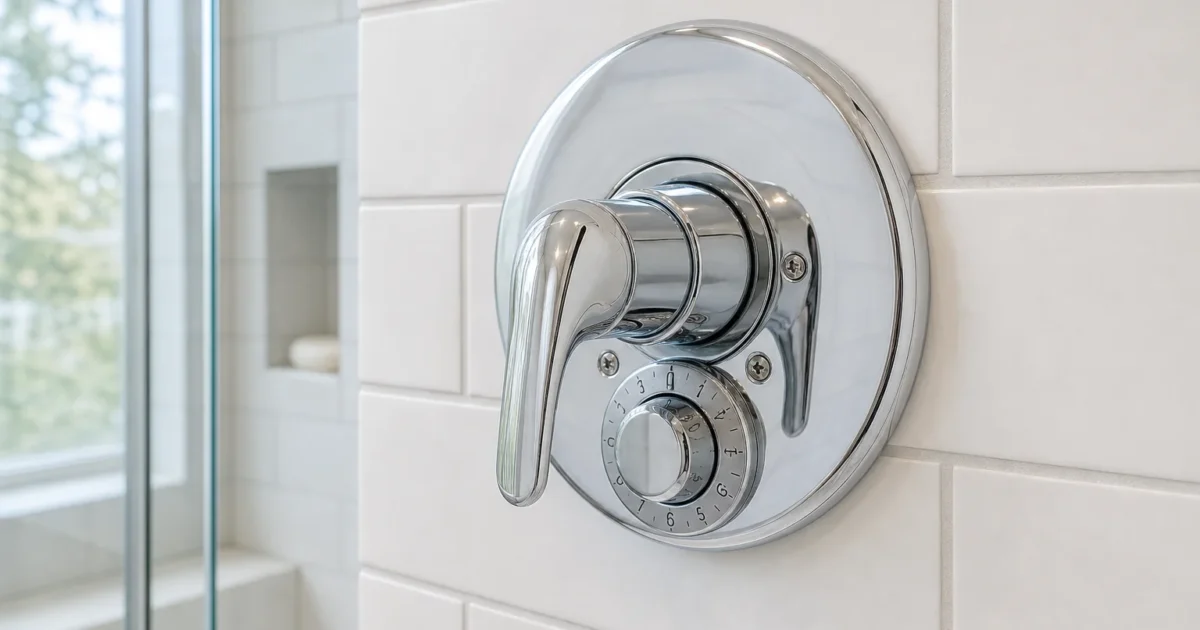
The fastest and most definitive Symmons identifier is the one you read standing in front of the shower with zero tools: the separate round, numbered temperature dial.
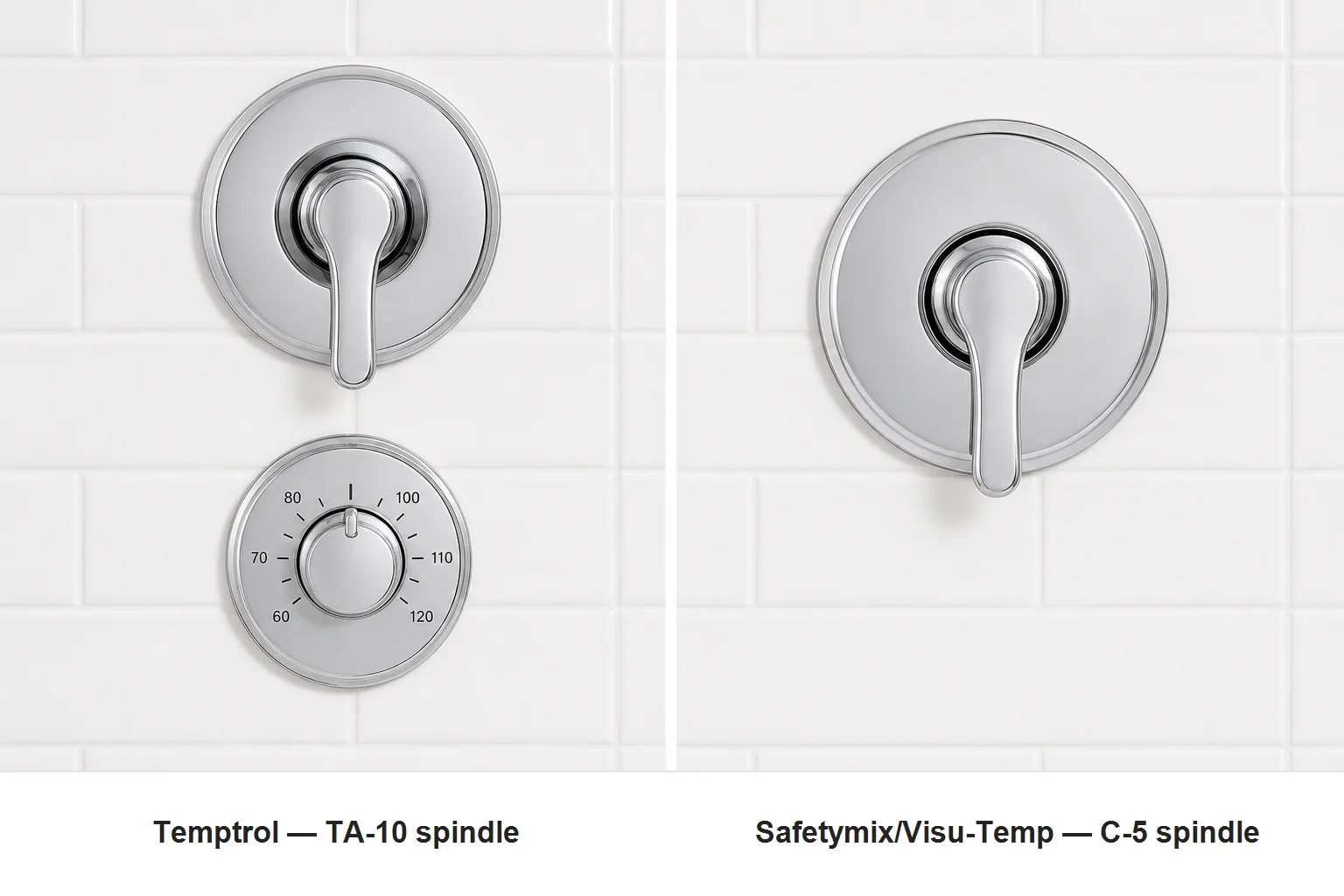
Symmons’ Temptrol pressure-balancing valve has a trim layout unique in the industry — a calibrated dial plate that sits behind or below the handle, carrying a numbered temperature scale. Symmons sells these dial plates as distinct parts: Dial Model A (T-29A), Dial Model B (T-29B), and Dial Model C (T-29C). (T-29A, symmons.com; T-29B, symmons.com; T-29C, symmons.com) The dial letter identifies the trim generation and is useful when ordering a replacement dial plate — but for spindle purposes, what matters is simpler: if you see a separate round numbered temperature dial, you have a Temptrol, and the spindle inside is a TA-10. (TA-10 Spindle, symmons.com)
If the wall has a single lever with no separate round dial — just the handle and an escutcheon — you’re looking at a Safetymix/Visu-Temp, Symmetrix, Showeroff, or Maxline. Those platforms each have their own tell, described in the next section.
Read the Trim Shape: Safetymix, Symmetrix, Showeroff, and Maxline
Once you’ve ruled out (or confirmed) the Temptrol by checking for the round dial, the remaining four platforms sort out quickly by trim geometry and mechanical feel.
Safetymix / Visu-Temp. A single lever with an internal temperature stop — no separate dial. Some Visu-Temp trims show a temperature indicator window or scale printed on the escutcheon itself. (Safetymix/Visu-Temp valve, symmons.com) The spindle is the C-5, which fits Safetymix valves from 1960 to date and Visu-Temp valves from 1975 to date — so era doesn’t change the part number on this platform. (C-5 spindle, symmons.com)
Symmetrix. This is the Symmons platform that feels like a sink faucet — a single lever over a ceramic disc mechanism rather than a traditional brass pressure-balance spindle. If turning the handle feels smooth and faucet-like (lever side to side or up and down, ceramic action), that’s a Symmetrix, and the repair part is the ceramic KN-4 cartridge. (KN-4 cartridge, symmons.com) Symmons lists the KN-4 as “for use with Symmetrix single handle lavatory and kitchen faucets,” so finding a KN-4-style ceramic cartridge is positive platform confirmation.
Showeroff. A push-button metering valve that delivers a timed burst of water and shuts itself off — common in gyms, school locker rooms, dorms, and commercial facilities. If the valve operates with a push button rather than a lever, it’s a Showeroff. The cartridge splits by era: PS-1 for 1960–1983 installations, NS-1 for 1983 and newer. (PS-1, symmons.com; NS-1, symmons.com) This is the only Symmons platform where the installation year determines which part you buy.
Maxline thermostatic. High-flow trim with two distinct controls — a thermostatic temperature knob and a separate flow valve — often found in hotel-grade or commercial installs. If the trim has both a thermostatic control and a separate flow handle (not just a temperature dial that calibrates the balance, but a true second control), that’s a Maxline. The service kit is the TMX-267-KIT, covering the 7-225 and 7-230 series Maxline thermostatic valves. (TMX-267-KIT, symmons.com)
Remove the Handle: The Cap Assembly Confirms the Platform
If the trim doesn’t settle it — the dial plate is missing, the escutcheon is worn smooth, or you inherited the house — removing the handle gives you a mechanical confirmation with no guesswork.
On a Temptrol, once you pull the handle and dial plate (a Phillips or Allen key plus a spanner for the trim ring), you expose the T-12A cap assembly — a distinctive hex brass cap that threads into the valve body and retains the spindle. (T-12A Cap Assembly, symmons.com; also available retail-packaged as T-12A-RP at Home Depot) Seeing that hex brass cap is positive confirmation of a Temptrol body. No other Symmons platform uses the T-12A — it is the Temptrol-specific retainer.
If you remove the handle and find a ceramic cartridge carrier, a push-button metering unit, or a thermostatic cartridge housing instead, you’re looking at a different platform and can route accordingly from the table at the top of this article.
Pull the Spindle — and Why the TA-10 vs. C-5 Look-Alike Is the #1 Mistake
Unthreading the T-12A cap pulls the spindle out of the body. This is the moment where most wrong-part orders happen on a Symmons shower valve — so the warning deserves its own section.
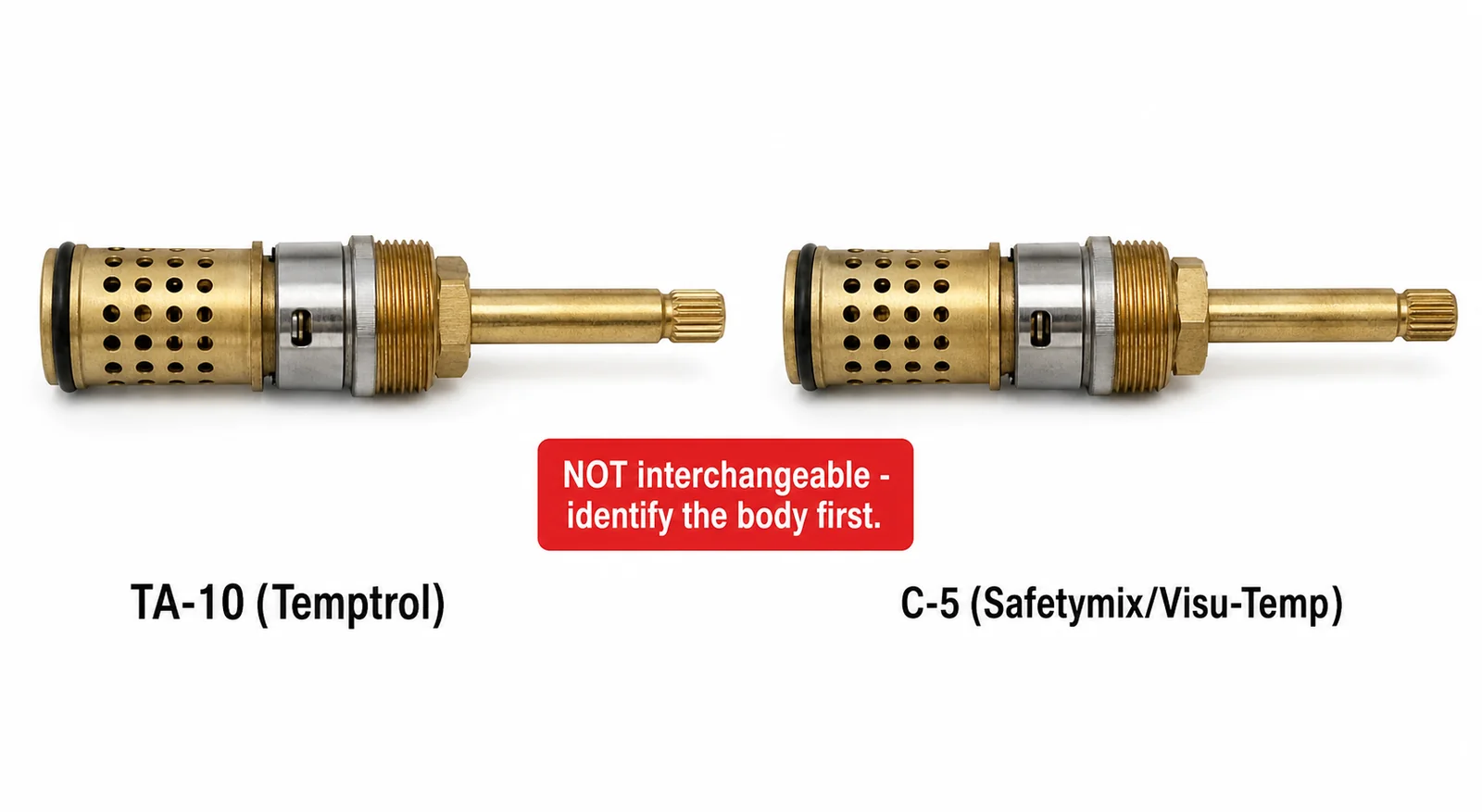
The Temptrol TA-10 and the Safetymix/Visu-Temp C-5 are both solid brass and bronze flow-control spindles with stainless steel pistons, and they look nearly identical in your hand. They are not interchangeable.
Symmons is explicit: the TA-10 is “for use with Temptrol shower series valves,” (TA-10, symmons.com) and the C-5 is a separate part “for use with Safetymix valves from 1960 to date / Visu-Temp valves from 1975 to date.” (C-5, symmons.com) Crossing a TA-10 into a Safetymix body — or a C-5 into a Temptrol — produces a spindle that may fit the bore but seals incorrectly.
The rule: identify by the cap and body the spindle came out of, not by the spindle’s appearance. A spindle extracted from under a T-12A hex brass Temptrol cap is a TA-10. A spindle extracted from a Safetymix body without that cap is a C-5. If you pulled the part before identifying the body, photograph it next to a ruler and confirm with Symmons before ordering — see the manufacturer lookup section below.
Read the Cast Body Markings (The Most Authoritative Identifier)
If the trim is gone, the markings are worn smooth, and the spindle is unrecognizable, there’s still one source of truth: the number cast or stamped directly into the brass body. Symmons casts model designations into the valve body — and that body number outranks every other clue on the list.
Temptrol II bodies carry the designations S-46-1 (shower-only, no diverter) and S-46-2 (tub/shower with a diverter). (Temptrol II Body, symmons.com; S-46-1/S-46-2 Installation Guide, symmons.com) That distinction also cross-checks the wall — one flow control = S-46-1; one flow control plus a diverter = S-46-2. Older Temptrol bodies were sold under part numbers like 262BODY and S262BODY. (Temptrol Body, symmons.com)
If you can read a number cast into the brass behind the access panel, type it directly into Symmons’ product search at symmons.com. Do not assume a long alphanumeric string is a manufacture-date serial — Symmons does not publish a homeowner-facing serial-number-to-year decoder. Cast or stamped numbers are model and body numbers; treat them as such and search them on the Symmons site for exact fitment confirmation.
If the cast number is painted over or corroded, a penlight and a wire brush can usually bring it legible without removing tile.
Showeroff Era: PS-1 vs. NS-1 (The Date-Split Platform)
The Showeroff is the one Symmons platform where the installation era changes which part you order — and Symmons is explicit about the cutoff.
PS-1 fits Showeroff series valves installed from 1960 to 1983. NS-1 fits Showeroff series valves installed from 1983 to present. (PS-1, symmons.com; NS-1, symmons.com; cross-referenced at Ferguson NS-1) For every other Symmons platform, the part number doesn’t split by era — the C-5 covers all Safetymix years, the TA-10 covers all Temptrol years. The Showeroff is the exception.
To estimate the installation era without a serial decoder: 1. Check the building permit or original construction date. A pre-1983 building that was never remodeled = PS-1. 2. If the building was renovated, find the renovation records — a 1991 remodel in a 1970 building almost certainly put in a post-1983 valve = NS-1. 3. If you genuinely can’t estimate the era, photograph the metering unit and contact Symmons (details below) for photo-based confirmation before ordering. One photograph saves a return.
How to Identify Your Symmons Shower Valve: Quick Decision Tree
Work through these questions in order — the first “yes” routes you to the correct platform and part.
-
Is there a separate round numbered temperature dial on the trim? → Yes → Temptrol → order TA-10 spindle (lives under the T-12A brass cap)
-
Is there a single lever with no separate dial — possibly a temperature indicator window on the escutcheon? → Yes → Safetymix / Visu-Temp → order C-5 spindle (fits all years on both lines)
-
Does the lever feel like a sink faucet — smooth ceramic-disc action, not a brass-piston feel? → Yes → Symmetrix → order KN-4 ceramic cartridge
-
Is there a push button that triggers a timed water burst, then shuts off automatically? → Yes → Showeroff → order PS-1 (pre-1983) or NS-1 (1983 or later) by estimated install era
-
Are there two distinct controls — a thermostatic temperature handle AND a separate flow handle? → Yes → Maxline thermostatic → order TMX-267-KIT (for 7-225 / 7-230 series)
-
Can you read a number cast or stamped into the brass body behind the trim? → Search that body number on symmons.com — the body number overrules every other identifier on this list
If you’ve worked through all six and still aren’t certain, use our free Cartridge & Valve Finder to narrow brand → platform → part without reading exploded diagrams. It encodes the Symmons look-alike traps above — TA-10 vs. C-5, PS-1 vs. NS-1 — so you don’t have to hold them all in your head.
What to Do If You Can’t Identify It
Symmons is a brand where genuine OEM parts are the correct answer and aftermarket substitutes are genuinely risky — the TA-10 is a precision brass/piston pressure-balancing assembly, not a generic rubber cartridge that an aftermarket look-alike can replicate to the same tolerances. Before you guess, work through the rebuild and support options.
Rebuild before you replace the body. Many Symmons valves that feel “dead” only need seats and seals replaced — not a new body. Symmons sells the full Temptrol rebuild toolkit: the TA-9 washer and seal repair kit, the TA-4 seat kit (used with the T-35A/B seat-removal tools), and the T-12A cap if the cap itself is worn. (TA-10 page listing TA-9 and TA-4 fitment, symmons.com; T-12A Cap, symmons.com) Replacing seats and seals typically stops a drip without touching the in-wall body.
If you still can’t ID it: install the RTSTC1 Shower Valve Test Cap to safely cap and protect the valve while you wait on a photo identification — rather than guessing at a part and risking a cracked body. (RTSTC1, symmons.com) Then photograph the spindle and cap assembly next to a ruler and send it directly to Symmons: – Phone: 1-800-SYMMONS (796-6667) – Email/text: gethelp@symmons.com — Symmons will identify from a photo
That exchange takes 15 minutes and costs nothing. It is better than a non-returnable wrong-platform spindle.
On “universal” substitutes: the only place a generic part is reasonable on a Symmons valve is consumable seats and washers within a documented rebuild kit. Never substitute the pressure-balancing spindle itself — the TA-10 is a platform-specific assembly, not a commodity.
When to replace the whole body: if the brass body is cracked, the seat threads are stripped, or the valve predates available parts, a body swap may be warranted. Symmons still sells Temptrol bodies (S-46-1, S-46-2, S262BODY) and a Rapid Install path. Body replacement usually means opening the wall — see the plumber section next.
When to Call a Plumber
Symmons identification is DIY-able to the point of knowing exactly which part to order. Call a plumber when:
- The body number is cast deep in the wall and can’t be reached without removing tile or an access panel you don’t have. A plumber can ID by feel and OEM catalog.
- The Showeroff straddles the 1983 cutoff and you can’t estimate the installation era. A misidentified era means a cartridge that physically won’t fit the metering mechanism — not correctable once you’ve cracked the unit open.
- The Temptrol seats are seized. Pulling seats requires the T-35A/B seat-removal tools; forced extraction on a corroded body risks cracking the brass at the seat threads.
- The diagnosis is a cracked or stripped brass body — not a worn spindle, but the body itself. A body swap typically means opening the wall and reconnecting supply lines. That is licensed-plumber territory in most jurisdictions.
- It’s a commercial or institutional install — a Showeroff in a school or gym, or a Maxline in a code-governed facility where downtime, code compliance, and water management carry more weight than a DIY save.
The dividing line: identifying the platform and ordering the spindle or cartridge is DIY. Replacing the in-wall brass body — or any identification that requires destructive wall access — is a call-the-pro job.
What’s Next
Once you know the platform and the part number, the repair itself is typically a 30-minute job with a crescent wrench and a flathead. If you confirmed a Temptrol or Safetymix here, the Shower Repair Guide covers the full repair sequence — valve access, seat removal, spindle swap, and reassembly. If you’re also sorting out other shower valve brands — Moen, Delta, Kohler — the brand-by-brand identification method is in How to Identify Your Shower Valve and Cartridge (Moen, Delta, Kohler).
Before you add anything to a cart, confirm the model number printed on your part against the Symmons product page — every part-number claim in this article links to Symmons’ own listings and may be verified there directly.
What is the difference between the Symmons TA-10 and the C-5 spindle?
Both are solid brass and bronze flow-control spindles with stainless steel pistons — they look nearly identical in the hand and are about the same size. The TA-10 is the Temptrol spindle; the C-5 is the Safetymix/Visu-Temp spindle. They are not interchangeable and live in different valve bodies. Identify which body and cap your spindle came out of before ordering either part.
How do I tell if my Symmons valve is a Temptrol or a Safetymix?
The fastest tell is the temperature dial. A Temptrol has a separate round numbered dial plate (T-29A, T-29B, or T-29C) behind the handle — a configuration unique to the Temptrol trim. A Safetymix or Visu-Temp has a single lever with no separate dial. If you’ve removed the handle, a T-12A hex brass cap confirms a Temptrol; a different internal assembly points to Safetymix or another platform.
Which Symmons Showeroff cartridge do I need — PS-1 or NS-1?
It depends on when the valve was installed. The PS-1 fits Showeroff valves from 1960 to 1983; the NS-1 fits 1983 to present. If you cannot estimate the installation era, photograph the metering unit and contact Symmons at 1-800-SYMMONS (796-6667) or gethelp@symmons.com — they will confirm from a photo before you order.
Can I use an aftermarket spindle in my Symmons Temptrol?
Aftermarket TA-10 look-alikes exist, but Symmons’ recommendation — and the safer choice — is the genuine TA-10 or the retail-packaged TA-10-RP. The Temptrol spindle is a precision pressure-balancing assembly; an aftermarket substitute may not replicate the piston tolerances that make the pressure balance work correctly. For consumable seats and washers (TA-9 kit, TA-4 seat kit), aftermarket parts within a documented rebuild kit are more reasonable.
What do the Symmons dial letters A, B, and C mean?
T-29A, T-29B, and T-29C are trim-generation designators — Dial Model A, B, and C respectively. They identify which generation of Temptrol trim is on the wall, which matters when ordering a replacement dial plate. For spindle identification, the letter doesn’t change anything: any lettered round temperature dial signals a Temptrol, and the spindle is a TA-10. Symmons does not publish a plain-language “Model A = built in year X” guide, so treat the dial letter as a trim part number, not a manufacture-date code.
What if my Symmons valve has no legible markings at all?
Install the RTSTC1 Shower Valve Test Cap to keep the valve capped while you investigate — don’t guess at a part. Photograph the spindle, cap, and any cast numbers on the body next to a ruler and send the photos to Symmons by text or email (gethelp@symmons.com). Symmons will identify the platform from photos. That 15-minute exchange is faster and cheaper than ordering a wrong-platform spindle.
Sources
- Symmons Temptrol Parts Hub — symmons.com
- Symmons Temptrol Parts Breakdown Diagram (PDF) — symmons.com
- TA-10 Spindle, Temptrol — symmons.com
- C-5 Spindle, Safetymix (1960–date) / Visu-Temp (1975–date) — symmons.com
- Safetymix / Visu-Temp Valve — symmons.com
- KN-4 Cartridge, Symmetrix — symmons.com
- TMX-267-KIT, Maxline Thermostatic Cartridge Kit (7-225 / 7-230 series) — symmons.com
- PS-1 Showeroff Cartridge (1960–1983) — symmons.com
- NS-1 Showeroff Cartridge (1983–date) — symmons.com
- T-12A Cap Assembly, Temptrol — symmons.com
- RTSTC1 Shower Valve Test Cap — symmons.com
- Dial Model A (T-29A) — symmons.com
- Dial Model B (T-29B) — symmons.com
- Dial Model C (T-29C) — symmons.com
- Temptrol Body (262BODY / S262BODY) — symmons.com
- Temptrol II Body (S-46-1 / S-46-2) — symmons.com
- S-46-1 / S-46-2 Valve Body Installation Guide — symmons.com
- TA-10-RP Temptrol Spindle, Retail Package — Home Depot
- TA-10-RP Brass Valve Repair Kit — Lowe’s
- T-12A-RP Temptrol Cap Assembly — Home Depot
- KN-4 Symmetrix Cartridge — SupplyHouse
- NS-1 Showeroff Metering Cartridge — Home Depot
- NS-1 Showeroff Cartridge — Ferguson
- C-5 Spindle, Symmons Safetymix — Noel’s Plumbing Supply
Educational content only. Not a substitute for licensed professional advice. Local plumbing codes vary by jurisdiction. Use of any guidance from this guide is at your own risk.
Get the homeowner’s plumbing repair toolkit checklist — the tools, parts, and decisions every homeowner should have on hand. [Free download — enter your email]
Parts for this repair
As an Amazon Associate, plumbingbythebook earns from qualifying purchases. Links below are affiliate links — they cost you nothing extra.
- Symmons TA-10-RP Temptrol Spindle (Retail Package) — Genuine OEM replacement spindle for Symmons Temptrol pressure-balancing shower valves. The retail-packaged TA-10-RP is the standard homeowner buy — confirm your valve has the T-12A brass cap before ordering.
- Symmons C-5 Safetymix Spindle — OEM spindle for Symmons Safetymix (1960–date) and Visu-Temp (1975–date) single-handle shower valves. Looks almost identical to the TA-10 — confirm by the valve body, not the spindle shape, before ordering.
- Symmons KN-4 Symmetrix Cartridge — Ceramic-disc cartridge for Symmons Symmetrix single-handle faucet-style shower valves. Identifiable by the faucet-lever feel; does not apply to Temptrol or Safetymix bodies.
- Symmons NS-1 Showeroff Metering Cartridge — Replacement cartridge for Symmons Showeroff push-button metering valves made 1983 or later. Common in gyms, schools, and dorms — confirm installation era before ordering (pre-1983 valves need the PS-1).
Related guides
Which Shower Trim Kits Fit Your Valve? How to Tell by Brand
You found a shower trim kit you like, in the right finish, from the right brand. It still…
Shower Cartridge Identification Chart: Every Major Brand in One Table [2026]
Shower Cartridge Identification Chart: Every Major Brand in One Table [2026] This shower cartridge identification chart puts nine…
![Title card for the article 'Should I Repair or Replace My Shower Valve? [2026]' on Plumbing By The Book](https://plumbingbythebook.com/wp-content/uploads/2026/08/article-99-hero-should-i-repair-or-replace-my-shower-valve-600x400.webp)
Should I Repair or Replace My Shower Valve? [2026]
Should I repair or replace my shower valve? For most homeowners, the honest answer is: repair the cartridge…