Every brand wants to tell you what breaks most in your home. We wanted the unfiltered version, so we read 227 real homeowner plumbing posts — actual questions people asked while standing over a failing fixture with a wrench — and ranked them two ways: by the fixture involved, and by what actually went wrong.
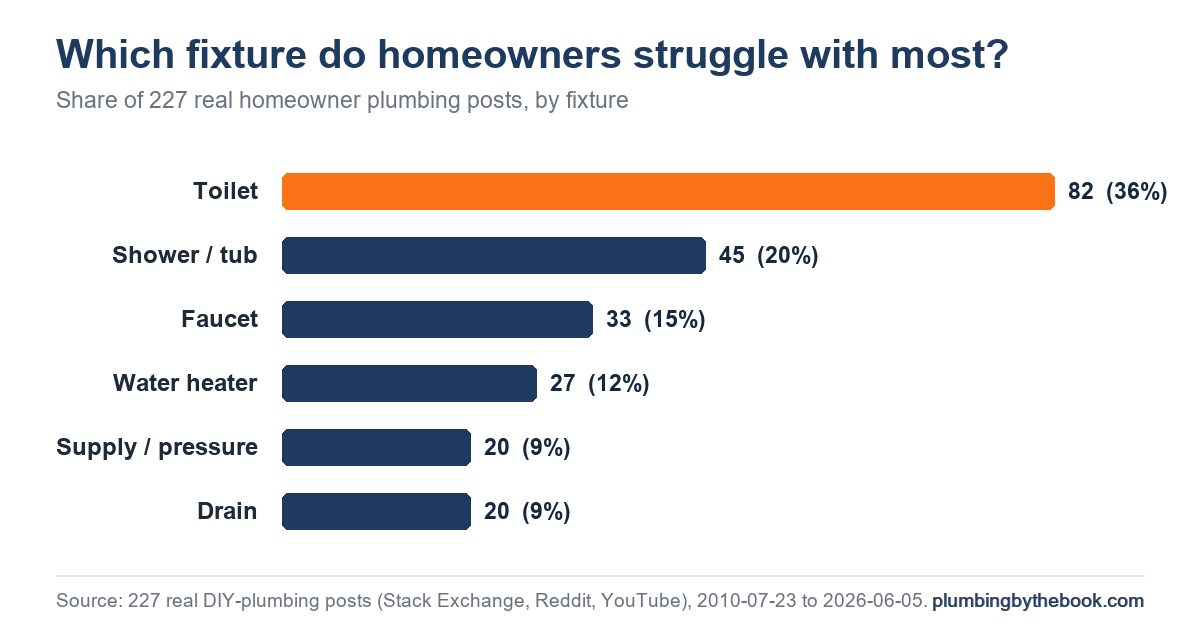
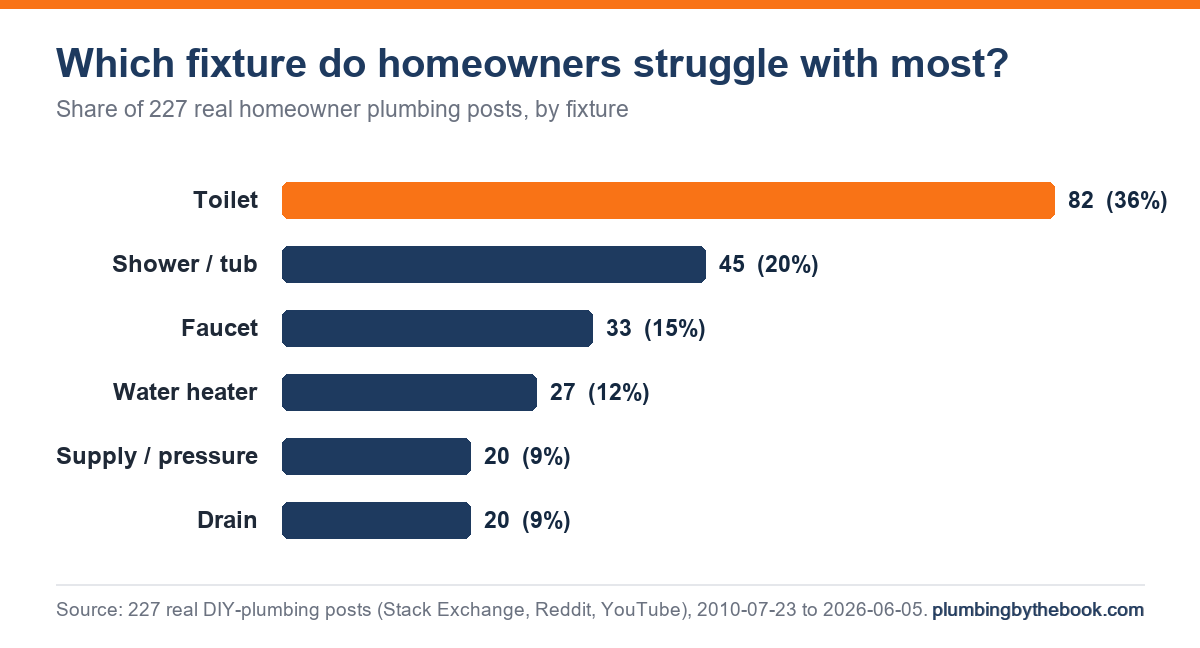
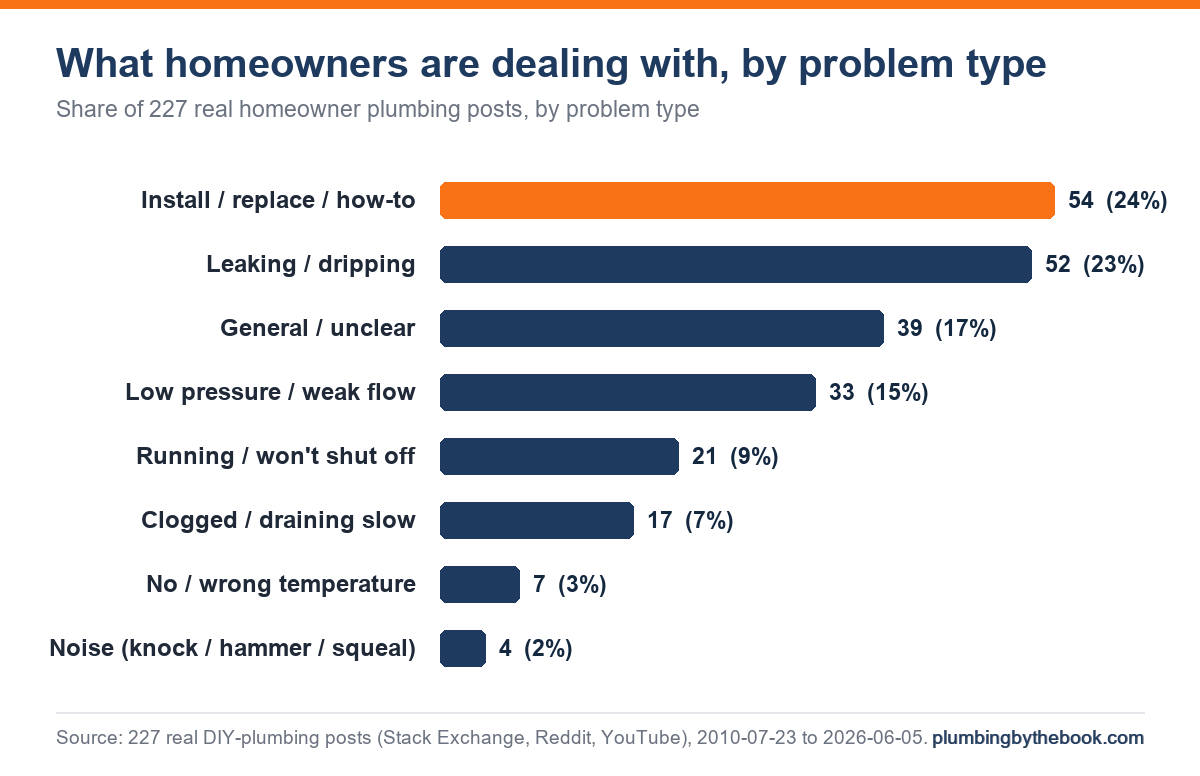
This is the frequency leaderboard. Toilets are the runaway #1 (36% of posts — more than faucets and drains combined), shower and tub problems come next (20%), leaking is the single most common symptom (23%), and how-to and installation questions (24%) show most homeowners arrive ready to do the job themselves. If you want to know not WHAT homeowners are trying to do but WHICH fixture is most likely to be the thing that sent them looking, start here. For the flip side — what homeowners actually want when they ask — see our companion plumbing search-intent study. The methodology and limitations are laid out plainly below so you can check our work.
The headline findings
- Toilets are the #1 DIY plumbing headache — 36% of all posts, more than faucets and drains combined.
- Leaking is the single most common thing that actually goes wrong — 23% of posts describe a leak or drip.
- Nearly 1 in 4 posts (24%) are how-to and installation questions — people planning a job, not just reacting to a failure.
- Shower and tub valves are the #2 trouble spot (20%) — and the riskiest to force, because the valve sits inside the wall.
Which fixture gives homeowners the most trouble
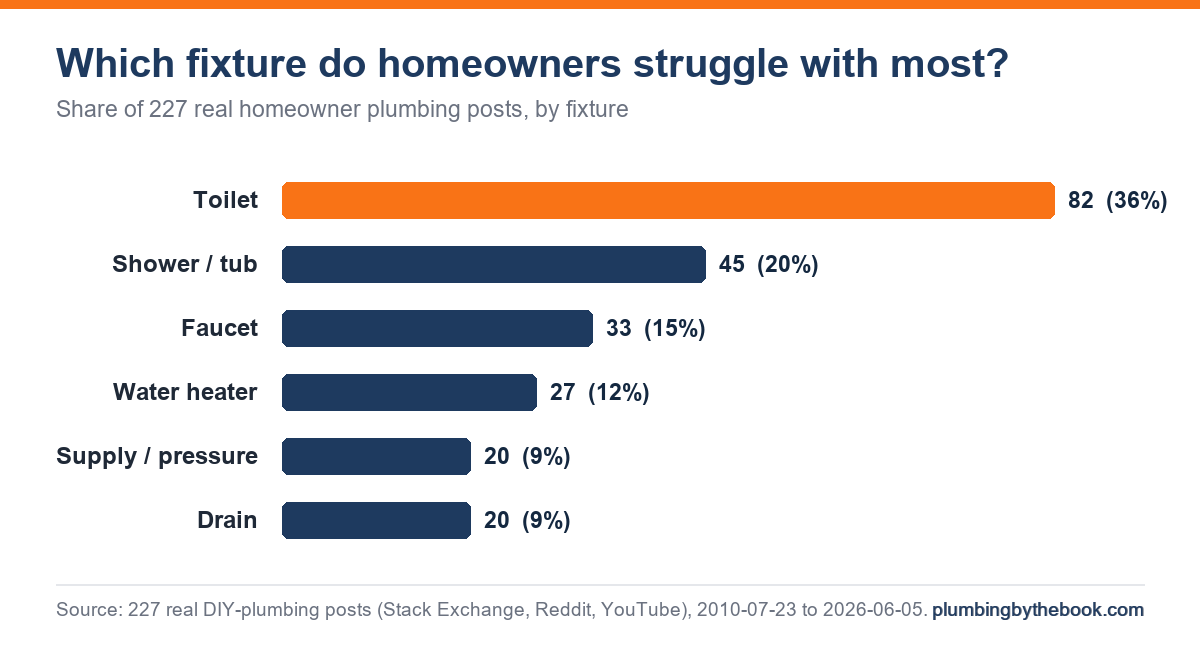
Toilets run away with it: more than a third of every plumbing post we read was about a toilet — running, leaking, or a parts swap. That tracks with reality. Toilets have the most moving parts a homeowner will ever touch (flapper, fill valve, flush valve, supply line), and they fail often enough that almost everyone deals with one eventually. Shower and tub valves come second, faucets third.
What actually goes wrong
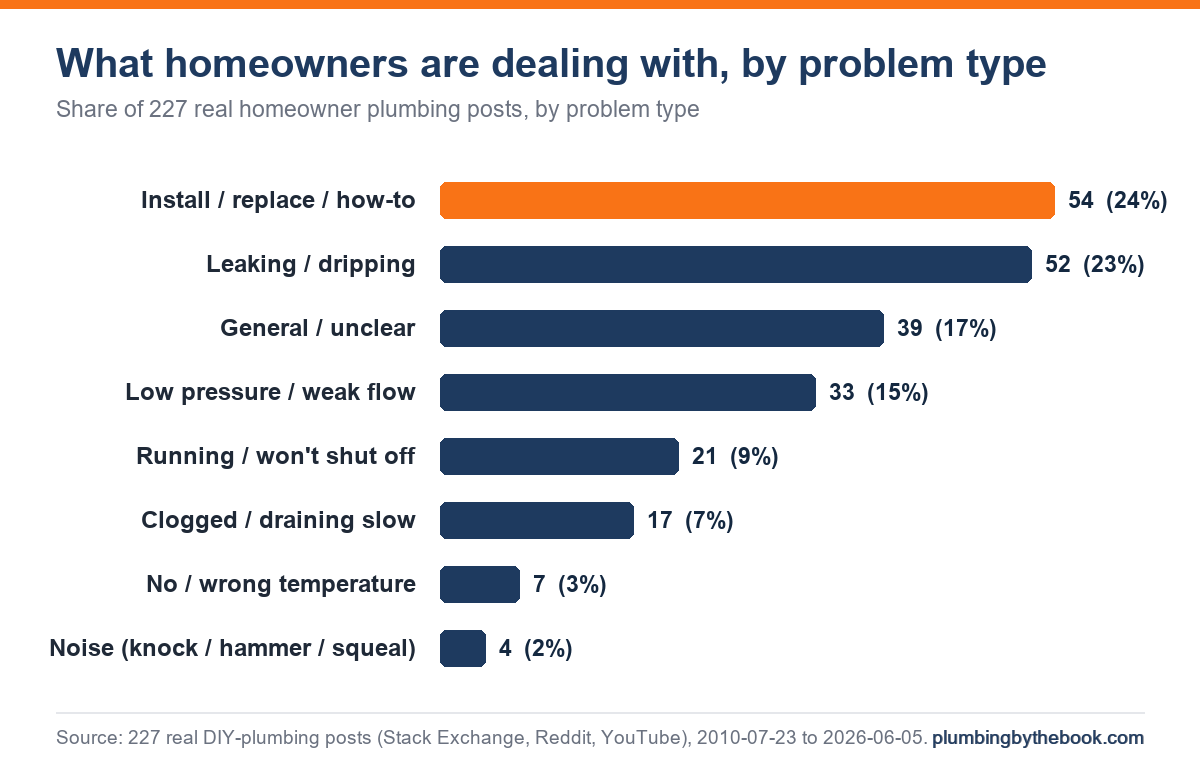
When you sort by problem type, two things stand out. First, leaks dominate the actual failures — a faucet that drips, a toilet that weeps at the base, a supply line that seeps. Second, a huge slice of posts are not failures at all: people asking how to install or replace something. That is good news for a DIYer — most of these are jobs you can do yourself with the right part and a little guidance, which is exactly what our guides and our free repair finder are built for.
Where the data comes from
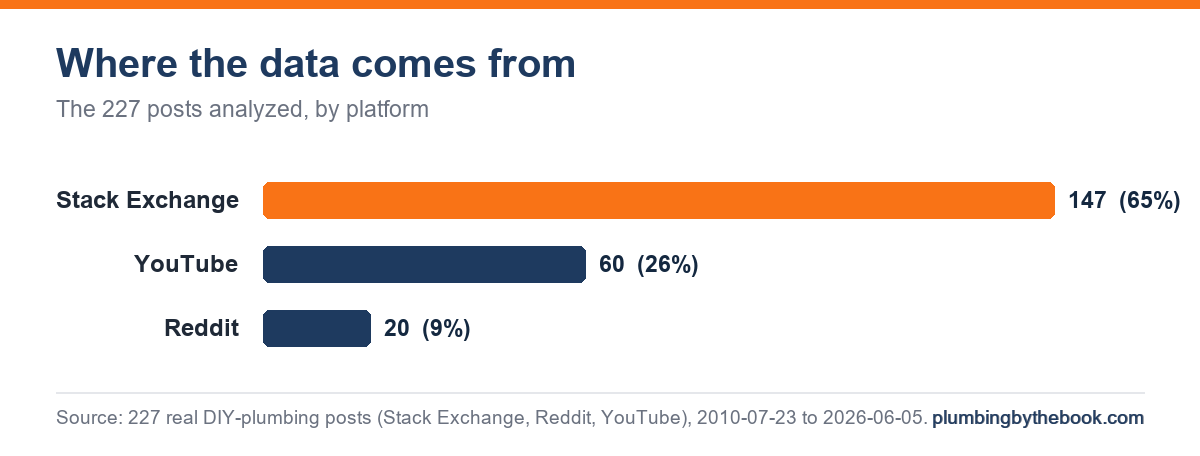
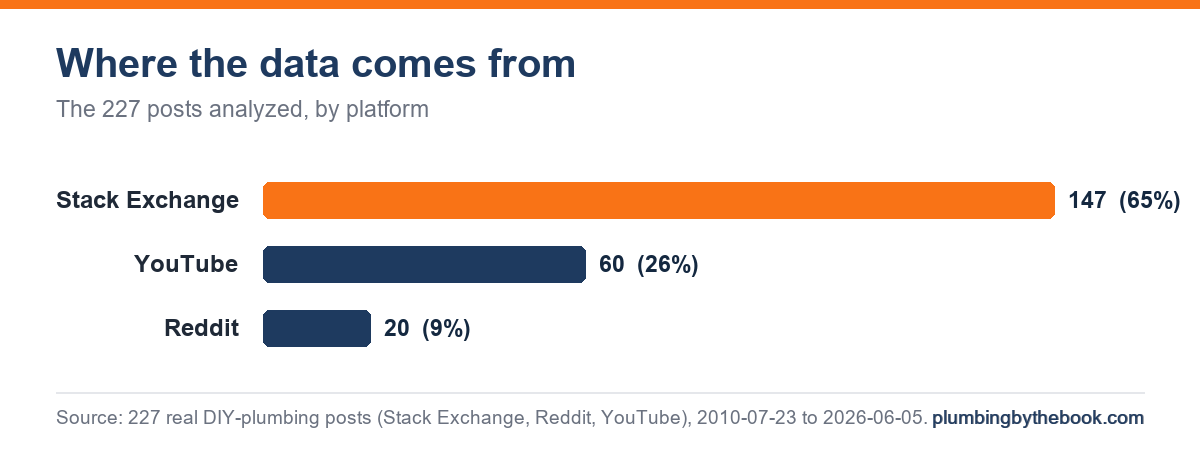
We pulled from three public sources where homeowners describe real problems in their own words: Stack Exchange (Home Improvement), Reddit, and YouTube. The mix matters — Stack Exchange skews toward detailed questions, while Reddit and YouTube catch the messier, in-the-moment stuff — so reading across all three gives a fuller picture than any one platform alone.
What this means if you are the one holding the wrench
The pattern is encouraging: the most common plumbing problems are also among the most DIY-friendly. A running toilet, a dripping faucet, a weak shower — these usually come down to a single inexpensive part, if you can identify the right one. The hard part is almost never the repair; it is figuring out exactly what you have. Start here:
- Toilet repair guide — the #1 problem in this data.
- Faucet repair guide — for drips and leaks.
- Shower & tub valve guide — the riskiest fix to force, so read the off-ramps.
- Faucet, Shower & Toilet Repair Finder — answer a few questions and find the exact part you need, free.
Methodology
We analyzed 227 on-topic homeowner plumbing posts (90 distinct discussion threads) collected between 2010-07-23 and 2026-06-05. The posts come from Stack Exchange Home Improvement (questions and top answers), Reddit plumbing/DIY feeds, and YouTube repair-video comments. We started with 269 collected records and excluded 42 that were off-topic — subreddit rules posts, adjacent trades like HVAC, and general comment chatter — keeping only posts about an actual plumbing fixture or problem.
Every post was classified into exactly one fixture (toilet, shower/tub, faucet, water heater, supply/pressure, or drain) and one problem type (leak, clog, running, low pressure, noise, temperature, or install/how-to) using a transparent keyword rule set — first match wins, so the categories do not double-count. The full analysis is reproducible: the script and the keyword rules are versioned in our repository, and running them against the same corpus produces these exact numbers.
Limitations (read these before you cite us)
- This is a snapshot of public online discussion, not a representative survey of all U.S. households. People post when they are stuck, so failures are over-represented relative to how often things quietly work.
- The corpus spans a wide window (2010-07-23 to 2026-06-05) and a modest sample (N=227); treat the percentages as directional, not precise to the point.
- Classification is keyword-based. It is transparent and reproducible, but a human might code a handful of ambiguous posts differently.
- Source mix shapes the result — Stack Exchange contributes the most posts, so its style is weighted more heavily.
Cite this study
This study is free to reference and link. If it is useful to your readers, please cite it as: “What Homeowners Actually Ask About Plumbing: A Data Study of 227 Real Problems,” PlumbingByTheBook, 2026, https://plumbingbythebook.com/diy-plumbing-problems-data-study/. Journalists and bloggers are welcome to use the charts with attribution; reach us through our contact page for the underlying numbers.
Key findings (free to cite with a link)
Cite this study
Free to cite with a link to plumbingbythebook.com. Three ready formats:
Plain text
HTML
APA
Embed a chart (free, please keep the credit)
For journalists
Author: Thomas Kwayne, editorial voice of Plumbing by the Book -- researched, spec-checked DIY guidance (not a licensed plumber). Guides + studies are researched and drafted with AI tools and checked against manufacturer specifications and published standards.
Method: Observational corpus of 227 real homeowner plumbing questions (269 collected, 42 off-topic excluded) from public Q&A, 2010-2026 (Stack Exchange 147, YouTube 60, Reddit 20). First-match-wins keyword classification. Not a representative survey.
Charts and stats are free to use with a link to https://plumbingbythebook.com/diy-plumbing-problems-data-study/. Questions / the underlying classification rules: via the contact page.
Related guides
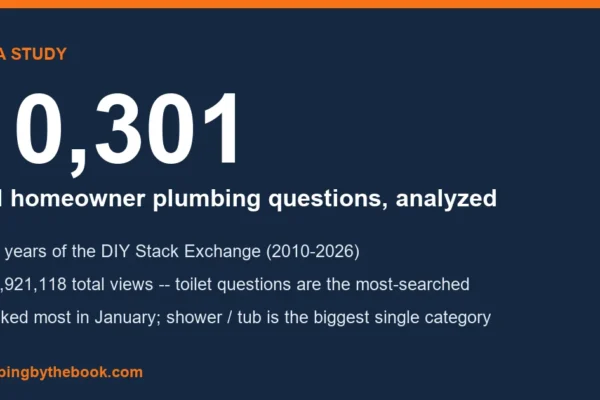
Plumbing Problems at Scale: What 10,301 Real Questions Reveal, Including the January Spike [2026]
What do homeowners actually struggle with when a pipe, fixture, or drain goes wrong? Not what a brand’s…
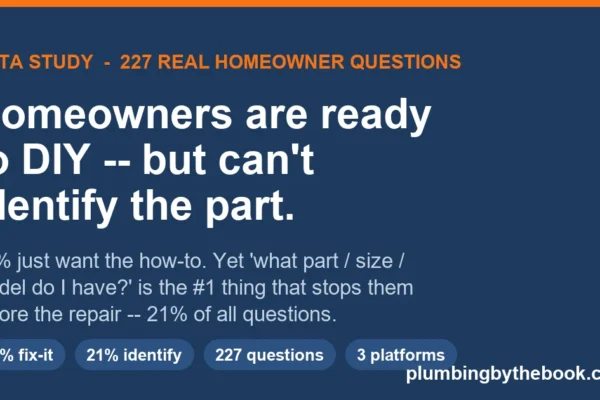
What Homeowners Really Want When Plumbing Breaks: A Search-Intent Study of 227 Questions [2026]
When a plumbing fixture fails, conventional wisdom says the homeowner’s problem is the repair itself. The data says…