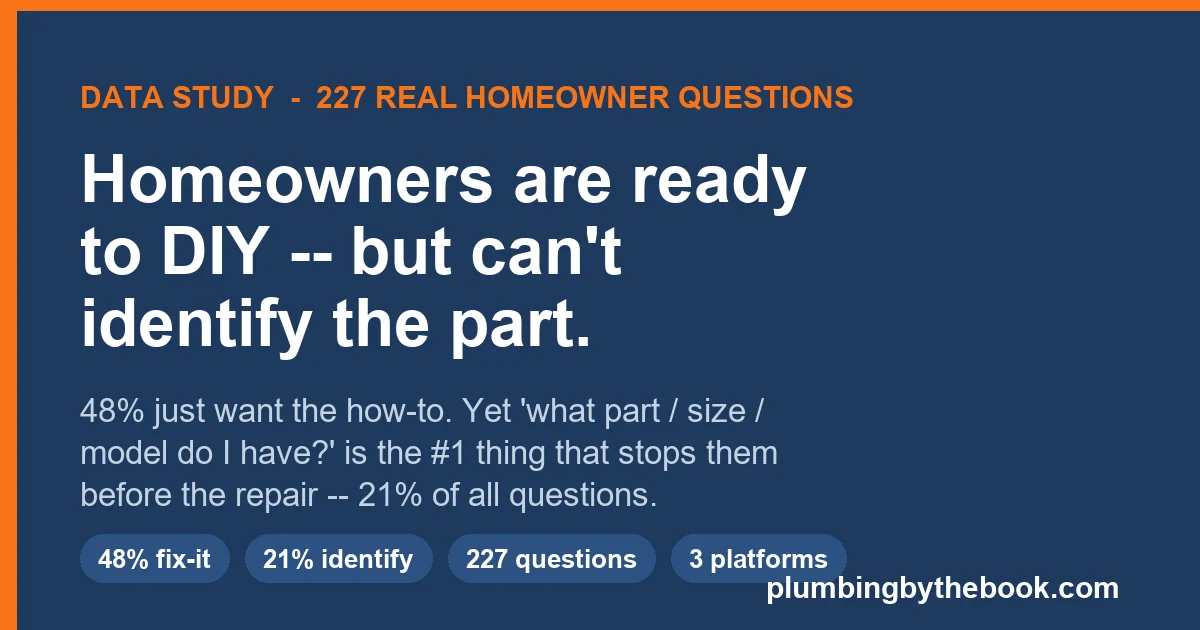
When a plumbing fixture fails, conventional wisdom says the homeowner’s problem is the repair itself. The data says otherwise. We re-cut our corpus of 227 real homeowner plumbing questions — the same posts behind our by-fixture frequency study, but classified this time by what the person was actually trying to do — and one finding jumped out: the wall homeowners hit first is not “how do I fix this,” it is “what part do I even have?”
This is a search-intent study. Classified into a single primary intent each, 48% of homeowners just want the how-to — but a step earlier, more than a third are stuck before the repair can even start, and identification alone (21%) is the single biggest blocker, bigger than diagnosis or the decision to call a pro. If you build or sell anything for DIY plumbers, that is the gap to fill.
What homeowner plumbing questions reveal
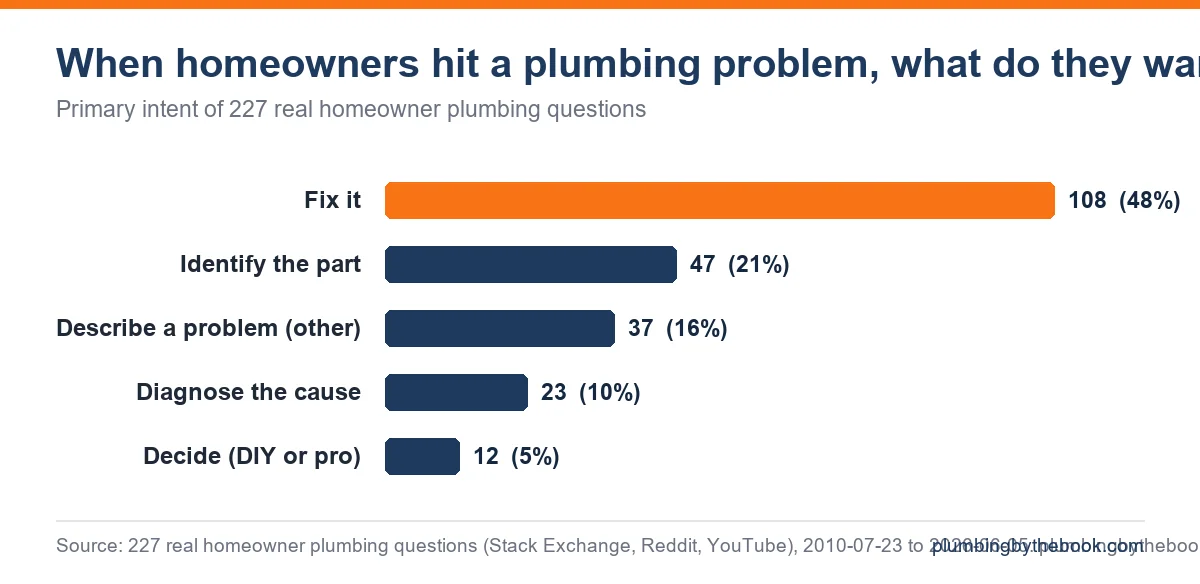
Across 227 real homeowner plumbing questions, classified into one primary intent each:
- 48% just want to fix it themselves. “How do I replace…”, “how to install…”, “best way to remove…” – the plurality arrive ready to turn a wrench.
- 21% are stuck identifying the part or model. “What size flapper?”, “which cartridge does my faucet use?”, “what is this fitting?” – they cannot start the repair because they do not know what they have.
- 10% need to diagnose the cause (“why is my toilet running?”) and 5% are weighing whether to DIY or call a pro at all.
- Put together, 36% need help BEFORE the repair can even start (identify + diagnose + decide) – and identification is the largest single piece of that.
The takeaway for anyone building plumbing content: the how-to guide is table stakes. The homeowners you are losing are the ones who cannot get far enough to use it, because they cannot name the part.
Identification is the wall they hit first
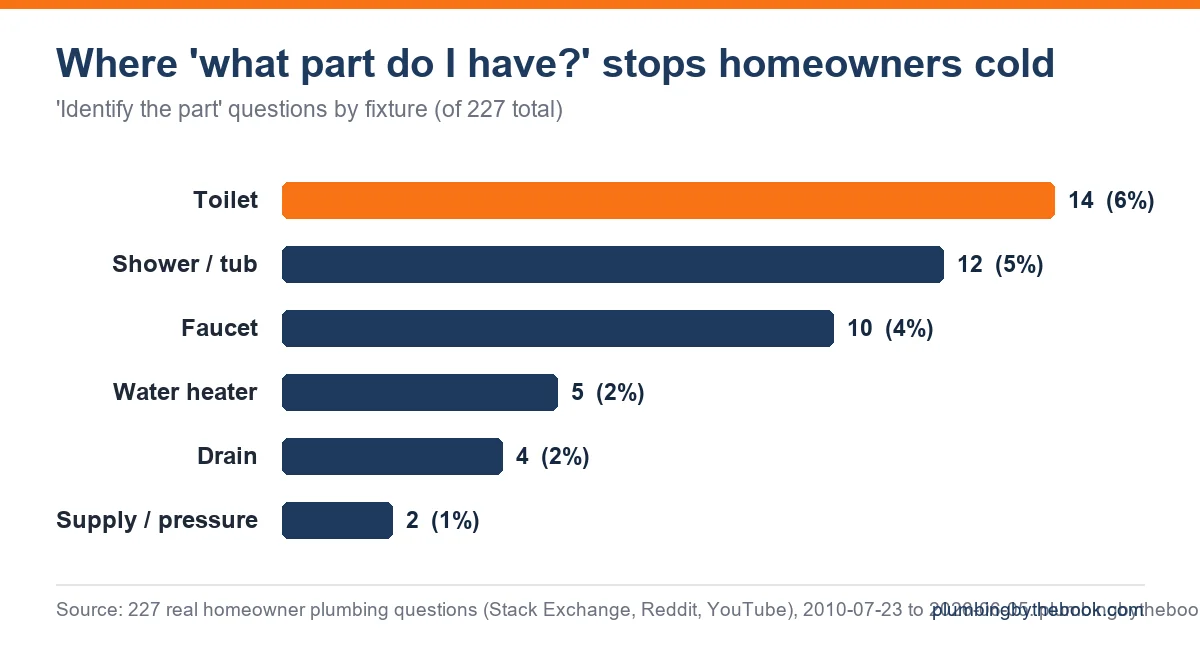
Break the “identify the part” questions down by fixture and the problem is everywhere, not isolated to one tricky category:
- Toilet: 14 identification questions (the most) – flappers, fill valves, and flush-valve sizes that vary more than people expect.
- Shower / tub: 12 – shower cartridges are the classic “looks identical, is not interchangeable” trap.
- Faucet: 10 – single-handle cartridges differ by brand and even by year of manufacture.
- Water heater: 5, drain: 4, supply / pressure: 2.
This is exactly why a $4 flapper or a $10 cartridge turns into a wasted weekend: buy the wrong size or the wrong generation and you are back at the store, not back in business. The fix is not “try harder” – it is identifying the part correctly before you buy.
What this means if you are the one holding the wrench
If you are staring at a leak or a running toilet right now, this is the order that actually works:
- Identify before you buy. Most failed DIY repairs are a misidentification, not a skill problem. Our free Faucet, Shower & Toilet Repair Finder answers a few questions and points you at the exact part; the identify-your-faucet and identify-your-toilet guides walk the manual route.
- Then follow the how-to. Once you know the part, the repair guides do the heavy lifting – start at the Faucet Repair, Toilet Repair, or Shower Repair hub.
- Know the line. A small share of problems genuinely belong to a pro (water on the floor, a valve that will not shut off, anything in the wall). Every one of our repair guides marks that line explicitly.
And if your running toilet is the problem, the toilet water-waste calculator shows what the delay is costing you on the water bill while you sort out the part.
Where the data comes from
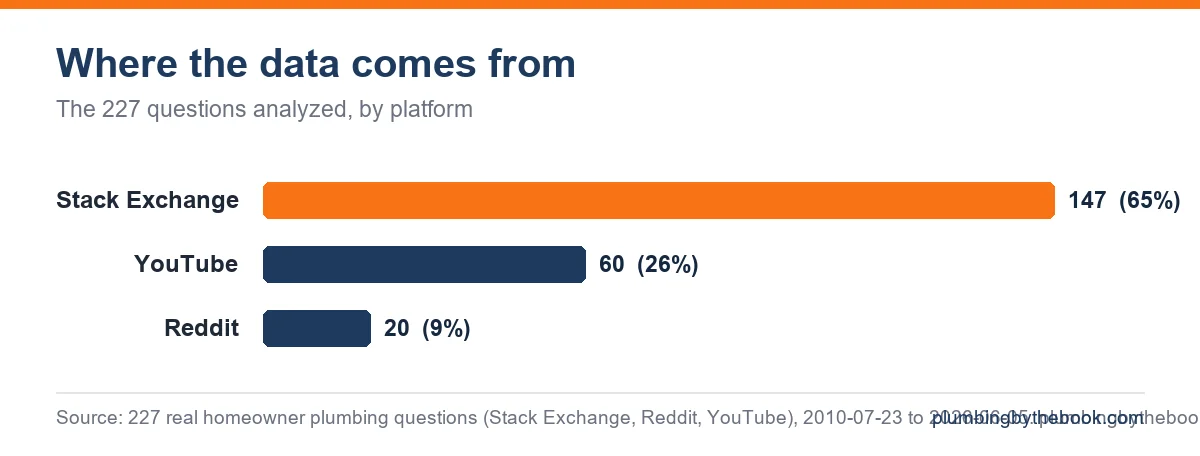
The 227 analyzed questions are real homeowner posts pulled from three public communities, deduped and filtered to on-topic plumbing only:
- Stack Exchange (Home Improvement): 147
- YouTube (plumbing how-to comments/questions): 60
- Reddit: 20
Methodology
We started from a corpus of 269 collected posts and excluded 42 off-topic ones (40 Reddit, 2 Stack Exchange) that did not contain a plumbing term – subreddit rules posts, adjacent-trade chatter, and the like – leaving 227 on-topic homeowner plumbing questions across 90 unique threads, dated 2010-07-23 to 2026-06-05.
Each post is classified into exactly ONE primary intent using transparent, inspectable keyword rules with a stated precedence (first match wins, so the buckets are mutually exclusive):
- Identify the part or model – “what size / kind / model / which part” cues. (Counted first: a “what size flapper do I replace” is fundamentally an identification problem even though it says “replace”.)
- Decide: handle it myself or call a pro – “should I”, “is it serious / normal / safe”, “need a plumber”.
- Diagnose the cause – “why is”, “what’s causing”, “where is the leak coming from”.
- Fix it (how-to / install / replace) – “how do I”, “how to”, “install”, “replace”, “unclog”.
- Anything matching none of the above is counted as Describe a problem (other) rather than forced into a bucket.
The analysis is a committed, deterministic script – same corpus in, same numbers out – so anyone can reproduce or audit it: scripts/data_study_diy_intent.py in our open pipeline. It reuses the exact on-topic filter and fixture classifier from Data Study #1, so the two studies are directly comparable.
Limitations (read these before you cite us)
Honesty is the whole point of a data study, so here is what this is NOT:
- It is a sample, not a census. 227 questions from three communities is a meaningful read on how DIY homeowners ask, but it is not every homeowner, and people who post questions skew DIY-inclined by definition. Someone who immediately calls a plumber never shows up here – so the real “call a pro” share in the general population is almost certainly higher than the 5% who ASK about it.
- Intent is inferred from wording, with overlap. A single question can carry more than one intent; the first-match precedence (above) resolves it, and reasonable people could order those rules differently. The “Describe a problem (other)” bucket (16%) is exactly the posts where intent was ambiguous – we did not force them.
- The date range is wide (2010-2026) and the platform mix is uneven (Stack Exchange dominates). We report counts, not trends over time, for that reason.
- No engagement weighting. Every question counts once, regardless of upvotes or replies.
None of these change the core, robust finding: homeowners are DIY-first, and identification is the most common thing standing between them and the repair.
Cite this study
Free to cite or link with attribution to PlumbingByTheBook.
PlumbingByTheBook (2026). “What 227 Real Homeowner Plumbing Questions Reveal About DIY.” Analysis of 227 on-topic homeowner plumbing questions (Stack Exchange, Reddit, YouTube; 2010-2026). Key finding: 48% of questions are primarily “how do I fix this,” but 21% are stuck identifying the part or model – the single most common blocker before a repair can start. plumbingbythebook.com
Journalists, bloggers, and tool sites: the reproducible analysis + the chart files are available on request, and our Repair Finder is the free tool that closes the identification gap this study found.
Sources
- Stack Exchange – Home Improvement (DIY) plumbing questions
- Stack Exchange Data Explorer (the open question/answer dataset)
- Reddit – r/Plumbing
- Reddit – r/DIY
- PlumbingByTheBook Data Study #1: What homeowners actually ask about plumbing
Educational content only. Not a substitute for licensed professional advice. Local plumbing codes vary by jurisdiction.
Key findings (free to cite with a link)
Cite this study
Free to cite with a link to plumbingbythebook.com. Three ready formats:
Plain text
HTML
APA
Embed a chart (free, please keep the credit)
For journalists
Author: Thomas Kwayne, editorial voice of Plumbing by the Book -- researched, spec-checked DIY guidance (not a licensed plumber). Guides + studies are researched and drafted with AI tools and checked against manufacturer specifications and published standards.
Method: The same 227-question corpus, cut by INTENT: what homeowners actually ask for, and what stops them. Observational public-Q&A data, not a representative survey.
Charts and stats are free to use with a link to https://plumbingbythebook.com/homeowner-plumbing-questions-data-study/. Questions / the underlying classification rules: via the contact page.
Related guides
Plumbing Problems at Scale: What 10,301 Real Questions Reveal, Including the January Spike [2026]
What do homeowners actually struggle with when a pipe, fixture, or drain goes wrong? Not what a brand’s…
Most Common DIY Plumbing Problems, Ranked: What 227 Real Homeowner Questions Show [2026]
An analysis of 227 real homeowner plumbing posts: toilets are the #1 problem (36%), leaks the most common…