
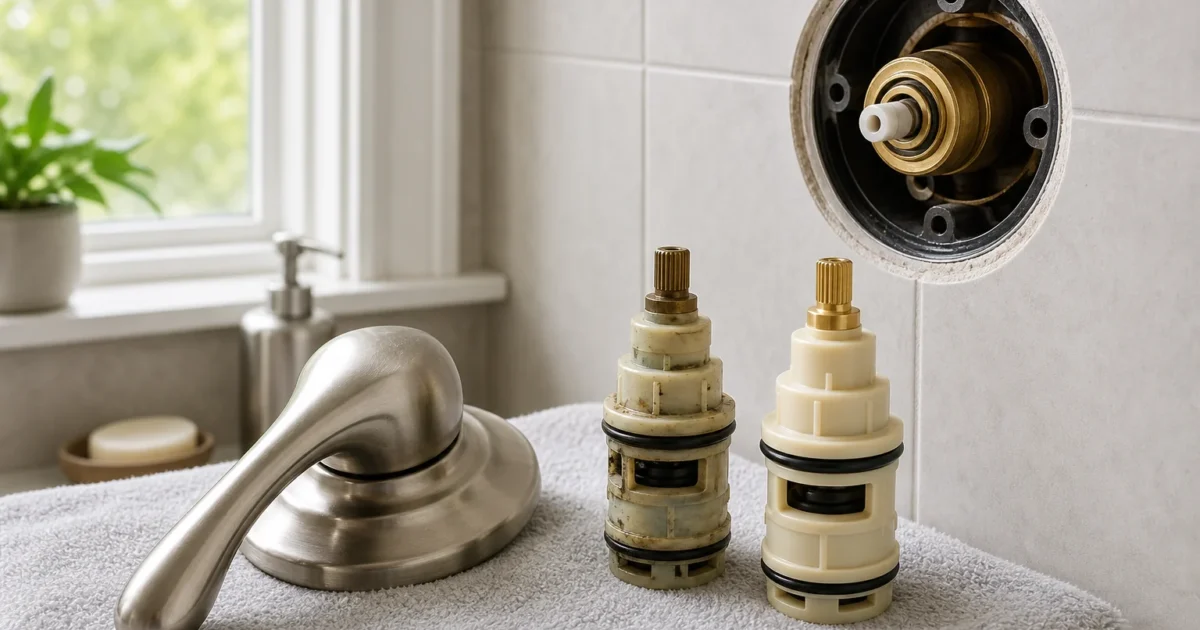
How to Identify Your Pfister Shower Valve: Model Number, Cartridge, and Valve Family [2026]
How to identify your Pfister shower valve starts with a fact Pfister itself puts front and center: the product model number, not the trim’s looks, is the reliable starting point, and it’s typically printed on the box and instruction manual as an 8-character-style code — Pfister’s own example is F-529-7AYY (Pfister FAQ). If the trim looks unfamiliar or the handle’s worn smooth, that model number — or the cartridge behind the handle — is what actually determines which part fits.
This matters more for a tub/shower valve than for a sink faucet, because the visible trim and the in-wall rough valve are two different things. Trim can be swapped during a remodel without touching the valve body, so a shiny new escutcheon doesn’t tell you what cartridge is behind the wall (Pfister replacement-parts workflow). This guide walks through where Pfister’s model number actually lives, how to read the cartridge once you can see it, Pfister’s own lookup tools, and what to do when none of that gets you a confirmed match.
| Clue | What it looks like | Likely valve family | Example part |
|---|---|---|---|
| Box, manual, or spec sheet | 8-character-style code, e.g. F-529-7AYY |
Depends on model | Model-specific |
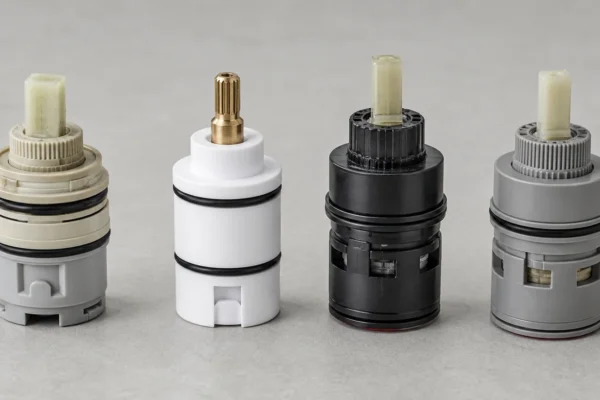
| Plastic cartridge, outside threading, white stem, integrated temp-limit stop | Single-handle tub/shower cartridge | 0X8 / JX8 / VB8 / JV8 deep-casting family | 974042 |
| Pfister or Price Pfister mark on handle, cap, or escutcheon | Confirms brand, not generation | — | — |
| No visible marks anywhere | Worn trim, painted-over, or mixed-brand repair | Unknown — needs cartridge removal | — |
Narrowed your Pfister valve above? Confirm the cartridge against the one in your wall before you buy — the trim does not tell you the generation:
As an Amazon Associate, plumbingbythebook earns from qualifying purchases. Links below are affiliate links — they cost you nothing extra.
Not sure which part you have? The faucet & valve finder narrows it to the exact part in a few questions.
This guide covers identification in order from easiest (no tools, no water shutoff) to last resort (cartridge removed and compared against manufacturer listings). Use the first method that gives you a confirmed model or part number and stop there.
How to Identify Your Pfister Shower Valve: Start With the Pfister Mark
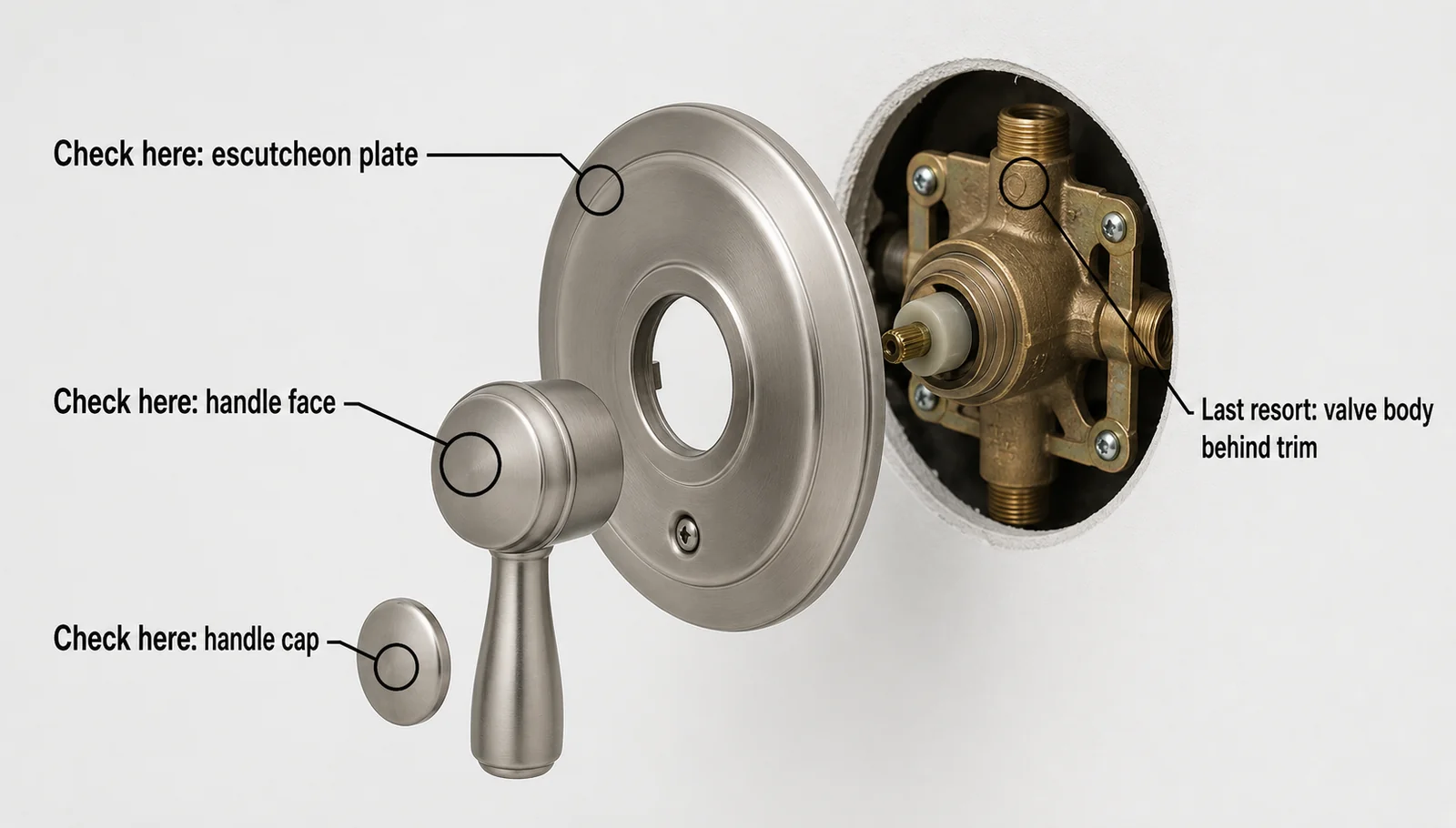
The first check costs nothing and needs no tools. Look at the handle face, the handle cap, the escutcheon plate, the tub spout, the showerhead, and any decorative sleeve for a Pfister or older Price Pfister mark — the brand mark can appear on any of those trim pieces even when a model number isn’t visible anywhere (Pfister tub/shower category). Photograph each visible piece separately before removing anything, since Pfister organizes its bath products into distinct visible groups — shower trim, tub and shower trim kits, tub fillers, tub spouts, and handle options (Pfister bath navigation).
Finding the mark confirms the brand family. It does not confirm which cartridge or valve generation is behind the wall — the visible trim often identifies only the trim family, while the in-wall rough valve determines which cartridge actually fits (Pfister replacement-parts workflow). A showerhead, arm flange, tub spout, or decorative escutcheon can confirm you’re looking at a Pfister product without telling you anything about the valve generation underneath, because trim can be changed without changing the rough valve (Delta MultiChoice cartridge page illustrates the same generation problem on a different brand). If no mark is visible at all — worn finish, painted-over trim, a builder-grade install — move to the model-number and cartridge checks below before assuming a different brand.
Method 1: Find the Model Number on the Box, Manual, or Installation Paperwork
Pfister’s own guidance treats this as the most reliable starting point, not the trim’s appearance. The model number “is usually an 8 digit code,” Pfister’s example being F-529-7AYY, and it’s printed on the product package and on the instruction manual below the product name (Pfister FAQ).
Check these, in order of reliability:
The original box or instruction manual. If it’s still in a closet, garage, or a builder’s remodel folder, the model number is printed on it exactly as Pfister describes. This beats guessing from the installed trim every time.
Warranty packets and contractor records. If a contractor installed the shower, ask whether they kept a fixture list or invoice — it often names the exact model. Pfister’s FAQ explicitly lists these paper records (box, install guide, warranty packet, contractor folder, or remodel photos) as more useful than guessing from trim appearance (Pfister FAQ).
Photos from the original remodel. If you or a previous owner photographed the shower during installation, zoom in on any box or paperwork visible in the background — it’s a common way to recover a model number years later.
If none of that paperwork exists, move to the cartridge and valve-body markings in Method 2 — Pfister’s own cartridge-identification workflow starts with identifying the faucet, then opening the Installation & Support section, and using the parts diagram to identify the cartridge (Pfister FAQ).
Method 2: Read the Cartridge and Valve Body — the 0X8/JX8/VB8/JV8 Family
If the handle comes off (after the water is safely shut off), the cartridge and valve body carry more reliable identifying details than the trim ever will. Pfister says a removed cartridge can be identified either by a known part number or by comparing it against cartridge listings, thumbnail images, and dimensions (Pfister FAQ).
What to check after the handle is off. Look at the handle adapter, stem extension, temperature-limit stop, retaining nut, cartridge face, sleeve, and the brass or plastic valve body itself for molded or stamped identifiers (Pfister FAQ). This matters because the cartridge body — not the escutcheon design — is often the deciding clue for Pfister’s common single-handle families (Lowe’s Pfister 974042 listing).
The 0X8/JX8/VB8/JV8 deep-casting family. One of the most common Pfister single-handle tub/shower cartridges is listed at Lowe’s as model 974042 — an OEM universal pressure-balance cartridge for Pfister’s 0X8, JX8, VB8, and JV8 deep-casting valves (Lowe’s Pfister 974042 listing). Visually, it’s distinctive: a plastic body, outside threading, a single-lever broach, a white stem, and an integrated temperature-limit stop, with an overall length of 4-1/8 inches (Lowe’s Pfister 974042 listing). If your removed cartridge matches that description, 974042 for the 0X8/JX8/VB8/JV8 family is a strong lead — confirm the exact match against Pfister’s own parts diagram before ordering.
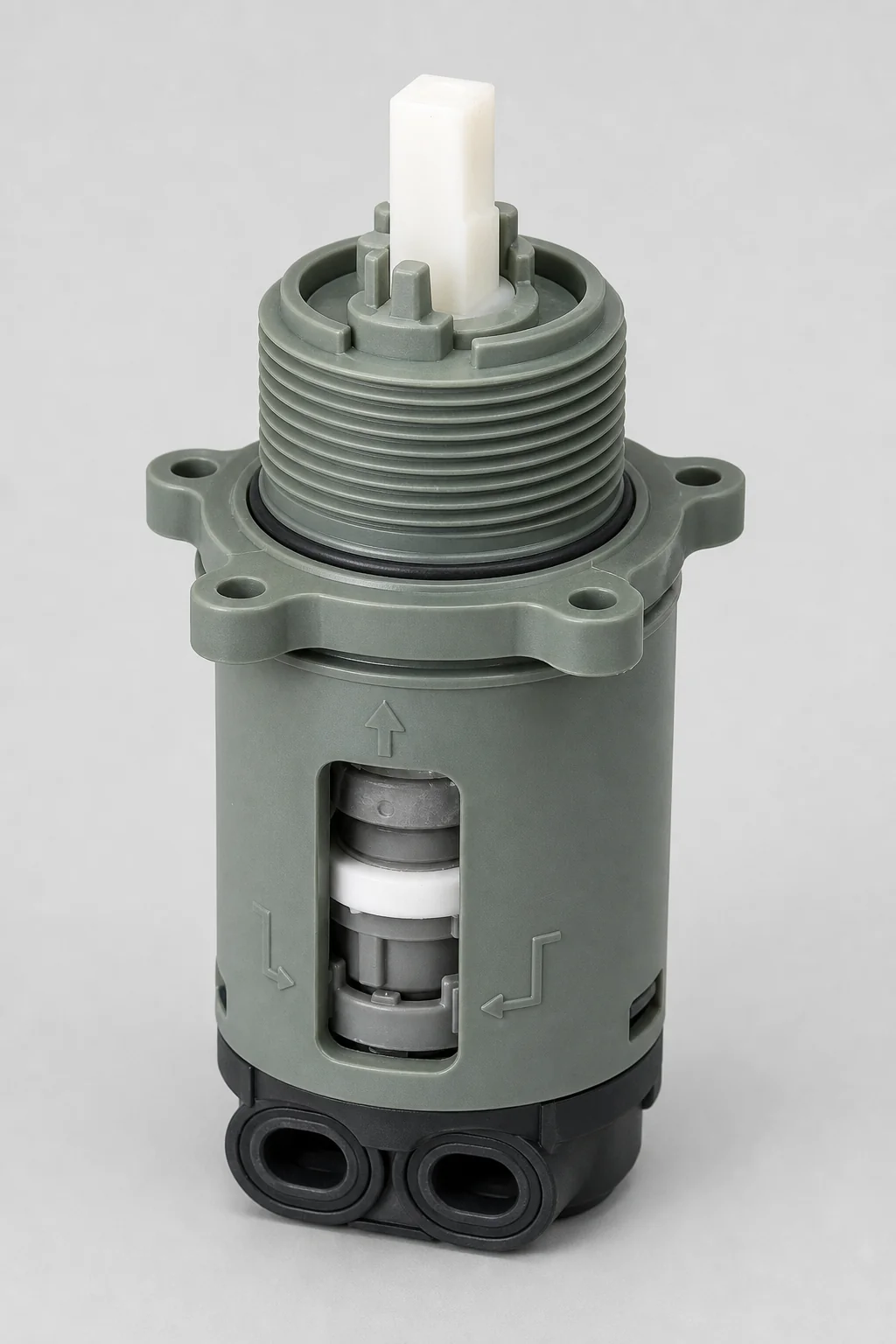
A secondary listing for part 974-5299 describes a similar general pressure-balanced cartridge valve for the 0X8 family, but that listing comes from a reseller rather than Pfister’s own product page, so treat it as a secondary reference only — confirm against Pfister’s own diagram, not a third-party MPN alone (OneClick Warehouse 974-5299 listing).
On serial numbers and date codes. There’s no published Pfister decoder for reading a manufacture date directly off a serial number or casting mark for tub/shower valves — the FAQ emphasizes the product model number from the package or manual, not a homeowner-facing serial-number format (Pfister FAQ). If the valve has a stamped casting date or molded code, record it and bring it to Pfister support rather than assuming it maps directly to a specific cartridge (Pfister FAQ).
Method 3: Use Pfister’s Own Lookup Tools
Once you have a model number, or a cartridge you’ve matched by appearance, Pfister’s support workflow confirms the exact part rather than leaving you to guess.
The identify-then-diagram path. Pfister’s documented workflow is: identify the product by model number if you have one, or browse the product category if you don’t, then open Installation & Support, then use the parts diagram to identify the cartridge (Pfister FAQ).
Browsing cartridges by appearance. If the cartridge is already removed and you don’t have a model number, Pfister’s Replacement Parts section lets you browse cartridges directly and compare thumbnail images, approximate dimensions, and exact specifications against what you’re holding (Pfister FAQ).
Comparing against manufacturer guides more broadly. Moen’s public Solutions library is a useful comparison model for how this kind of lookup works well — it identifies shower cartridges by handle operation, valve function, escutcheon screw arrangement, and cartridge images side by side (Moen shower cartridge guide). Delta’s Find Parts and Identify Your Product tool similarly separates a model-number lookup from a symptom-based common-parts search (Delta Find Parts and Identify Your Product). The shared rule across all three brands: don’t buy a cartridge from trim appearance alone when the cartridge body, valve family, or a parts diagram can confirm it first (Pfister FAQ).
Before ordering anything, confirm your exact replacement part with our free Repair Finder — it takes less than a minute and helps you avoid a second hardware run on a valve or cartridge that isn’t always in stock locally.
If you still can’t confirm the part, Pfister’s support line, 1-800-PFAUCET, is the documented next step when the online tools don’t resolve it — bring your photos and any part-number candidates to that call (Pfister FAQ).
How to Identify Your Pfister Shower Valve: Photo Checklist
Before contacting Pfister or ordering any part, take these photos — Pfister’s own guidance recommends this exact set before disassembly or a support call (Pfister FAQ):
- The full shower wall, showing the trim in context
- The handle straight-on
- The escutcheon screws
- The tub spout
- Any visible Pfister or Price Pfister logo on the handle or plate
- The handle removed (after water shutoff)
- The cartridge stem
- The retaining nut
- The cartridge itself, after removal, if water is safely shut off
For the 0X8/JX8 deep-casting family specifically, add a side photo of the cartridge body, a front photo of the stem and limit-stop area, and a photo with a ruler next to the cartridge — Lowe’s 974042 listing provides the dimensional and visual data you’ll be comparing against, and a ruler photo makes that comparison exact rather than a guess (Lowe’s Pfister 974042 listing).
What If You Can’t Find the Brand — Delta, Moen, Kohler, and American Standard
Sometimes the mark is worn off, or a past repair mixed trim from one brand onto another brand’s valve. Here’s the quick cross-brand scan: Delta’s most important generation cue is a pre- or post-March-2006 cutoff for its 13/14 Series tub/showers — Delta states its RP46074 cartridge fits MultiChoice 13/14 Series units made after March 2006, while a 1999 Classic Monitor 13 Series shower needs RP19804 instead (Delta RP46074). Moen’s most useful visual cue is handle operation — a 1225 standard or Moentrol valve pushes and pulls for on/off and volume then rotates for temperature, while a 1222 Posi-Temp valve only rotates and has no separate volume control (Moen shower cartridge guide). Kohler’s support path relies on packaging, literature, spec sheets, or a stamped product mark, plus a photo-upload tool called KOHLER Scout, which Kohler currently labels as beta (Kohler service parts). American Standard should be part of any full brand scan, but verify its current parts-lookup page directly with American Standard before relying on any specific serial-number or date-code claim — that detail isn’t independently confirmed here.
Universal parts caution. A universal trim kit can work for cosmetics, but the cartridge still has to match the in-wall valve for leaks and temperature-control problems (Delta Find Parts). Don’t force a near-match cartridge if you can’t confidently identify the part — a wrong pressure-balance cartridge can fail to seal properly or create temperature-control issues (Delta RP46074).
When replacement beats identification. Replacing the whole valve becomes the more rational move when the valve is obsolete, the cartridge is no longer available, the rough body is damaged, the wall is already open for other work, or multiple wrong-part attempts would cost more than a professional diagnosis (HomeAdvisor plumber cost guide).
When to Call a Plumber
Call a plumber when the water supply to the valve can’t be isolated locally — you shouldn’t be pulling a cartridge with no reliable way to stop the flow if something goes wrong.
Call a plumber when the handle screw is stripped or the cartridge is stuck — forcing a seized cartridge risks damaging the valve body itself, turning a simple identification job into a bigger repair.
Call a plumber when the wall is leaking behind the escutcheon, or the valve body itself may be damaged — these point to problems beyond a straightforward cartridge swap.
Call a plumber when the only identifying mark is on a part that requires disassembly under pressure-risk conditions you’re not equipped to manage safely.
This isn’t just caution for its own sake — Delta’s own tub/shower cartridge documentation notes that cartridges control both pressure balance and temperature limiting, so a wrong part is not a cosmetic mismatch, it’s a safety-relevant one (Delta RP46074). Moen’s guide shows the same risk from a different angle: similar-looking single-handle showers can use entirely different cartridge families depending on handle operation and valve type, so a visual guess alone can land on the wrong part (Moen shower cartridge guide).
On cost: according to HomeAdvisor’s 2026 plumber cost guide, plumber service call fees commonly run $100 to $250, trip fees run $50 to $300, and hourly rates commonly range from $45 to $200 depending on experience and location. A short identification visit is often worth it once one wrong cartridge — plus shipping, return time, and the risk of leaving water off longer than planned — starts to approach the cost of that service call.
What to Do Next
Once you’ve confirmed your Pfister valve family and cartridge, the repair itself follows Pfister’s own parts diagram for that specific part:
- 0X8/JX8/VB8/JV8 deep-casting family: Confirm the exact cartridge (such as
974042) against Pfister’s Replacement Parts diagram before ordering. - No confirmed match yet: Use the model number from your box or paperwork, or bring your photos to Pfister support at
1-800-PFAUCET. - Faucet, not shower valve: Use our faucet cartridge finder if you’re working on a sink faucet instead of a tub/shower valve — it identifies the cartridge by brand and handle type.
- Other brands in the cluster: For the same identification workflow on other shower brands, see our guides on Delta, Moen, and Kohler shower valves.
For the full shower repair cluster — cost guides, diagnostics, and step-by-step replacement how-tos — visit our Pillar 3 shower repair hub.
You can also use our free Repair Finder to confirm the exact replacement part before you buy — enter the model number you found, or answer a few questions about the cartridge, and the tool helps map it to the right part.
How do I find my Pfister shower valve model number?
Check the original box or instruction manual first — Pfister says the model number is usually an 8-character-style code printed on the package and manual below the product name. Warranty packets, contractor invoices, or remodel photos are the next-best sources if the box is gone.
Does a Pfister logo on the trim tell me which cartridge I need?
No. A Pfister or Price Pfister mark on the handle, escutcheon, or spout confirms the brand, but the visible trim can be changed without changing the in-wall valve. The cartridge or valve body behind the trim — not the trim’s logo — determines which part fits.
What is the Pfister 974042 cartridge?
It’s an OEM universal pressure-balance cartridge for Pfister’s 0X8, JX8, VB8, and JV8 deep-casting single-handle tub/shower valves. It has a plastic body, outside threading, a white stem, and an integrated temperature-limit stop, and measures 4-1/8 inches overall.
Can I decode a Pfister serial number to find the manufacture date?
Not from any public Pfister homeowner guide currently available — Pfister’s FAQ emphasizes the model number from the box or manual rather than a published serial-number date decoder. Record any stamped code you find and confirm it through Pfister support rather than assuming what it means.
What if I can’t identify the cartridge at all?
Photograph the fixture, remove the handle only if water can be safely shut off, photograph the cartridge and valve body, and compare against Pfister’s Replacement Parts listings by appearance and dimensions. If that still doesn’t confirm a match, call Pfister support at 1-800-PFAUCET with your photos, or have a plumber identify it during a short visit.
Should I just replace the whole valve instead of identifying the cartridge?
It can be the more rational move if the valve is obsolete, the cartridge is unavailable, the rough body is damaged, the wall is already open, or you’ve already ordered the wrong part more than once — at that point, a full valve replacement can cost less in time and reordering than chasing an exact cartridge match.
Sources
- Pfister FAQ — Cartridge-Identification Workflow
- Pfister Replacement Parts
- Pfister Registration and Support Navigation
- Delta Find Parts and Identify Your Product
- Delta RP46074 MultiChoice 13/14 Series Cartridge
- Delta Product Registration
- Moen Shower Cartridge Identification Guide
- Kohler Service & Replacement Parts and KOHLER Scout
- Lowe’s Pfister 974042 Tub/Shower Valve Cartridge
- HomeAdvisor 2026 Plumber Cost Guide
Educational content only. Not a substitute for licensed professional advice. Local plumbing codes vary by jurisdiction. Use of any guidance from this guide is at your own risk.
Get the homeowner’s plumbing repair toolkit checklist — the tools, parts, and decisions every homeowner should have on hand. [Free download — enter your email]
Parts for this repair
As an Amazon Associate, plumbingbythebook earns from qualifying purchases. Links below are affiliate links — they cost you nothing extra.
- Pfister 974-042 OEM Tub/Shower Valve Cartridge (0X8/JX8/VB8/JV8) — Pfister's OEM universal pressure-balance cartridge for the 0X8, JX8, VB8, and JV8 deep-casting valve family. Confirm your removed cartridge matches this family — plastic body, outside threading, white stem, integrated temperature-limit stop — before ordering.
Related guides
Which Shower Trim Kits Fit Your Valve? How to Tell by Brand
You found a shower trim kit you like, in the right finish, from the right brand. It still…
Shower Cartridge Identification Chart: Every Major Brand in One Table [2026]
Shower Cartridge Identification Chart: Every Major Brand in One Table [2026] This shower cartridge identification chart puts nine…
![Title card for the article 'Should I Repair or Replace My Shower Valve? [2026]' on Plumbing By The Book](https://plumbingbythebook.com/wp-content/uploads/2026/08/article-99-hero-should-i-repair-or-replace-my-shower-valve-600x400.webp)
Should I Repair or Replace My Shower Valve? [2026]
Should I repair or replace my shower valve? For most homeowners, the honest answer is: repair the cartridge…