
How to Identify Your Shower Valve and Cartridge (Moen, Delta, Kohler) [2026]
Knowing how to identify your shower valve and cartridge before you buy anything is the difference between a 20-minute repair and two hardware-store trips. The wrong cartridge almost fits — wrong seal, wrong stem, same frustrating result. Most homeowners don’t know their shower valve brand until the shower starts dripping or won’t regulate temperature. By then, they need the right part fast.
Almost every residential shower valve was made by one of five brands: Moen, Delta, Kohler, Pfister, or American Standard. Each uses a cartridge that is not cross-compatible with the others — and within each brand, different valve generations use different cartridges. This guide walks through seven inspection points (starting with the visible trim, working inward), brand-specific visual cues once the cartridge is out, manufacturer lookup tools for each brand, and a clear decision tree for when nothing is marked.
How to Identify Your Shower Valve: Start With What’s Visible
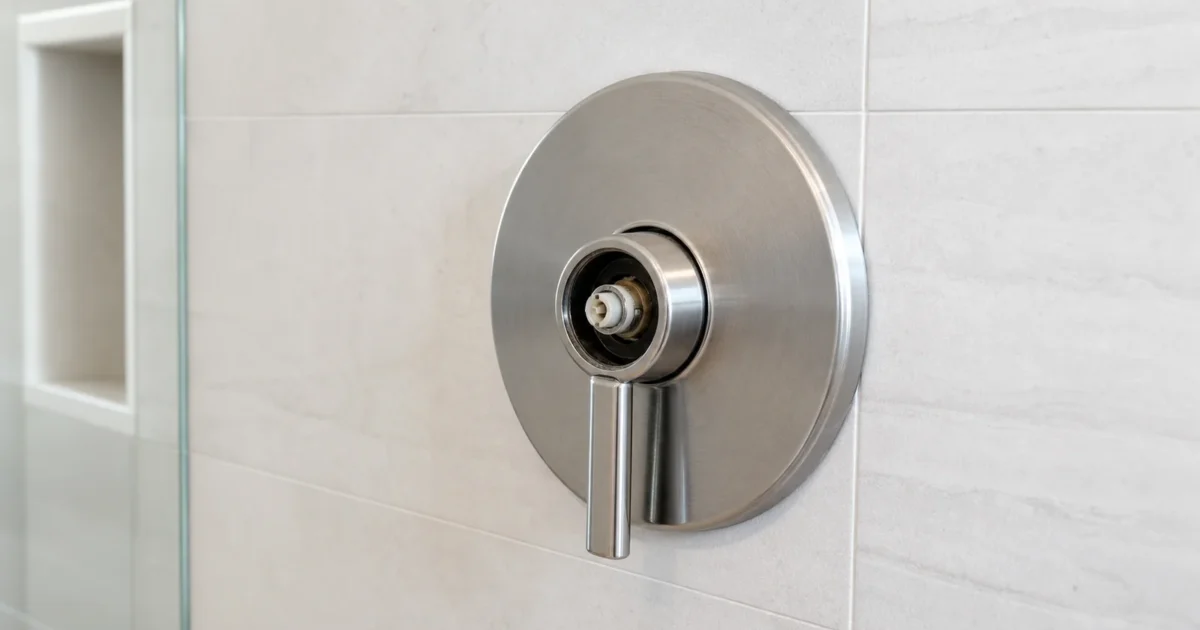
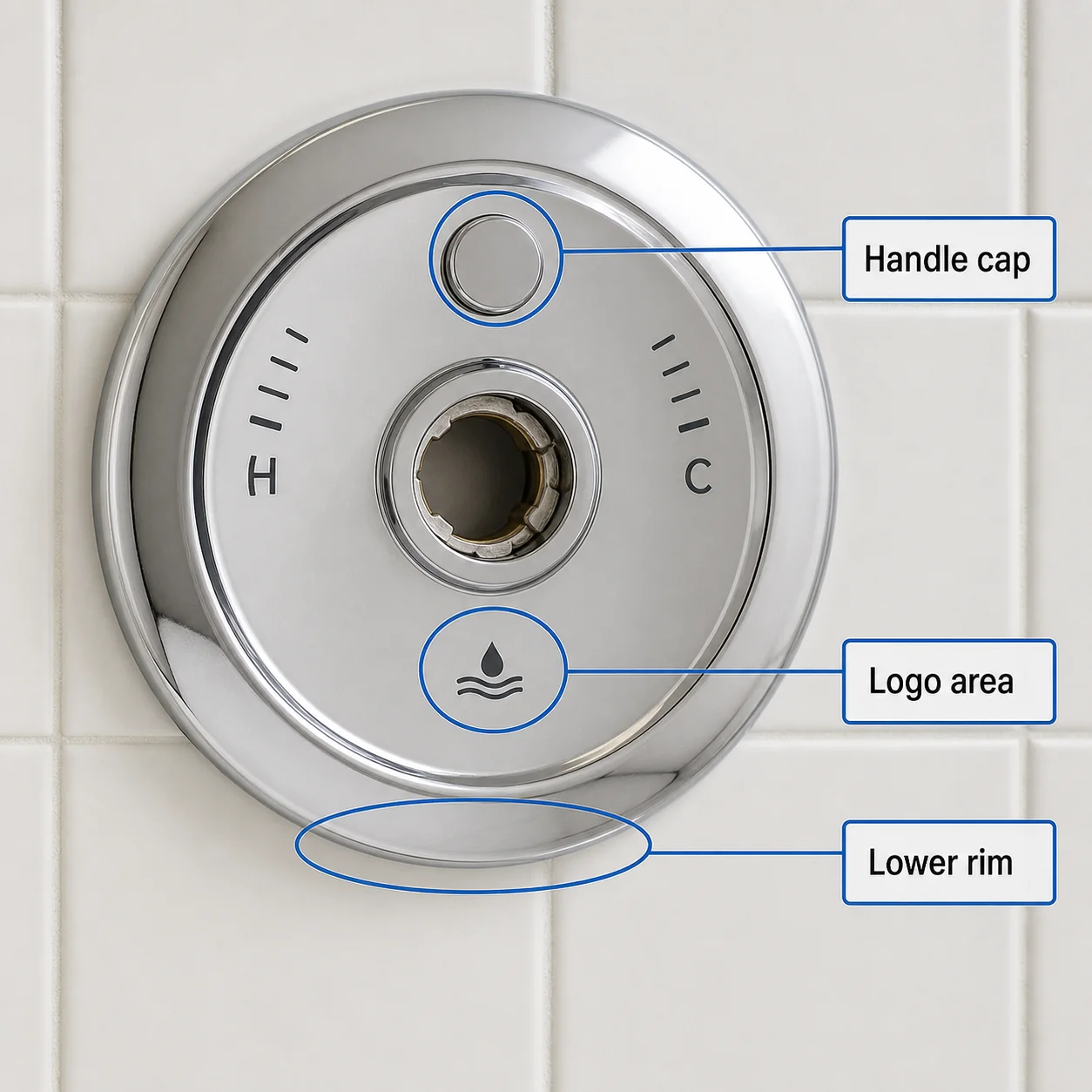
The fastest identification path doesn’t require shutting off the water. Start with the outside trim — the escutcheon plate, handle cap, and handle face — because the brand clue you need is usually there before any disassembly.
Every major manufacturer has built their parts workflow around the model number: Delta routes homeowners to the product detail page listing parts once the model is known; Kohler says identify the product, view the parts diagram, select the genuine part; Pfister routes through the packaging, instruction manual, filtered product search, or parts diagram before selecting a cartridge. The consistent message is that one visible model number or brand name saves more time than any workaround.
If the brand name is readable on the trim, go directly to that brand’s lookup tool (links in the section below). If it isn’t visible, work through the seven locations below in order — each one is faster than the next.
The 7 Places to Find Brand and Model Markings
Place 1 — Handle face, handle cap, or handle button. Many shower trims carry a brand mark on the handle assembly even when the escutcheon plate is plain. Delta’s parts path treats handle issues separately from cartridges, which is a signal that the handle is worth photographing before removal. Pfister navigation separates “Handle Options” from “Tub & Shower Trim Kits,” so a Pfister handle style can identify the trim family even when the in-wall valve still needs its own confirmation.
Place 2 — The escutcheon plate. Inspect the lower rim, the area around temperature markings, and any etched symbol near the handle opening. A fixture may carry only a small emblem — a circle with lines, a stylized letter — rather than a printed brand name. Treat any symbol as evidence, photograph it straight-on before polishing or disassembly, and search the description (“circle two lines shower faucet brand”) to find the manufacturer.
Place 3 — Under the escutcheon after removing handle and trim plate. Rough-in valves and trim adapters may expose cast marks, screw patterns, retaining clip designs, or cartridge-retaining hardware that identify the brand and generation. Kohler says model information can be stamped directly on the product, and Pfister says after identifying the faucet, the homeowner should open “Installation & Support” and use the parts diagram to select the cartridge.
Place 4 — Cartridge stem and body. This requires shutting off the water and removing the handle — it’s a later step, but the cartridge body often carries the most reliable ID. Look for a part number, a maker’s mark or a molded code on the body and the stem, and photograph every side before you set the cartridge down.
Place 5 — Original paperwork, packaging, or spec sheet. Kohler explicitly lists product packaging, literature, specification sheets, and stamped product markings as model-number sources. Pfister says the product model number is usually an eight-character code such as F-529-7AYY, displayed on the product package and instruction manual below the product name. If you have the original documentation, this is the most reliable method — no disassembly required.
Place 6 — Matching fixtures in the same bathroom. If the shower was installed as part of a coordinated bath suite, a sink faucet or tub spout from the same collection can confirm the brand — though not the shower valve’s specific generation or cartridge number. Use it as a brand clue, then verify with the valve’s own markings.
Place 7 — Cartridge packaging from a previous repair. Old receipts and cartridge packaging carry model numbers and retailer SKUs. The Home Depot listing for the Delta RP46074 shows the internet number, model number, and store SKU together — any one of those can reorder the same part. Note that some Pfister cartridges have been discontinued and superseded — the 974-0420 was replaced by a new part number — so an old package may require a cross-reference to confirm the current replacement.
Visual ID by Brand — What Each Shower Cartridge Looks Like
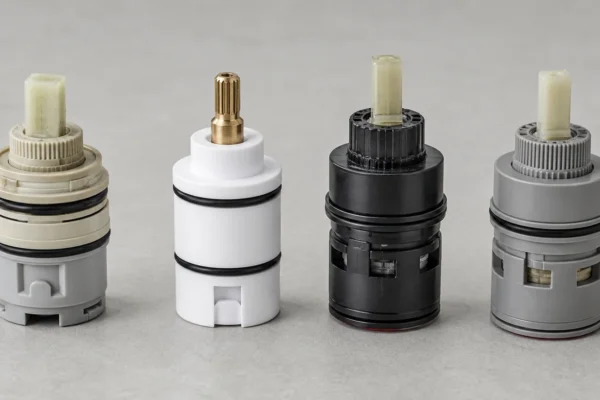
Once you have the cartridge out, these are the tells for each maker’s main cartridges. Where the maker documents one, it is quoted with a link; the rest is what the cartridge looks like in the maker’s own product photo.
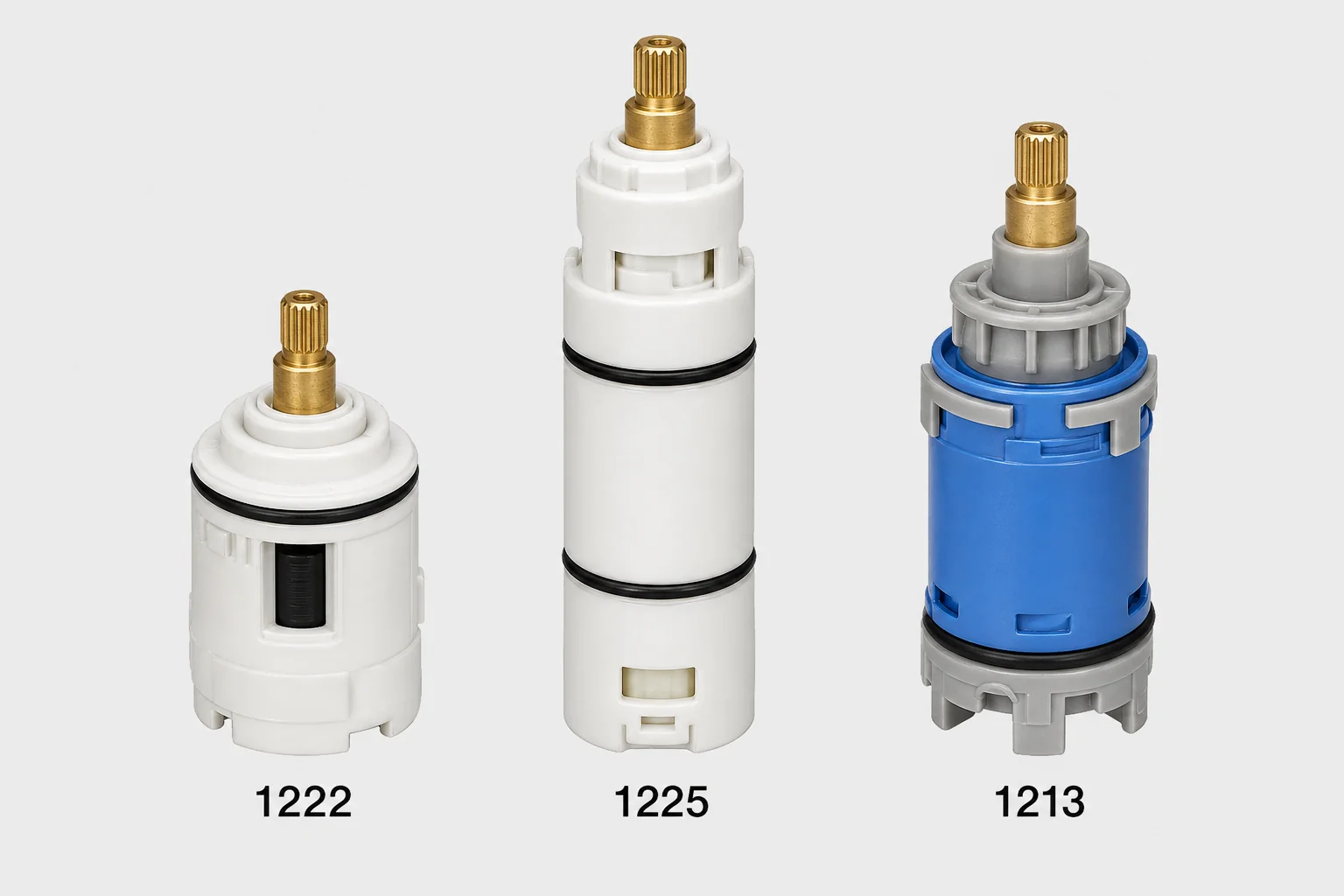
Moen: the handle narrows it down before anything comes out of the wall. Moen’s shower cartridge guide lists the 1222 for Posi-Temp valves, whose handle operation is “Rotate only”, and the 1225 for standard and Moentrol valves, whose handle is “Push/Pull-Off/On and Volume” and “Rotate to adjust temperature” (Moen: Faucet Cartridges: Shower). The Moen 1222 is Moen’s “Single-Handle Replacement Cartridge, Posi-Temp”. Out of the valve, it is a white plastic cartridge with a brass stem and a large black seal on one side. The Moen 1225 is Moen’s “One-Handle Replacement Cartridge”. It is a slim white cylinder with a brass stem and black seal bands. M-Core valves take their own cartridges. Moen’s M-Core guide lists “1212 (gray)” for the 2 Series, whose handle “Rotates only”, and “1213 (blue)” for the 3 Series, and says “the M-Core flow cartridge is included with the trim kit” (Moen: How to Identify Your M-Core Cartridge). Moen sells the 1213 as the M-Core Cartridge. It has a blue body, gray housing pieces and a brass-colored stem. So do not assume an M-Core trim takes a 1222 or 1225.
Delta: The RP46074 is Delta’s “Cartridge Assembly – MultiChoice® Universal – 13 / 14 Series”, for “MultiChoice® 13/14 Series tub & showers produced after March 2006”. In an answer on its RP19804 page, Delta calls it “The gray RP46074” and says the “blue and white Delta RP19804” fits only 1400 Series valves installed before 2006: “These cartridge are not interchangeable” (Delta RP19804). Out of the valve, it has a gray upper body over a white base with two inlet legs, and a brass stem. The cartridge includes an integrated rotational limit stop, which controls the temperature range and is another confirming feature when the body is out in your hand. For the full Delta lineup and how to tell the families apart by series and RP number, see how to identify your Delta cartridge.
Kohler: The K-28305-NA is Kohler’s “Rite-Temp® Thermostatic cartridge”. It is black, with an orange stem tip and orange seals, which makes it hard to confuse with anything else. Kohler’s other cartridges vary by valve, so photograph the cartridge body, including any molded marks or numbers, before reinstalling; those markings are the key lookup evidence for Kohler parts.
Pfister: The 974-0420 is Pfister’s “Cartridge for 0X8/JX8/VB8/JV8 Deep Casting Valve”, and its page now reads “Discontinued and Replaced By 974-5299”. It is gray, with a threaded upper body and an eared flange. Pfister lists a high-temperature limit stop and Pforever Seal as features — those functional details can help confirm a Pfister pressure-balance cartridge after removal. If you have a removed cartridge with no markings, Pfister’s support page says users can search directly by appearance using thumbnail images and dimensions for comparison.
American Standard: The M952100-0070A is American Standard’s “Temperature Control Pressure Balance Valve Cartridge”, “For use on R110, R120, R115, R125 rough-in valves”. It has a white body, a gray base and two green inlet seals. Because it fits several rough-in valves, you need to confirm the rough-in valve family, not just the cartridge appearance, to order the correct part. The rough-in valve family is the key lookup field for American Standard shower systems.
Matched your cartridge by sight? Get the exact replacement — confirm the model against your valve first:
As an Amazon Associate, plumbingbythebook earns from qualifying purchases. Links below are affiliate links — they cost you nothing extra.
Not sure which part you have? The cartridge finder narrows it to the exact part in a few questions.
Manufacturer Lookup Tools by Brand
Each manufacturer’s workflow is slightly different. Here’s what each tool does well and where it falls short.
Delta — Find Parts and Identify Your Product: Accepts a known product model number and routes directly to the product detail page listing that product’s parts. Also offers common-parts-by-issue navigation for homeowners who don’t have the model number. Limitation: without the model number, you navigate by symptom or category, which can surface multiple possible cartridge matches.
Moen — Faucet Finder / Identifier: Photo-based: the page opens with “Snap a photo to start unlocking your Moen benefits” and says “The Moen Identifier gives you the power to unlock the benefits of your Moen faucet.” Limitation: the tool is primarily oriented toward faucet (not shower valve) identification; a shower valve ID may still require cartridge photos or direct contact with Moen support.
Kohler — Service & Replacement Parts + KOHLER Scout: Offers a full “Find a Service Part” workflow plus KOHLER Scout — a beta photo ID tool that accepts an uploaded photo and attempts to identify the product model number. Limitation: Scout is marked beta, so treat its result as a starting point and confirm against the parts diagram before ordering.
Pfister — Parts & Support: Accepts a known product model number for parts and support information; also offers category filters by faucet type, finish, price, and style when the model number is unknown. Limitation: the support FAQ routes from faucet identification to “Installation & Support” and the parts diagram, so cartridge ID may take several steps.
American Standard — Parts Store: Organizes parts by category — toilet parts, bathroom faucet parts, bathtub parts, shower system parts, kitchen faucet parts. Limitation: shower cartridges must be matched to rough-in valve families, so browsing by category alone is not sufficient without the rough-in model number.
Before you order, use our free Repair Finder to cross-check your identified part number against confirmed compatible replacements — it’s the fastest way to avoid a wrong-cartridge purchase once you have a candidate model number.
Serial Numbers and Date Codes: What’s Actually Useful
Manufacturer pages for shower valves don’t publish a universal serial-number decoder. Delta, Kohler, Pfister, and Moen all route homeowners through model number, product photo, category filters, or parts diagrams — not a standardized serial format. Don’t build your identification strategy around an assumed format like “Moen YY-MM-XXXX” or “Delta YYYY production-week” — those require manufacturer confirmation to use reliably.
The defensible approach is to record every visible code exactly as printed, then search it with the brand name and product type. If a code doesn’t match a known model number directly, the safer query is “[brand guess] shower cartridge [code] photo” combined with the manufacturer’s support contact path.
Date codes are more useful than serial formats because they map directly to cartridge generations. Delta states that the RP46074 applies to MultiChoice 13/14 Series valves produced after March 2006 — so if your valve predates that cutoff, you’re working with a different generation. Kohler product photos sometimes show a date-like molded marking on the cartridge body; preserve that in your photos because it may help Kohler customer support distinguish between cartridge revisions.
When You Can’t Find the Brand — and When to Stop Searching
If all visible markings are gone, take three photo sets before buying anything: the full trim from straight-on, close-ups of the handle and escutcheon, and close-ups of the cartridge and valve body after safe disassembly. Moen’s Faucet Finder and Kohler Scout both accept uploaded photos for identification.
For cross-brand matching without a confirmed brand, Danco’s cartridge catalog filters by fit brand — American Standard, Delta, Kohler, Moen, Pfister, Symmons, Valley, and others — and the same page points to Danco’s StemFinder: “Find stem and cartridge sizes with the StemFinder”. Danco is useful for confirming a brand-matched part, but it is not a substitute for knowing the brand first.
Replace the whole trim or valve — don’t keep hunting — when: the brand cannot be established after all seven inspection points, the cartridge is discontinued and the maker names no replacement, the valve body is physically damaged, or the rough-in valve family can’t be confirmed (which creates American Standard mismatch risk).
Call a plumber for identification when: the cartridge cannot be accessed without shutting off the main water supply and your main shutoff is unreliable, the handle set screw is stripped, the cartridge is stuck, or the valve is behind finished tile. A 30-minute to one-hour identification visit typically runs $75–$150 in labor before local trip fees — based on plumber rate data from Fixr ($75–$150/hr average) and HomeGuide ($125–$350 for small jobs). That’s cheaper than two wrong cartridges and a third trip to the hardware store.
How to Identify Shower Valve and Cartridge: Quick Decision Tree
Work through these in order. Each step assumes the prior step gave no result.
-
Is there a visible brand name or logo on the handle, handle cap, or escutcheon? — Yes → Go directly to that brand’s lookup tool (links above) with any model number or product code you can read — No → Photograph the trim from straight-on and proceed to step 2
-
Does the cartridge body — after removing the handle — match a visual profile above? — Yes → Match to the brand’s official cartridge page to confirm the part number before ordering — No → Upload your photo to Moen’s Faucet Finder, Kohler Scout, or contact Pfister/Delta/American Standard support directly
-
Is there any code stamped or molded on the cartridge or valve body? — Yes → Search “[your brand guess] shower cartridge [code]” and cross-check on the manufacturer’s support page — No → Use Danco’s StemFinder or fit-brand cartridge filters to narrow by dimensions and broach shape
-
Do you have original paperwork, a purchase receipt, or old cartridge packaging? — Yes → The model number printed there is the most reliable lookup key — use it with the manufacturer’s search tool — No → If still unresolved after steps 1–3, call the manufacturer support line with your photos; a plumber can expose the valve in 30 minutes if that’s what it takes
Cartridge won’t budge? Most stuck cartridges come free once the retainer clip is fully out, and Moen publishes a tap-and-dowel procedure using about $25 of hardware that beats forcing it. A puller is only worth buying when the cartridge is genuinely seized — and the tool has to match your cartridge family, because “universal” mostly is not.
Which cartridge puller you actually need — and when to skip it starts with the 60-second check that tells you whether a tool is even in the picture.
What to Do Next
Once you’ve confirmed the brand and cartridge model, the repair path is specific. A Moen 1225 replacement involves a different pull force and retention clip approach than a Delta RP46074 swap — following the wrong procedure on the wrong cartridge damages the valve seat.
If you’re also trying to identify a kitchen or bathroom sink faucet rather than a shower valve, the same seven-location method applies to sink fixtures — see How to Identify Your Faucet Brand and Model for the sink-specific version. If your identified cartridge is leaking or the shower is dripping even after identification, Why Is My Faucet Leaking? walks through the diagnostic logic that follows.
How do I identify my shower valve without turning off the water?
Start with the visible trim — the handle face, handle cap, and escutcheon plate — before touching any plumbing. Most homeowners can confirm the brand from the outside trim alone. Only the cartridge model number requires removing the handle and, in most cases, shutting off the water at the local stop valve or main supply.
What is the difference between a shower valve and a shower cartridge?
The valve body is the permanent in-wall housing — brass or plastic — that connects to the hot and cold water supply lines. The cartridge is the replaceable insert inside the valve that controls flow and temperature. When a shower drips, won’t regulate temperature, or runs hot and cold erratically, the cartridge is typically the part that needs replacing; the valve body usually lasts the life of the home.
How do I know if I have a Moen 1222 or Moen 1225 cartridge?
Start with the handle. On these Moen valves, a handle that only rotates points to the Posi-Temp 1222, and one that pulls out for on/off and volume, then turns for temperature, points to the 1225; an M-Core valve moves the same ways but takes a 1212 or 1213. With the cartridge out, the 1222 is a white plastic body with a large black seal on one side, and the 1225 is a slim white cylinder with black seal bands. Confirm the number against the official Moen product page before ordering.
Can I use a generic or universal shower cartridge instead of the OEM part?
Generic cartridges like those in Danco’s fit-brand catalog can work, but only when the fit brand, dimensions, and cartridge type are confirmed to match. “Universal” does not mean compatible with every valve — it means the manufacturer tested it against several valve families within one brand. Confirm the match using Danco’s StemFinder or fit-brand filters before purchasing; the wrong cartridge in a pressure-balance valve affects scald protection.
What does the Delta RP46074 fit?
The Delta RP46074 is the MultiChoice Universal 13/14 Series cartridge, used in Delta tub/shower valves produced after March 2006. It is a Monitor single-function pressure-balance cartridge with an integrated rotational limit stop. If your valve predates March 2006, it likely takes a different cartridge: in an answer on its RP46074 page, Delta says “1400 series units manufactured prior to 2006 will use the RP19804” cartridge (Delta RP46074). Delta’s Find Parts page offers to “Identify your product model number” if you are not sure which valve you have.
When should I call a plumber just to identify my shower valve?
Call when the cartridge cannot be safely accessed without shutting off the main water supply and the main shutoff is unreliable, the handle set screw is stripped, the cartridge is stuck, or the valve is behind finished tile. A 30-minute identification visit typically costs $75–$150 in labor before trip fees — that’s still cheaper than purchasing two wrong cartridges on guesswork and making a third trip.
Sources
- Delta Find Parts and Identify Your Product
- Delta RP46074 MultiChoice Universal 13/14 Series Cartridge
- Moen 1222 Posi-Temp Cartridge
- Moen 1225 One-Handle Replacement Cartridge
- Moen 1213 M-CORE Cartridge
- Moen Faucet Finder / Identifier
- Kohler Service & Replacement Parts
- Kohler K-28305-NA Rite-Temp Thermostatic Cartridge
- Pfister Parts & Support
- Pfister 974-0420 Cartridge for 0X8/JX8/VB8/JV8 Deep Casting Valves
- American Standard M952100-0070A Pressure-Balance Valve Cartridge
- Danco Cartridge Catalog — Fit-Brand Filters
- Home Depot Delta RP46074 Listing
- Fixr Plumber Cost Guide
- HomeGuide Plumber Cost Guide
Educational content only. Not a substitute for licensed professional advice. Local plumbing codes vary by jurisdiction. Use of any guidance from this guide is at your own risk.
Get the homeowner’s plumbing repair toolkit checklist — the tools, parts, and decisions every homeowner should have on hand. [Free download — enter your email]
Parts for this repair
As an Amazon Associate, plumbingbythebook earns from qualifying purchases. Links below are affiliate links — they cost you nothing extra.
- Moen 1222 Posi-Temp Cartridge — OEM replacement for Moen Posi-Temp single-handle shower valves — confirm your model before ordering
- Moen 1225 One-Handle Cartridge — OEM replacement for Moen one-handle shower valves — confirm your model before ordering
- Delta RP46074 MultiChoice Cartridge — OEM Delta cartridge for MultiChoice 13/14 Series tub/showers made after March 2006
Related guides
Which Shower Trim Kits Fit Your Valve? How to Tell by Brand
You found a shower trim kit you like, in the right finish, from the right brand. It still…
Shower Cartridge Identification Chart: Every Major Brand in One Table [2026]
Shower Cartridge Identification Chart: Every Major Brand in One Table [2026] This shower cartridge identification chart puts nine…
![Title card for the article 'Should I Repair or Replace My Shower Valve? [2026]' on Plumbing By The Book](https://plumbingbythebook.com/wp-content/uploads/2026/08/article-99-hero-should-i-repair-or-replace-my-shower-valve-600x400.webp)
Should I Repair or Replace My Shower Valve? [2026]
Should I repair or replace my shower valve? For most homeowners, the honest answer is: repair the cartridge…