
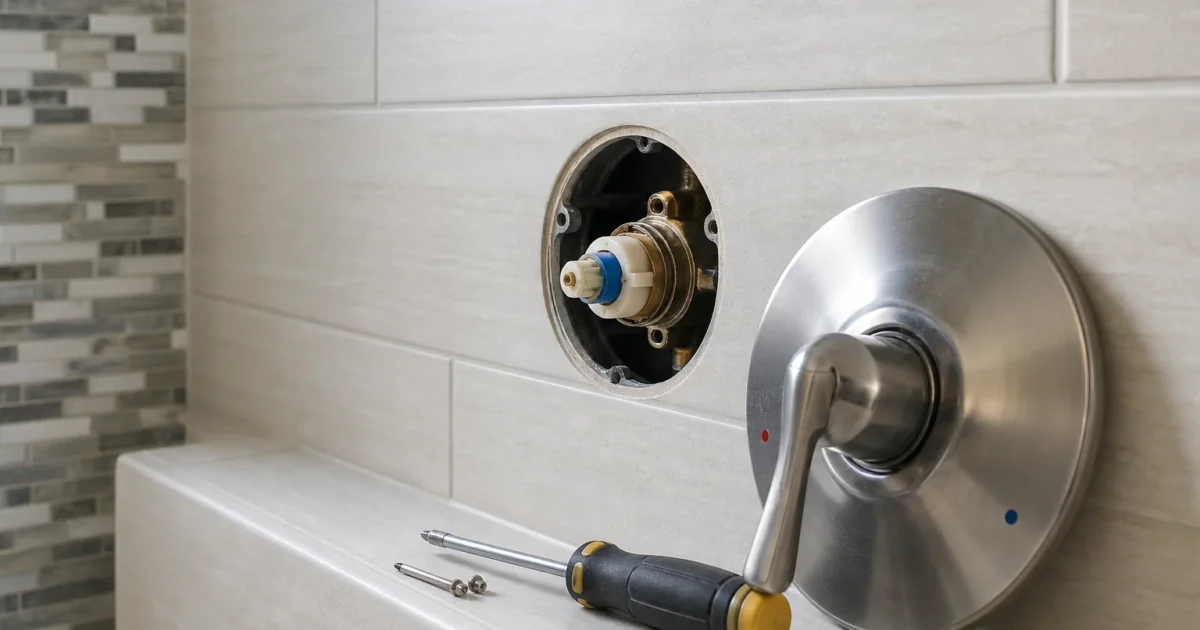
Why is my shower dripping even though the handle is fully off? It starts as background noise, but a single faucet dripping at roughly one drip per second wastes more than 3,000 gallons of water per year, according to EPA — enough to run a dishwasher 200 times. The good news is that most shower drips have only five common causes, and three of them are straightforward DIY repairs that don’t require opening walls.
If the leak is the valve body rather than the cartridge, here is what a shower valve replacement costs.
This article walks through each cause in diagnostic order — starting with a quick test you can run before touching a tool — so you know exactly what you’re dealing with before you order a part or call a plumber.
Why Is My Shower Dripping? Start With When and Where
The fastest way to narrow down the cause is to ask two questions: when does the drip happen and where is the water coming from?
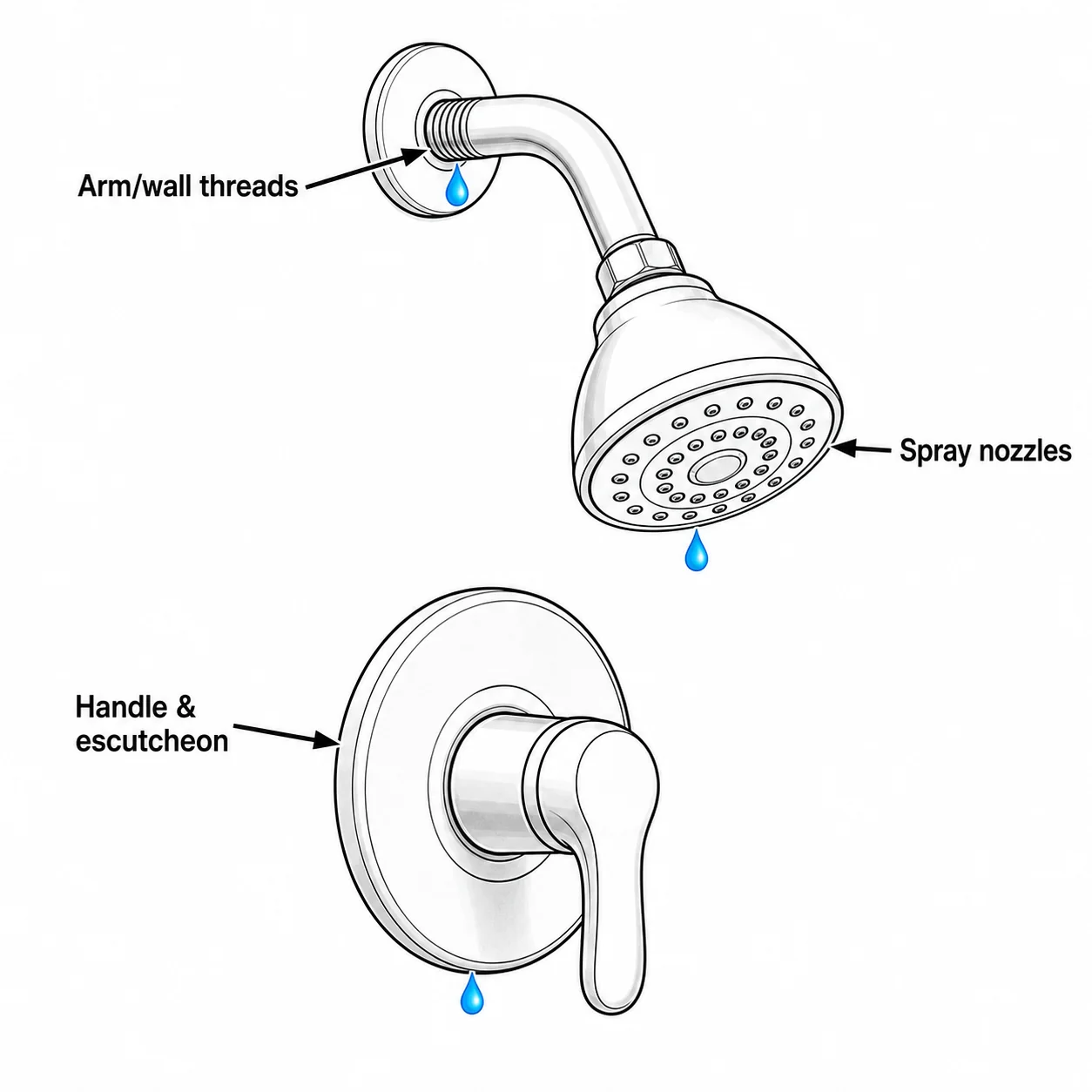
When: A drip that continues after the handle is fully off — and keeps going longer than it takes the showerhead to drain after shutoff — almost always traces to the valve cartridge inside the wall. Moen’s PosiTemp leaking guide and Moentrol leaking guide both map continuous off-position dripping directly to cartridge replacement. A drip that appears only while the shower is running — and stops when the system drains — is more likely a loose connection, a worn washer, or a shared-flow problem in a tub/shower combo.
Where: Water at the showerhead nozzles with the handle off → cartridge is the primary suspect. Wetness at the threaded joint between the shower arm and showerhead while the water is running → connection or washer issue. Water at the handle or escutcheon plate → still cartridge-side, but if you can see wall staining or the wetness is coming from behind the trim rather than at the handle, stop — that’s a behind-the-wall leak and a job for a licensed plumber.
Cause 1: A Worn Shower Valve Cartridge, Washer, or Gasket
This is the most common answer to why is my shower dripping with the handle off — and the first fix listed in Moen’s official troubleshooting tables for both PosiTemp and Moentrol systems.
The mechanism is simple: a single-handle shower valve controls flow and temperature through a cartridge that slides or rotates against an internal seal. Over years of use, that seal wears down, accumulates mineral scale, or traps debris — and water passes through even when the handle says “off.” Faucets fail the same way: EPA notes that old and worn faucet washers and gaskets frequently cause leaks in faucets.
The correct replacement cartridge depends on which Moen valve you have:
- PosiTemp valve → Moen 1222 cartridge
- Moentrol valve → Moen 1225 or 1200 cartridge
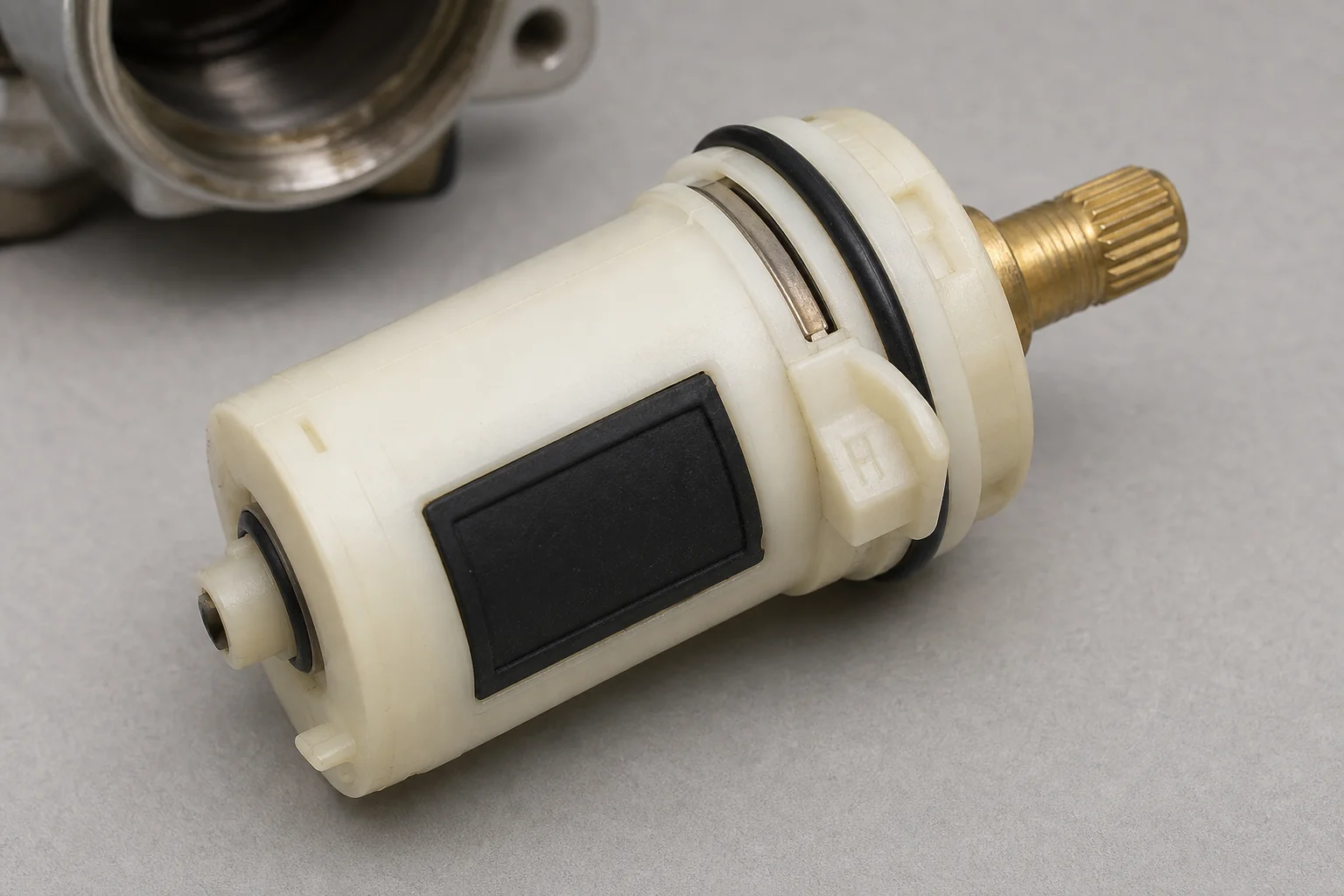
Moen’s 1222 procedure (from their official cartridge guide): shut off the water supply, remove the retaining clip, twist and pull the cartridge out, clean and flush the valve body of debris, lubricate the new cartridge’s seals, insert the 1222 with the H tab facing up, and reinstall the retaining clip until it clicks. If the retaining clip won’t seat or is damaged, Moen is direct: do not turn the water back on. That is the point where a plumber replaces a DIY cartridge swap.
Before you order, confirm which valve family you’re dealing with — find your exact shower cartridge with our free Repair Finder so you don’t make a wasted trip. Installing a 1222 in a Moentrol valve (or vice versa) will not stop the drip.
DIY difficulty: moderate. The repair is fully accessible from the trim side without opening walls, but a stuck cartridge, a broken retaining clip, or the wrong part warrants calling a plumber rather than pushing through.
Cause 2: A Loose Showerhead Connection or Failed Washer
If the wetness appears at the threaded joint between the shower arm and the showerhead — especially while the water is running, not after shutoff — the problem is likely outside the wall, not inside it.
EPA’s Fix a Leak Week guide describes this as one of the easier showerhead repairs: tighten the connection between the showerhead and pipe stem, apply pipe tape to the threads, and check or replace the rubber washer or O-ring inside the showerhead. Total material cost is typically $3–$10.
The quickest diagnostic: wrap a dry tissue or paper towel around the shower arm threads and run the shower briefly. Wetness at the joint confirms the connection is the source — not the cartridge. If the tissue stays dry and the drip comes from the showerhead nozzles after shutoff, the problem is the cartridge.
Escalate if the shower arm itself moves in the wall when you tighten the showerhead, the pipe threads are visibly stripped, or water appears behind the escutcheon — those signs move the problem from a surface seal to the in-wall plumbing path.
Cause 3: Tub Spout Diverter or “Stacking” — Shared Flow
Stacking is common enough that Moen publishes a dedicated guide for it — and it is frequently mistaken for a cartridge leak because the symptom looks similar at first glance.
Moen’s stacking guide defines stacking as “a steady stream from the showerhead while the tub is filling” and says it is “generally found in new installations” in tub/shower combination setups. The critical distinction: stacking occurs while the system is operating (tub spout running), whereas a cartridge leak begins after the handle is shut off. If your showerhead flows only while the tub spout is running — not after shutoff — diagnose stacking, not a worn cartridge.
The mechanism is excess restriction between the valve and the tub spout outlet. Moen identifies several causes: a partially blocking diverter gate, debris or damage in the tub spout, incorrect piping height, multiple elbows or adapters that slow flow, and upside-down valve installation. Water backs up and exits through the shower outlet rather than the tub.
Moen’s recommended test: remove the tub spout entirely. If the showerhead flow stops, replace the tub spout. If the flow continues without the tub spout, the problem is in the rough-in piping — outlet spacing, adapters, elbows, or valve orientation — and that is plumber territory.
DIY difficulty ranges from easy (swap the tub spout, $15–$40) to hard (correct outlet spacing, re-pipe the tub outlet, or reinstall an upside-down valve).
Cause 4: High or Fluctuating House Water Pressure
High pressure is rarely the only cause of a dripping shower on its own — but it can push a marginal cartridge or worn gasket past its failure point, and it is the most likely explanation when the drip worsens at night or when multiple fixtures in the house start leaking at the same time.
Residential plumbing is designed for 40–80 psi. The Spruce’s pressure-regulator guide notes that pressure above 80 psi can damage valves, faucets, appliances, pipes, and fittings throughout the home. Municipal pressure often rises at night when neighborhood demand drops — so a drip that gets worse after midnight or tests higher at 6 a.m. than at 6 p.m. is a pressure red flag.
Testing is inexpensive: a hose-bib pressure gauge costs $10–$15 at any hardware store. Check at different times of day; readings that swing 20+ psi between morning and late night suggest pressure-regulator trouble.
The fix is to adjust or replace the pressure-reducing valve (PRV) near the main shutoff. The Spruce recommends calling a plumber for a new PRV installation unless you’re experienced at plumbing work, and its installation steps include soldering threaded couplings onto the pipe with a blow torch. Cost framing: The Spruce’s pressure-regulator guide puts a regulator at about $50 to $100 (up to $200, depending on the size of the incoming water line) and a plumber’s installation at $250 to $450 on average.
Cause 5: Wrong Cartridge, Wrong Valve Family, or Installation Error
A correctly diagnosed cartridge problem still fails if the wrong part is installed. Moen’s tub and shower identification guide says “identification is required to ensure the correct repair parts are ordered”, and its M-Core valve guide separates the M-Core 2 and 3 Series by cartridge. Not every family takes its own cartridge: Moen lists the 1225 for both its Standard valve and its Moentrol valve. These four families each take a different one:
| Valve family | Cartridge |
|---|---|
| PosiTemp | 1222 |
| Moentrol / legacy Moentrol | 1225 or 1200 |
| M-Core 2 Series | 1212 |
| M-Core 3 Series | 1213 |
Moen uses handle operation, escutcheon screw position, and installation era to distinguish them. A PosiTemp handle rotates; a Moentrol handle pulls in and out for volume control; an M-Core uses a push-button on the handle. Installing a 1222 in a Moentrol valve won’t stop the drip — it just delays the right diagnosis.
Installation errors cause the same result: a cartridge seated upside-down (H tab facing down instead of up) produces hot/cold reversal; a cartridge not fully seated causes a continued drip; a retaining clip that won’t close means the old cartridge wasn’t fully removed and the new one isn’t seating correctly.
If you replaced the cartridge and why is my shower dripping is still your question — go back to valve identification before buying another part. Our guide to how to identify your shower valve and cartridge covers all four Moen families plus Delta, Kohler, and Pfister, with the visual cues for each.
The Symptom-to-Cause Shortcut
| Symptom | Most likely cause | First check |
|---|---|---|
| Drips continuously after handle is fully off | Worn cartridge | Identify valve family, order correct cartridge |
| Drips at arm-to-showerhead threads while running | Loose connection or failed washer | Tissue test at arm threads; pipe tape + washer fix |
| Showerhead flows while tub spout is running | Stacking / shared flow | Remove tub spout and retest |
| Drip worsens at night; multiple fixtures leaking | High water pressure | Hose-bib gauge test; PRV inspection |
| Drip remains after cartridge replacement | Wrong cartridge or installation error | Re-identify valve family; confirm H tab orientation |
| Water behind handle or escutcheon; wall staining | In-wall leak | Stop DIY — call a licensed plumber |
What to Do Next
If your drip is a classic off-position showerhead drip, the fastest path is: confirm the valve family, order the correct cartridge (1222 for PosiTemp, 1225 for Moentrol), follow Moen’s trim-side procedure, and confirm the retaining clip is seated before turning the water back on.
If the drip is at the showerhead connection, start with a roll of pipe tape before buying any parts. EPA says some leaky showerheads can be fixed by tightening the connection between the showerhead and the pipe stem and securing it with pipe tape, and that for more complicated valve leaks in showers that drip when not in use you should contact an experienced handyperson or licensed plumber.
For the full picture on everything a shower can fail to do — low pressure, temperature swings, a broken diverter, slow drains — the Shower Repair Guide covers the complete Pillar 3 cluster and points to the right article for each symptom.
If none of the five causes match your situation — water is visible behind the wall, shutoffs don’t work reliably, multiple fixtures started leaking overnight — stop and call a licensed plumber.
Why is my shower still dripping after I replaced the cartridge?
The three most common reasons: the wrong cartridge was installed (a PosiTemp needs the 1222; a Moentrol needs the 1225), the cartridge was inserted with the H tab facing down instead of up, or debris was left in the valve body. Before installing the new cartridge, flush the valve body and confirm the retaining clip clicks fully into place after installation.
How much does it cost to fix a dripping shower?
Home Depot listed Moen’s 1225B cartridge at $29.98 and Moen’s 1222 at $71.68 in October 2026; check current pricing before ordering. A showerhead connection fix costs $3–$10 in pipe tape and a replacement washer. If you call a plumber, HomeAdvisor’s plumber cost guide puts most plumber bills between $182 and $501, $341 on average, and says service-call fees of $100 to $250 usually include the first hour of work.
Can I fix a dripping shower myself?
For a showerhead connection leak — yes, it’s an easy DIY fix with pipe tape and a washer. For a cartridge replacement — yes, with moderate DIY skill and working shutoff valves. For an in-wall leak, stacking caused by rough-in errors, or pressure-regulator installation — those are plumber jobs.
How do I know if the drip is the cartridge or just the showerhead connection?
Turn the shower fully off, dry the showerhead and arm, and wait 60 seconds — long enough for trapped water to drain from the head. If water keeps dripping from the nozzles after that, the cartridge is the likely cause. If wetness appeared only at the arm threads while the shower was running, the connection is the issue.
Why is my shower dripping more at night than during the day?
Municipal water pressure typically rises at night when neighborhood demand drops. A drip that worsens overnight suggests that elevated pressure is pushing past a marginal cartridge or gasket — check pressure with a hose-bib gauge, especially between midnight and 6 a.m. Pressure above 80 psi warrants a pressure-reducing valve inspection.
Sources
- Moen PosiTemp Valve Leaking — Official Troubleshooting Guide
- Moen Moentrol Valve Leaking — Official Troubleshooting Guide
- Moen 1222 Cartridge Replacement — PosiTemp Single Handle Shower
- Moen 1225 Cartridge Replacement — Moentrol Single Handle Shower
- Moen Stacking / Shared Flow Guide
- Moen Tub and Shower Systems Identification Guide
- Moen M-Core Valve Identification Guide
- EPA WaterSense: Fix a Leak Week
- The Spruce: Water Pressure Regulator — When and How to Replace
- The Spruce: How Much Does a Plumber Cost?
- Home Depot: Faucet Cartridges — Current SKU and Pricing
- Lowe’s: Faucet Cartridges — Current SKU and Pricing
Educational content only. Not a substitute for licensed professional advice. Local plumbing codes vary by jurisdiction. Use of any guidance from this guide is at your own risk.
Get the homeowner’s plumbing repair toolkit checklist — the tools, parts, and decisions every homeowner should have on hand. [Free download — enter your email]
Parts for this repair
As an Amazon Associate, plumbingbythebook earns from qualifying purchases. Links below are affiliate links — they cost you nothing extra.
- Moen 1222 PosiTemp Shower Cartridge — OEM replacement cartridge for Moen PosiTemp single-handle shower valves — the standard fix for continuous off-position dripping or a handle leak on the most common single-handle shower valve in U.S. homes.
- Moen 1225 Moentrol Shower Cartridge — OEM replacement cartridge for Moen Moentrol and legacy Moentrol single-handle shower valves — confirms the drip fix when the valve pulls in and out rather than rotating.
Related guides
Which Shower Trim Kits Fit Your Valve? How to Tell by Brand
You found a shower trim kit you like, in the right finish, from the right brand. It still…
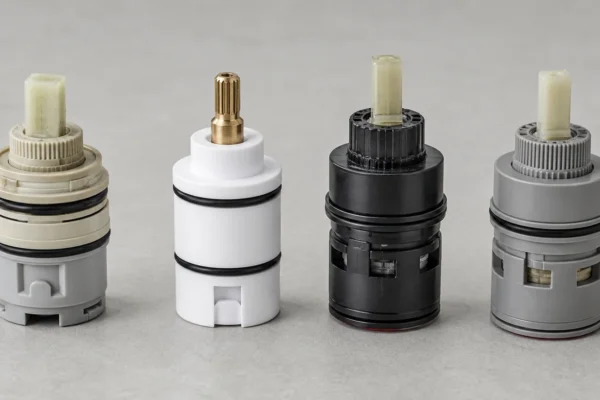
Shower Cartridge Identification Chart: Every Major Brand in One Table [2026]
Shower Cartridge Identification Chart: Every Major Brand in One Table [2026] This shower cartridge identification chart puts nine…
![Title card for the article 'Should I Repair or Replace My Shower Valve? [2026]' on Plumbing By The Book](https://plumbingbythebook.com/wp-content/uploads/2026/08/article-99-hero-should-i-repair-or-replace-my-shower-valve-600x400.webp)
Should I Repair or Replace My Shower Valve? [2026]
Should I repair or replace my shower valve? For most homeowners, the honest answer is: repair the cartridge…