An original Plumbing By The Book data study · by Thomas Kwayne · June 2026 · free to cite with attribution (CC BY 4.0)
“Should I learn to fix this myself, or call a plumber?” The honest answer is not the same for every problem. So we crossed two of our own datasets to find the repairs that are genuinely worth learning: how often homeowners actually run into each fixture (from 10,301 real plumbing questions) against how much you save doing it yourself (from our meta-analysis of 14 common repairs). The repairs that are BOTH common AND clearly DIY-friendly are the ones to learn first.
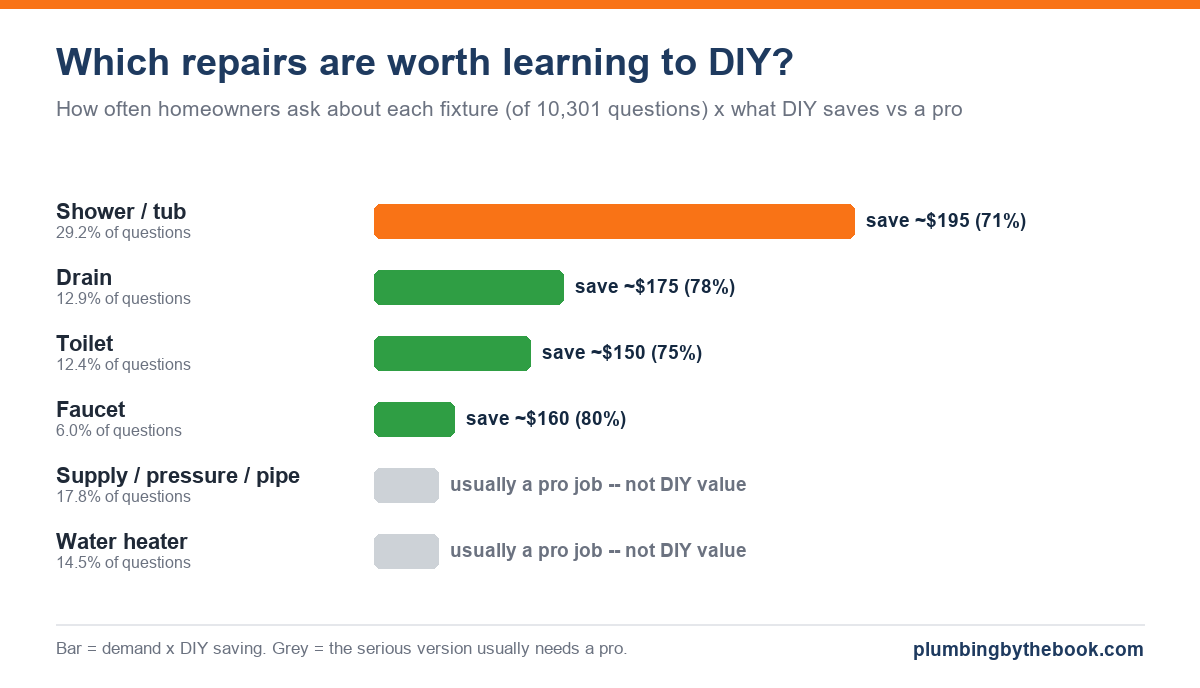
The single highest-value DIY plumbing skill is the shower/tub valve cartridge swap: it is the most-asked-about fixture (29.2% of 10,301 questions) AND it saves about $195 (71%) versus a pro. Learn just 4 repairs — Shower / tub, Drain, Toilet, Faucet — and you cover 60% of what homeowners actually ask about, each saving $150–$195.
The repairs worth learning, ranked by DIY value
We rank by a simple, transparent DIY-value: how often the fixture comes up × how much DIY saves on its common repair. The higher the bar, the more total value there is in learning it.
Most of what homeowners ask about is DIY-friendly
Of the fixtures we could map to a specific repair, 60% of all questions are about ones whose common repair is clearly DIY-friendly (Shower / tub, Drain, Toilet, Faucet). Another 32% — water heaters and supply/pipe problems — are the “sometimes DIY, often a pro” category: an element swap or a small leak can be DIY, but a tank replacement, a burst pipe, or a main sewer line is genuinely a pro job (gas, code, water damage).
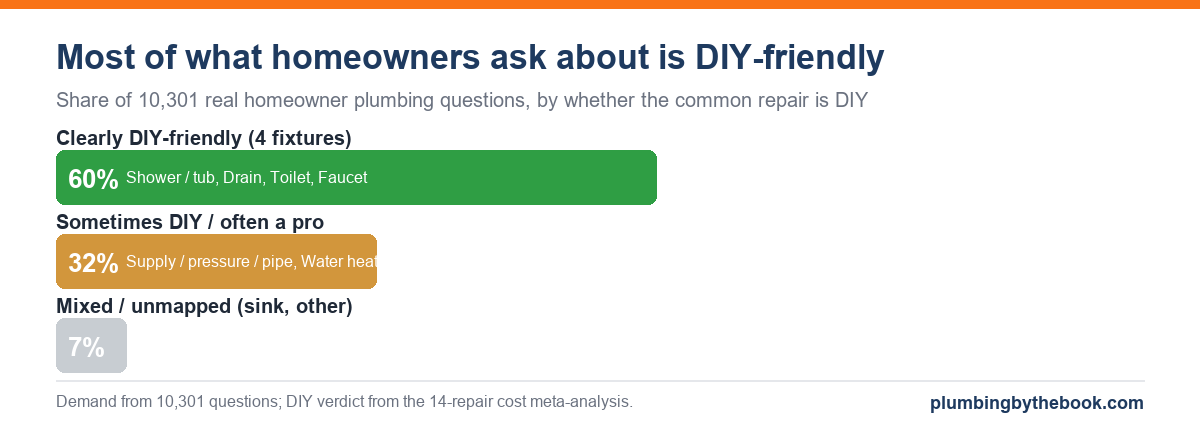
The honest flip side: the high-demand water-heater and pipe problems (32% of questions) are where DIY gets risky. High demand does not mean “learn to DIY it” — for those, knowing WHEN to call a pro is the skill.
The full mapping (every number is traceable)
Here is exactly how each fixture maps to a repair, its demand share, its DIY verdict, and its conservative saving — so you can check the work:
| Fixture (demand) | Share of questions | Common repair | DIY? | Conservative saving |
|---|---|---|---|---|
| Supply / pressure / pipe | 17.8% | Leaky pipe repair | Sometimes DIY | — |
| Shower / tub | 29.2% | Shower / tub valve cartridge replacement | Usually DIY | ~$195 (71%) |
| Water heater | 14.5% | Water heater repair (element / thermostat / valve) | Sometimes DIY | — |
| Drain | 12.9% | Clear a clogged drain (sink / tub / shower) | Usually DIY | ~$175 (78%) |
| Toilet | 12.4% | Toilet repair (running toilet / flapper / fill valve) | Usually DIY | ~$150 (75%) |
| Faucet | 6.0% | Faucet repair (cartridge / washers / O-rings) | Usually DIY | ~$160 (80%) |
What to learn first
If you want the most leverage for the least learning: start with the four clearly-DIY repairs. A shower/tub cartridge, a running toilet, a dripping faucet, and a clogged drain are the highest-frequency, highest-saving, lowest-risk fixes. The #1 blocker on those is usually identifying the right part — which is why we built a free Cartridge & Valve Finder and a Repair Cost Estimator.
Methodology & honesty notes
What this is: a cross of two of our own already-published, already-verified original datasets — it invents no new numbers. DEMAND comes from our 10,301-question study (15 years of the DIY Stack Exchange, by fixture). SAVINGS comes from our 14-repair cost study (a meta-analysis of 11 US cost guides; the saving is conservative — typical pro total minus the high end of DIY parts). We map each fixture to its single most-common repair (the mapping is shown in full above), then compute DIY-value = demand × saving.
What this is not: a claim that every instance of a fixture is the DIY version. A clogged sink trap is DIY; a collapsed sewer line is not — so we flag the “sometimes/pro” fixtures and never count them as clearly-DIY. “Sink” and “other” questions (7%) do not map cleanly to one repair and are reported separately, not forced. Demand is from public Q&A (a DIY-leaning audience), so it reflects what DIYers ask about, which is exactly the relevant population for “is this worth learning.”
License: free to cite and reuse with attribution to Plumbing By The Book (CC BY 4.0). Suggested citation: Kwayne, Thomas. “Which Plumbing Repairs Are Actually Worth Learning to DIY? A 2026 Data Study.” Plumbing By The Book, 2026. https://plumbingbythebook.com/plumbing-diy-value-study/
Key findings (free to cite with a link)
Cite this study
Free to cite with a link to plumbingbythebook.com. Three ready formats:
Plain text
HTML
APA
Embed a chart (free, please keep the credit)
For journalists
Author: Thomas Kwayne, editorial voice of Plumbing by the Book -- researched, spec-checked DIY guidance (not a licensed plumber). Guides + studies are researched and drafted with AI tools and checked against manufacturer specifications and published standards.
Method: A cross of two prior original datasets: the demand for each plumbing fixture (10,301 real homeowner questions, 15 years of the DIY Stack Exchange) times the conservative DIY-vs-pro saving for the common repair of each (a meta-analysis of 14 repairs across 11 US cost guides). A transparent fixture-to-repair mapping (shown in full on the page) yields a DIY-value = demand x saving. Not a new survey; the "sometimes / pro" fixtures (water heaters, pipes) are flagged, not counted as DIY. Free to reuse with attribution (CC BY 4.0).
Charts and stats are free to use with a link to https://plumbingbythebook.com/plumbing-diy-value-study/. Questions / the underlying classification rules: via the contact page.