
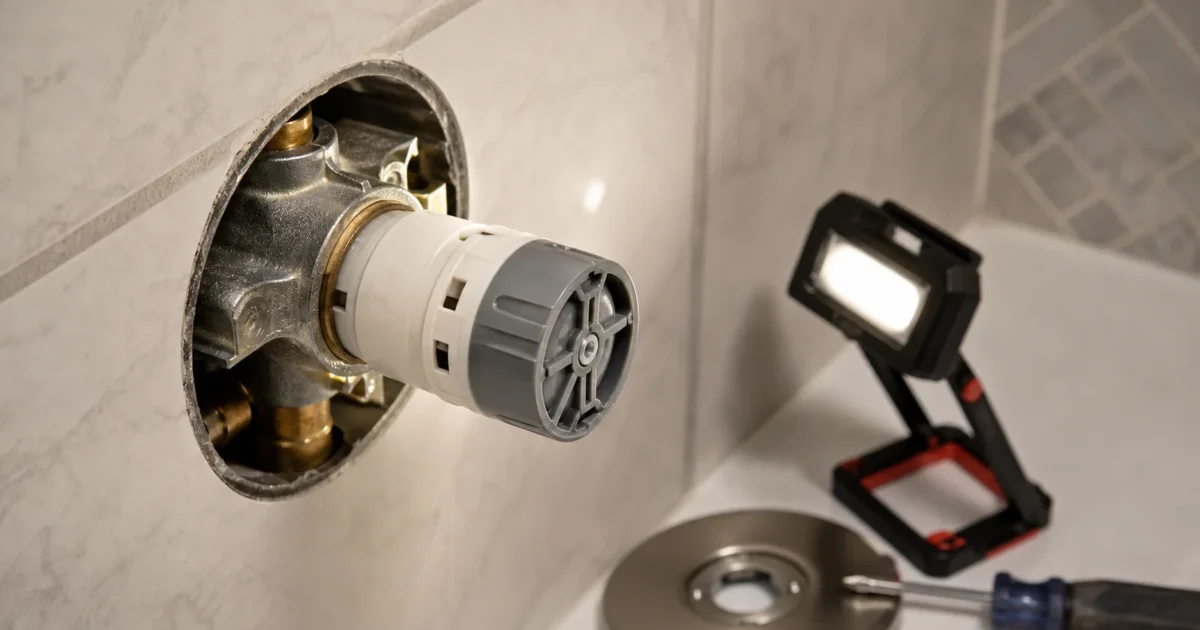
How to Identify Your Gerber Shower Valve [2026]
How to identify your Gerber shower valve comes down to one thing: finding the series before you buy a cartridge. Gerber’s single-handle pressure-balance valves use four different, non-interchangeable cartridge families — and several of them look nearly identical from the outside. A cartridge that fits a 49-300 series body will not seat in a Safetemp or GH-300 body. The good news is that Gerber valves leave enough markings to identify the series without professional help, as long as you check them in the right order. Here is that order — from easiest and least invasive to most thorough.
How to Identify Your Gerber Shower Valve: Why the Series Is the Whole Job
Gerber single-handle shower valves use a pressure-balance, ceramic-disc design — the cartridge sits inside the valve body, controls both water mix and flow, and is the part that wears and causes temperature swings or drips. Four cartridge families cover the full production run from the 1990s through today:
- 49-300 series → 97-510 ceramic-disc cartridge
- 49-400 / 49-700 Safetemp series → 97-022 Safetemp assembly (with 97-014 element + 92-294 temperature-limit stop)
- GH-300 platform → 97-231 (GH-301 trim) or 97-232 (GH-305 trim) — same platform, different cartridges, not interchangeable with each other
- Treysta (current generation) → GA510015 ceramic-disc cartridge, “one cartridge fits all” within the Treysta family
The common mistake is searching “Gerber shower cartridge” on a marketplace and ordering whatever looks right. These are series-specific parts. This article walks through the identification process in order — stop at whichever step gives you the answer and buy the right part the first time.
Before you head to a hardware store, use our free Repair Finder — enter the model number or series and it returns the confirmed cartridge part number.
Identified your Gerber series above? Confirm the exact cartridge before you buy — Gerber uses four non-interchangeable cartridge families, and several look nearly identical:
As an Amazon Associate, plumbingbythebook earns from qualifying purchases. Links below are affiliate links — they cost you nothing extra.
- Gerber Treysta Ceramic Disc Cartridge GA510015
- Gerber 97-510 Ceramic Disc Cartridge (49-300 Series)
- Gerber 97-022 / 97-014 Safetemp Pressure-Balance Assembly (49-400/700 Series)
Not sure which part you have? The faucet & valve finder narrows it to the exact part in a few questions.
Method 1: Check the Handle Canopy Label (No Tools, No Water Shutoff)
This is the fastest step and works on most Gerber valves installed after 2010 — no water shutoff, no tools beyond a screwdriver.
Gerber and Danze-by-Gerber products have carried a small adhesive model-number label since around 2010. The most common location is the underside of the handle canopy — the dome or cap that sits directly behind the handle, against the wall. To read it: pop or unscrew the decorative handle (most Gerber single-handle trims have a small set screw under the lever or a snap-off index button on the front face), slide the handle off the stem, and look at the back face of the canopy and the wall side of the trim plate. A label there will print a model number — a “G00…” item number on current Gerber trim, or a “D-” or four-digit number on older Danze-branded trim. (Gerber USA support, “Where can I find the model number of my Gerber faucet?”)
That model number is your best identifier. Enter it at the Gerber USA support and parts site or at gerberparts.com and you’ll get an exploded diagram with the cartridge part number called out by name.
If the label is there and legible, you’re done. Write down the model number, look up the cartridge, confirm the part number printed on the listing matches your series, and order.
If the label is gone, worn, or absent — common on valves installed before 2010 — move to Method 2.
Method 2: Pull the Cartridge and Read the Cap Color
The cartridge itself is the most definitive identifier, because it’s the exact part you’re replacing. This step requires shutting off water to the shower (via access-panel stops behind an adjacent wall, or the home’s main shutoff), removing the handle and escutcheon, and unscrewing the bonnet nut that retains the cartridge.
With the cartridge in hand, check three things:
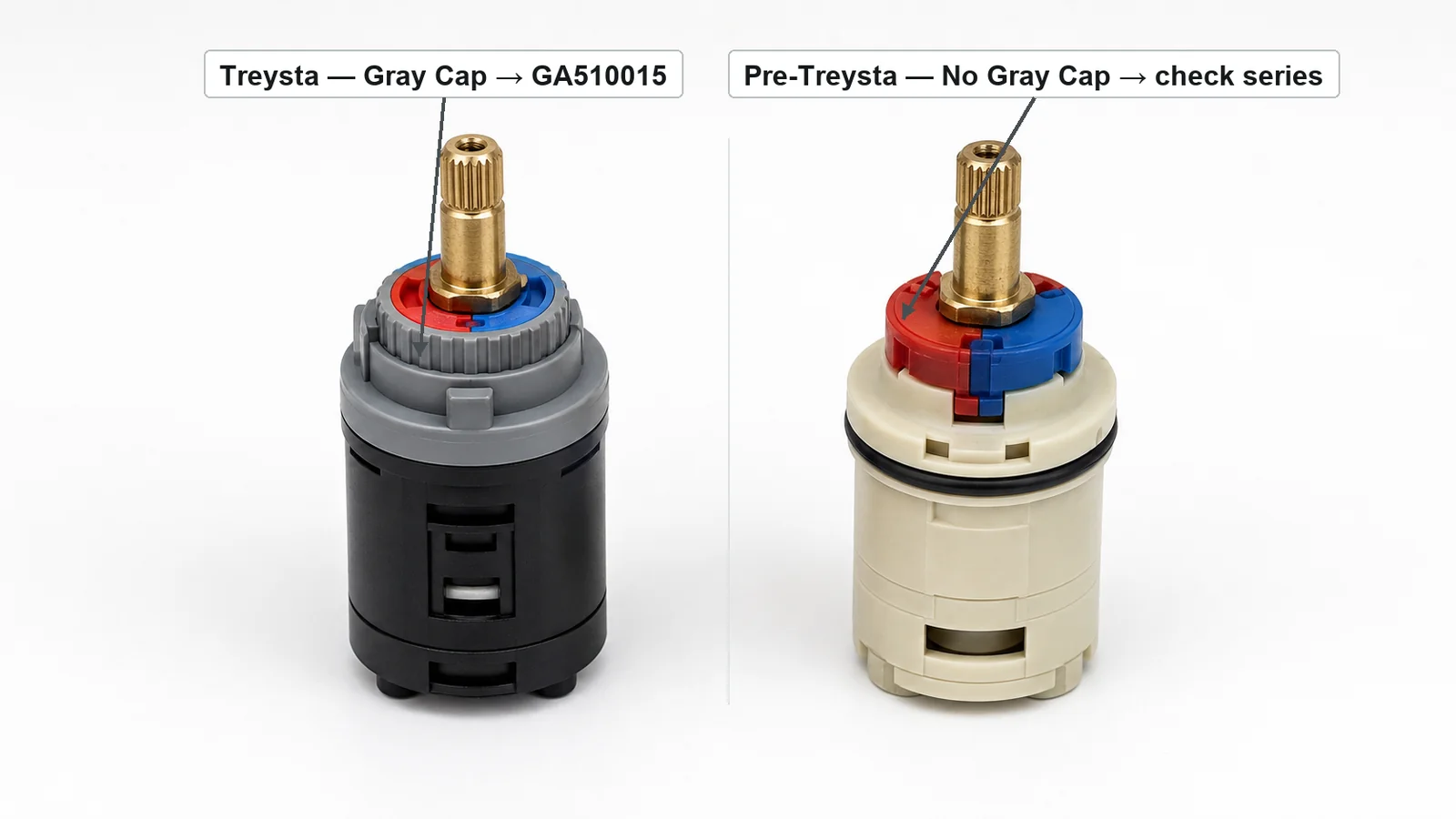
1. Cap color — the single best visual tell. A gray cap means Treysta generation — full stop. Gerber publishes this as the official visual indicator: a gray-capped ceramic cartridge is a GA510015 Treysta replacement regardless of which Treysta body it came from. An older cartridge from any other series will not have that gray cap. (Gerber USA, “How to identify old ceramic cartridge vs. new Treysta”)
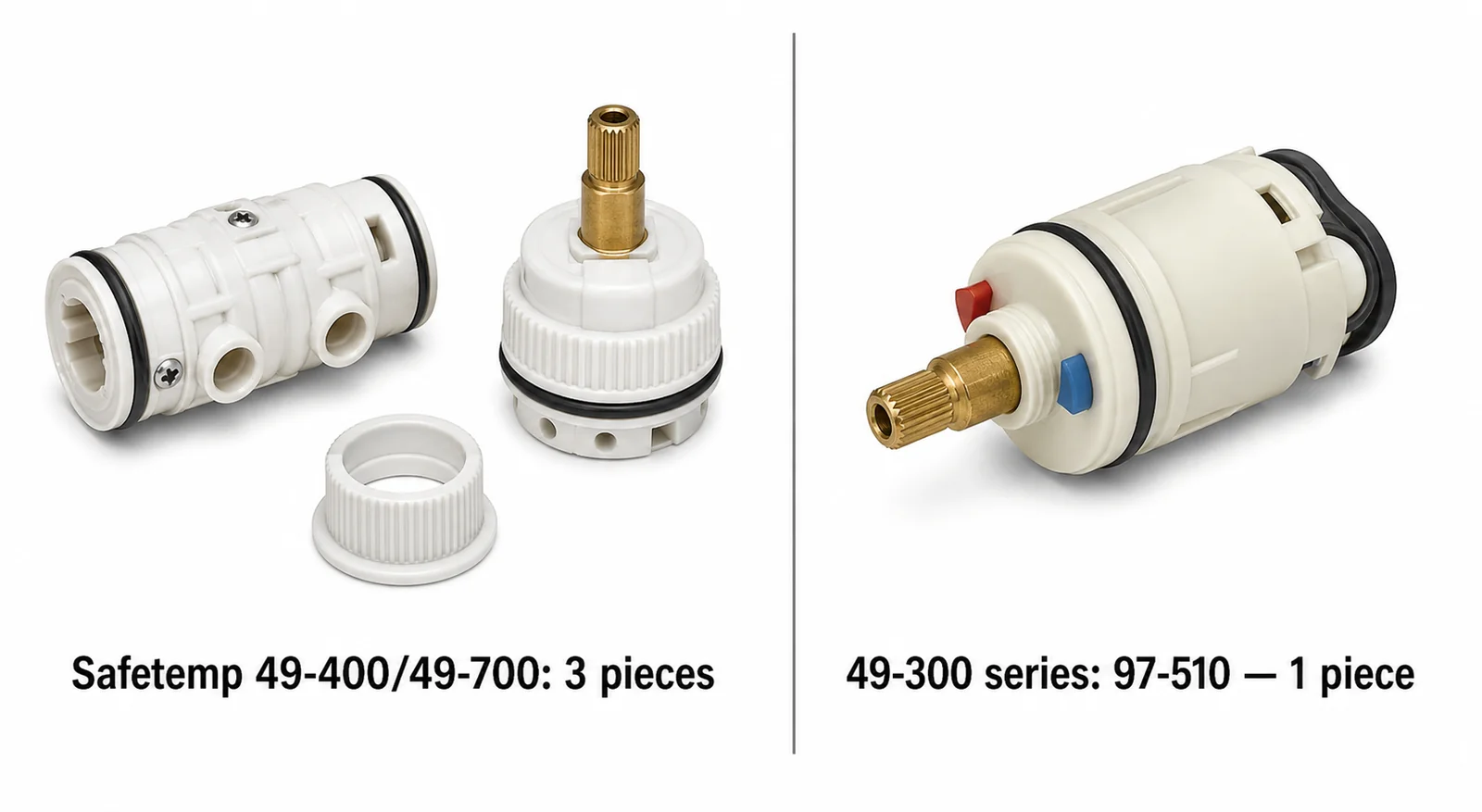
2. Single piece or multi-piece assembly? If the cartridge comes out as a single ceramic-disc unit, you have a 49-300 (→ 97-510) or a GH-300 cartridge (→ 97-231 or 97-232). If it comes out in multiple pieces — a pressure-balance spool plus a separate stem and a round temperature-limit stop ring — that is the Safetemp design for 49-400/49-700 valves (the full assembly is 97-022 + 97-014 + 92-294). (Gia Hardware, Safetemp assembly)
3. Molded or stamped numbers on the cap or body. Photograph the cartridge in good light before putting it down. A “97-” prefix points to the older series cartridges; a “GA” prefix to newer Gerber-coded parts. If you see “97-510,” “97-231,” or “97-232” molded on the body, you have the series.
Method 3: Inspect the Rough-In Valve Body
The brass valve body — the casting plumbed into the wall — defines the series, and it sometimes carries a cast or stamped series number. With the cartridge removed, shine a flashlight into the valve cavity and look at the brass body and any paper or foil tag that survived the install.
The series families and their cartridges, confirmed against manufacturer and parts pages:
- 49-300 series → 97-510 ceramic-disc cartridge (Quality Plumbing Supply; Chicago Faucet Shoppe)
- 49-400 and 49-700 “Safetemp” series → 97-022 Safetemp assembly (97-014 element + 97-022 stem/bonnet + 92-294 temperature-limit stop) (Gia Hardware; Grigg Industries)
- GH-300 platform → GH-301 trim takes the 97-231 pressure-balance cartridge; GH-305 trim takes the 97-232 ceramic-disc cartridge. These are different parts on the same platform — not interchangeable. (Amazon, OEM 97-231; Gia Hardware, 97-232)
- Treysta (current) → GA510015 ceramic-disc cartridge (Gerber USA; Quality Plumbing Supply)
A series number visible in the valve body plus the cartridge evidence from Method 2 gives you a high-confidence ID. At this point you have everything needed to order the exact part.
Visual Identification When the Markings Are Gone
Older valves lose their labels, and cartridges sometimes carry no readable numbers. You can still narrow the series by feature — this doesn’t replace a stamped part number, but it reliably gets you to the right cartridge family.
Step A: Confirm it’s a single-handle pressure-balance Gerber valve. A single lever that both turns the water on and sets temperature — with anti-scald behavior (holds temperature when a toilet flushes elsewhere) — is a pressure-balance valve. Two or three separate handles indicate an older Gerber compression or two-handle system and a different parts path.
Step B: Cap color and assembly count. As covered in Method 2 — gray cap = Treysta → GA510015; no gray cap, multi-piece assembly = Safetemp → 97-022 assembly; no gray cap, single disc unit = 49-300 → 97-510 or GH-300 → 97-231/97-232.
Step C: Measure when you need a tiebreaker. When cap color and assembly type leave ambiguity between similar-looking series, measure: – Overall cartridge length to the nearest ⅛ inch (the GH-301 / 97-231 cartridge is commonly listed at about 5¾ inches) – Stem spline count and broach shape (a 20-point spline is common on Gerber pressure-balance stems) – Bonnet thread diameter and escutcheon screw spacing
These three measurements let a plumbing-supply counter match an unmarked Gerber cartridge by physical fit. (HD Supply, Gerber single-handle cartridge listing)
The honesty call: feature-matching gets you to the right series family with good confidence — but always confirm the exact cartridge part number against the listing photo before buying. Gerber’s series look-alikes are precisely where wrong-part purchases happen.
Gerber Shower Valve Series: Quick Reference
| What you see | Likely series | Correct cartridge | Source |
|---|---|---|---|
| Gray-capped cartridge; “G00…” model; trim ends in “TC” | Treysta (current) | GA510015 + bonnet A016257-Z if adapting old trim | Gerber USA |
| Single ceramic-disc unit, no gray cap, older trim | 49-300 series | 97-510 | Quality Plumbing Supply |
| Multi-piece assembly + separate temp-limit stop ring; “Safetemp” branding | 49-400 / 49-700 Safetemp | 97-022 + 97-014 + 92-294 | Gia Hardware |
| GH-300 platform trim, “301” lever style | GH-301 | 97-231 pressure-balance | Amazon OEM |
| GH-300 platform trim, “305” lever style | GH-305 | 97-232 ceramic-disc | Gia Hardware |
| “Danze” wordmark on trim | Danze-by-Gerber (same platforms) | Identify via Danze legacy lookup, then map above | Danze support |
| No markings — need measurement | Unknown → measure | Length + spline count + cap color → plumbing counter | HD Supply |
The one rule across all rows: Gerber cartridges are series-specific. The 97-510, 97-022 assembly, 97-231/97-232, and GA510015 are different parts for different valve bodies and do not freely interchange. Identify the series before you buy.
Lookup Tools and Fallback Options
When you have a model number, enter it at Gerber USA support or gerberparts.com. The OEM exploded diagram calls out the cartridge by exact part number — the most authoritative path, more reliable than any marketplace search.
For Treysta confirmation, Gerber’s Treysta compatibility page tells you whether your existing trim accepts the GA510015 + bonnet A016257-Z upgrade. If you’re already replacing a hard-to-source older cartridge, upgrading to the current Treysta line is often the more future-proof path — Gerber supports it officially.
For Danze-branded trim, the Danze-by-Gerber legacy lookup handles model-number searches. Danze and Gerber share valve platforms after the brands merged, so the cartridge part numbers map directly to the same series table above.
If the internet can’t settle it: bring the physical cartridge to a local plumbing-supply wholesaler. A counter pro can match an unmarked Gerber cartridge by length, spline, and cap color against their Gerber bin faster than any website. Specialist parts retailers — Quality Plumbing Supply, Chicago Faucet Shoppe, Gia Hardware — list each cartridge as “for Gerber 49-300 series” or “for Safetemp 49-400/700” with photos; compare the photo to your part before ordering.
On aftermarket cartridges: Danco and similar OEM-equivalent suppliers sell cartridges compatible with specific Gerber series — a valid and often less expensive fix. They are still matched to a specific series, not truly universal. Confirm the listing’s compatibility note includes your series and that the photo matches. The only genuinely series-wide universal Gerber cartridge is the GA510015 — and only within Treysta valve bodies.
Reliability rule: trust the OEM diagram first, a specialist parts page’s photo second, and a big-box marketplace search last. In every case, confirm the printed part number on the listing matches what you’re holding before completing the order.
When to Call a Plumber
Most of this identification process is straightforward homeowner work with the water off. Call a licensed plumber when:
- The cartridge is seized and won’t come out — a proper cartridge puller (Gerber-specific or aftermarket) should remove it; if it won’t budge, forcing it can crack the valve body and turn a cheap cartridge swap into an open-wall replacement.
- There are no service stops and you can’t isolate the shower without shutting the whole house — a pro can do this safely and confirm the shutoff location.
- The valve body itself is damaged — cracked casting, stripped bonnet threads, or a pitted seat means full valve replacement, usually behind tile, which is solidly pro-level work.
- You can’t identify the series after all four methods above and the cartridge appears discontinued — a plumber who regularly works the Gerber line can often identify the body on sight and source the part.
- It’s a thermostatic or multi-outlet diverter Gerber system — higher complexity, scald risk if mis-set, tighter tolerances.
- Soldered inlets need to be reworked — open-flame plumbing near framing requires a license.
A practical rule of thumb: read the label and pull the cartridge yourself — that’s well within homeowner territory. The moment the cartridge won’t budge, the body looks damaged, or you can’t isolate the water, stop and call a plumber. A cracked Gerber valve body costs far more than the service call.
What to Do Next
Once you have the series confirmed and the cartridge part number in hand, the repair itself — removing the old cartridge, seating the new one, and reassembling the trim — follows the standard Gerber single-handle procedure. For the same identification process on other shower brands, see how to identify your Symmons shower valve or how to identify your Grohe shower valve.
Before placing the order: double-check that the printed part number on the listing matches your series, and confirm the photo looks like the cartridge you pulled. When in doubt, the Repair Finder can cross-reference the model number and return the confirmed part. Confirm the model printed on your part before buying — that’s the whole job.
Is there a universal Gerber shower cartridge that fits all valve bodies?
Not across all Gerber valves. The 97-510, 97-022 assembly, 97-231/97-232, and GA510015 are each series-specific and not interchangeable across generations. The GA510015 Treysta cartridge is “one cartridge fits all” only within Treysta valve bodies. For all other Gerber series you must identify the series first.
How do I know if I have a Gerber Treysta valve without opening the wall?
Look for the gray cap on the cartridge. The Treysta ceramic-disc cartridge has a distinctive gray cap that is visible once the handle and escutcheon are removed — Gerber publishes this as the official visual indicator. A trim model number ending in “TC” (the trim ships with a Treysta cartridge) is also a Treysta sign. No other Gerber cartridge family has the gray cap.
What is the difference between the Gerber 49-300 and 49-400/700 Safetemp series?
The 49-300 uses a single-piece 97-510 ceramic-disc cartridge. The 49-400 and 49-700 both use the multi-piece Safetemp assembly — a pressure-balance spool (97-014) plus a stem/bonnet (97-022) plus a temperature-limit stop ring (92-294) — so they share repair parts with each other but not with the 49-300. “Safetemp” branding on the trim or a two-piece cartridge coming out of the valve are the quickest tells.
Can I use a Danze cartridge in a Gerber valve, or vice versa?
Yes — Danze-by-Gerber and Gerber share valve platforms after the brands merged. A valve with “Danze” on the trim is identified through the Danze legacy lookup and then maps to the same series-cartridge table above. The part numbers are the same.
What should I do if the model-number label is gone and the cartridge has no markings?
Work through Methods 2 and 3: check the cap color (gray = Treysta), determine whether it’s a single-piece disc or a multi-piece Safetemp assembly, and inspect the rough-in valve body for a cast series number. If all three fail, bring the physical cartridge to a plumbing-supply counter — a counter pro can match an unmarked Gerber cartridge by length, spline count, and cap color against their Gerber bin in a few minutes. As a last resort, photograph the trim, cartridge, and valve cavity and contact Gerber support directly.
Is there a Gerber serial number decoder I can use to date the valve?
No. Gerber does not publish a homeowner-decodable serial or date code for shower cartridges or valve bodies. What you use instead is the model number from the handle canopy label — the identifying string, not a date code — or the series number stamped on the valve body. You can place the valve in a rough generation by features (gray cap and “G00…” model numbers = Treysta; “97-” cartridge prefix and Danze branding = older generation), but there is no public date-decode scheme. The model-number and series-number paths in this article are the lookup tools Gerber actually supports.
Sources
- Gerber USA — Where can I find the model number of my Gerber faucet?
- Gerber USA — Gerber TREYSTA: How to identify old ceramic cartridge vs. new Treysta (gray cap)
- Gerber USA — Treysta: Is my existing Gerber shower product compatible with Treysta valves?
- Gerber USA — Treysta Ceramic Disc Cartridge GA510015 (product page)
- Gerber USA — Danze legacy model number lookup
- gerberparts.com — Gerber Tub & Shower Parts Guide
- Quality Plumbing Supply — Gerber 97-510 ceramic-disc cartridge for 49-300 series
- Chicago Faucet Shoppe — Gerber 97-510 / 49-300 series cartridge
- Gia Hardware — Gerber 97-014 / 97-022 / 92-294 Safetemp assembly for 49-400/700
- Grigg Industries — Gerber 97-014 Safetemp pressure-balance cartridge
- Amazon — Gerber 97-231 OEM pressure-balance cartridge for GH-301
- Gia Hardware — Gerber 97-232 ceramic-disc cartridge for GH-305
- Quality Plumbing Supply — Gerber GA510015 Treysta ceramic disc cartridge
- HD Supply — Gerber single-handle pressure-balance cartridge (measurement reference)
- The Home Depot — Gerber Treysta rough-in valve G00GS555S
- Ferguson — Gerber Plumbing cartridges & stems
Educational content only. Not a substitute for licensed professional advice. Local plumbing codes vary by jurisdiction. Use of any guidance from this guide is at your own risk.
Get the homeowner’s plumbing repair toolkit checklist — the tools, parts, and decisions every homeowner should have on hand. [Free download — enter your email]
Parts for this repair
As an Amazon Associate, plumbingbythebook earns from qualifying purchases. Links below are affiliate links — they cost you nothing extra.
- Gerber Treysta Ceramic Disc Cartridge GA510015 — The one-cartridge-fits-all Treysta replacement. If your cartridge has a gray cap, this is your part — confirm by checking that your trim model number includes a 'TC' or 'T' suffix before ordering.
- Gerber 97-510 Ceramic Disc Cartridge (49-300 Series) — Replacement for 49-300 series Gerber pressure-balance valves. Confirm the series number is stamped on your valve body before buying — a 97-510 will not fit a Safetemp or GH-300 body.
- Gerber 97-022 / 97-014 Safetemp Pressure-Balance Assembly (49-400/700 Series) — The three-piece Safetemp assembly (97-014 + 97-022 + 92-294 limit stop) for 49-400 and 49-700 Gerber valves. If your cartridge comes out as a single ceramic disc unit, you have a different series.
Related guides
Which Shower Trim Kits Fit Your Valve? How to Tell by Brand
You found a shower trim kit you like, in the right finish, from the right brand. It still…
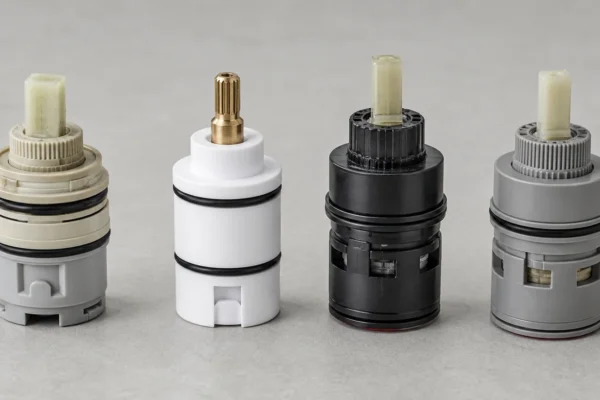
Shower Cartridge Identification Chart: Every Major Brand in One Table [2026]
Shower Cartridge Identification Chart: Every Major Brand in One Table [2026] This shower cartridge identification chart puts nine…
![Title card for the article 'Should I Repair or Replace My Shower Valve? [2026]' on Plumbing By The Book](https://plumbingbythebook.com/wp-content/uploads/2026/08/article-99-hero-should-i-repair-or-replace-my-shower-valve-600x400.webp)
Should I Repair or Replace My Shower Valve? [2026]
Should I repair or replace my shower valve? For most homeowners, the honest answer is: repair the cartridge…