
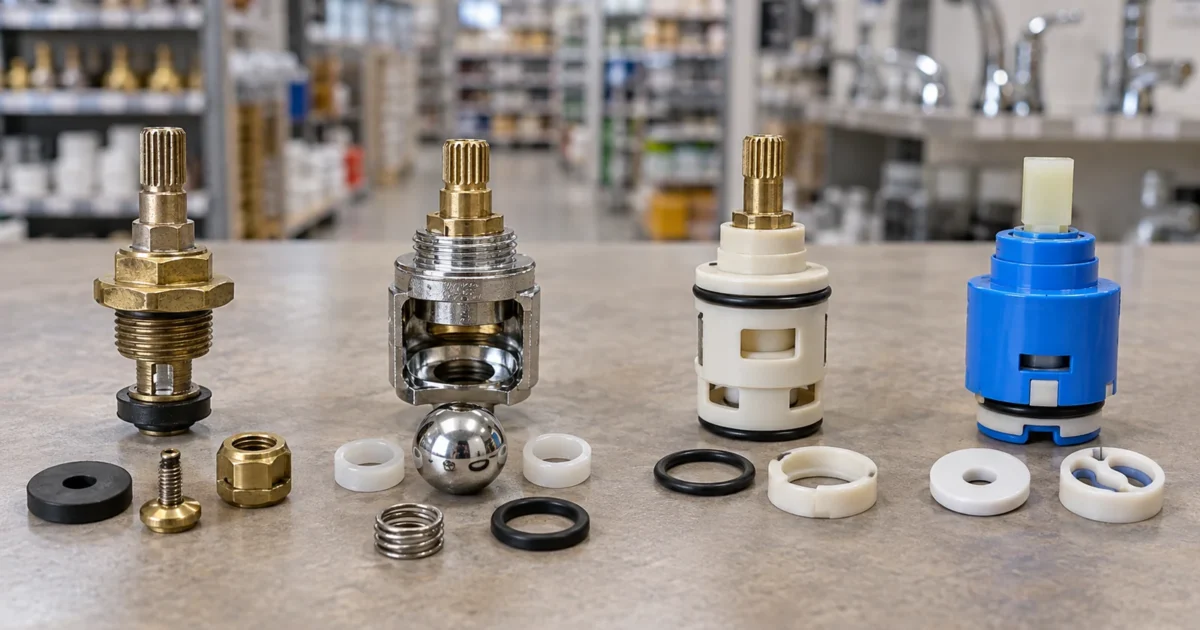
This faucet valve type identification chart covers the four mechanisms hiding inside almost every residential sink faucet — compression, ball, cartridge, and ceramic disc — so you can figure out what you’re working on before you buy a single part. None of the 27 brand-specific identification guides on this site can help you yet if you don’t know which of these four you have; this is the step before the step. Get the mechanism wrong and you’ll buy a part that never fits, because none of the four is interchangeable with another.
None of this requires a model number, a serial code, or a manufacturer parts-finder tool — those come later. What separates compression from ball from cartridge from ceramic disc is something you can feel with your hand before you turn off the water: how the handle moves.
Faucet Valve Type Identification Chart: Start With How the Handle Moves
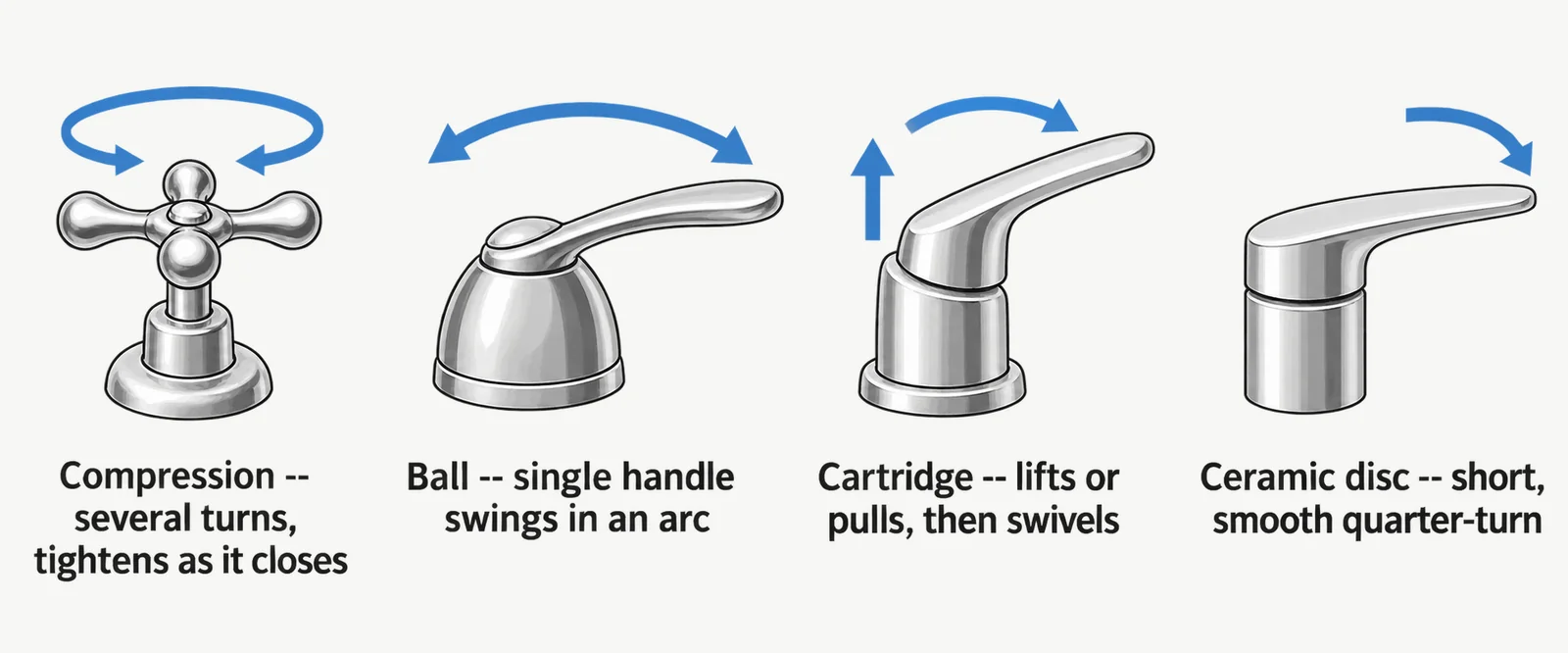
The most reliable first observation in any faucet valve type identification chart is handle motion — not brand, not finish, not how old the faucet looks. Handle count is a useful second clue, but it’s not decisive on its own; several of the biggest identification mistakes homeowners make come from trusting handle count over handle feel. Work through this sequence in order:
- The handle turns several full rotations, and resistance builds as it closes. Treat it as a compression faucet until proven otherwise. Compression valves close by turning a stem down until a washer seals against a valve seat, and that tightening feel as you shut it off is the tell (Home Depot).
- A two-handle faucet turns only a short quarter-turn, with smooth, even resistance and no tightening feel. That points to ceramic disc — either a ceramic valve or a ceramic-disc cartridge — because the seal is two hard discs sliding against each other rather than a washer compressing (Pfister 910-9000).
- A single handle swings through an arc around a rounded cap or dome, and taking it apart reveals a cap/cam/ball/seat/spring stack. That’s a ball faucet. Delta’s own ball repair parts document that exact stack — cap, adjusting ring, cam and packing, slotted ball, seats, and springs (Delta RP77763).
- A single handle lifts, pulls, pushes, or pivots, and disassembly reveals a self-contained cylindrical insert retained by a clip, nut, or bonnet. That’s a cartridge — which may or may not be a ceramic-disc cartridge inside. Moen’s 1225 kitchen cartridge and Delta’s RP50587 both follow this pattern: a pull-out or lift-out insert, not loose parts (Moen 1225 instructions, Delta RP50587).
- If the sealing technology turns out to be ceramic discs but the part is sold as a “cartridge,” classify it as ceramic disc for the mechanism and as a cartridge when you go shopping for the part. Moen says its Duralast cartridges feature ceramic discs, and Grohe says the ceramic discs in its SilkMove line sit inside a cartridge (Moen cartridges, Grohe SilkMove).
Handle count narrows the field but doesn’t prove anything by itself. Two handles usually means compression or ceramic-disc stems, but modern two-handle faucets commonly use ceramic-disc cartridges instead of compression washers, so two handles alone doesn’t prove compression (Kohler two-handle valve replacement, American Standard two-handle cartridge). One handle narrows things to ball, cartridge, or ceramic disc — but it doesn’t prove ball. Moen 1225, Delta RP50587, and Kohler’s single-handle cartridge systems are all common single-handle faucets that are not ball valves (Kohler single-handle valve replacement).
The two hardest cases genuinely require pulling the handle: cartridge-vs-ceramic-disc (because manufacturers sell ceramic-disc parts labeled as cartridges) and ball-vs-cartridge on single-handle kitchen faucets, especially older Delta-style faucets, where non-DST models used a ball assembly and newer DST models switched to cartridges with no visible difference from the outside (Delta parts identifier).
The Four-Way Comparison Chart
Once you’ve matched a handle motion above, use this table to confirm what you’re looking at and what it will cost to fix.
| Mechanism | Handle Motion | Typical Handle Count | What You See With the Handle Off | Part You Buy | Typical Part Price | Still Manufactured? |
|---|---|---|---|---|---|---|
| Compression | Multiple turns; tightens as it closes (Home Depot) | Usually two | Stem, washer, screw, packing, O-rings, sometimes a replaceable seat (Danco washer assortment) | Washer, bibb screw, packing, seat, or full stem | Washer assortments commonly run under $10; full stems vary by brand and length (BrassCraft stems) | Yes |
| Ball | Single handle swings through an arc (Danco) | Usually one | Cap/bonnet, cam and packing, slotted ball, seats, springs (Delta RP77763) | Ball, seats/springs, cam/packing, or full repair kit | Seat-and-spring kits commonly run under $10; complete ball assemblies and full kits cost more (Delta RP4993) | Yes |
| Cartridge | Lift, pull, push, or rotate (Moen 1225 instructions) | One or two | Cylindrical insert, stem, O-rings, tabs, retaining clip or bonnet nut | The exact cartridge or a verified aftermarket equivalent | Often $20-$65 in researched examples depending on brand (Moen 1225 product page) | Yes |
| Ceramic disc | Short, smooth quarter-turn or arc, no tightening feel (Grohe SilkMove) | One or two | A sealed ceramic valve or cartridge — discs are usually not visible until it’s opened | Ceramic cartridge, ceramic valve, or ceramic stem | Mainstream OEM quarter-turn cartridges commonly run about $25-$37; some product families price much higher (Pfister 910-9000) | Yes |
Treat those price bands as examples, not fixed national prices — manufacturer-direct pricing is often higher than what you’ll find at Home Depot, Lowe’s, or a specialty supplier for the identical part.
Matched your valve to a mechanism below? Confirm the exact part before you buy — brand and production date still matter within each mechanism family:
As an Amazon Associate, plumbingbythebook earns from qualifying purchases. Links below are affiliate links — they cost you nothing extra.
- Danco 80817 Rubber Washer Assortment (42 pc)
- Danco 34443 Rubber O-Ring Assortment (200 pc, 12 sizes)
- Delta RP4993 Ball Faucet Seats and Springs Kit
Not sure which part you have? The cartridge finder narrows it to the exact part in a few questions.
What Each Mechanism Looks Like Once the Handle Is Off
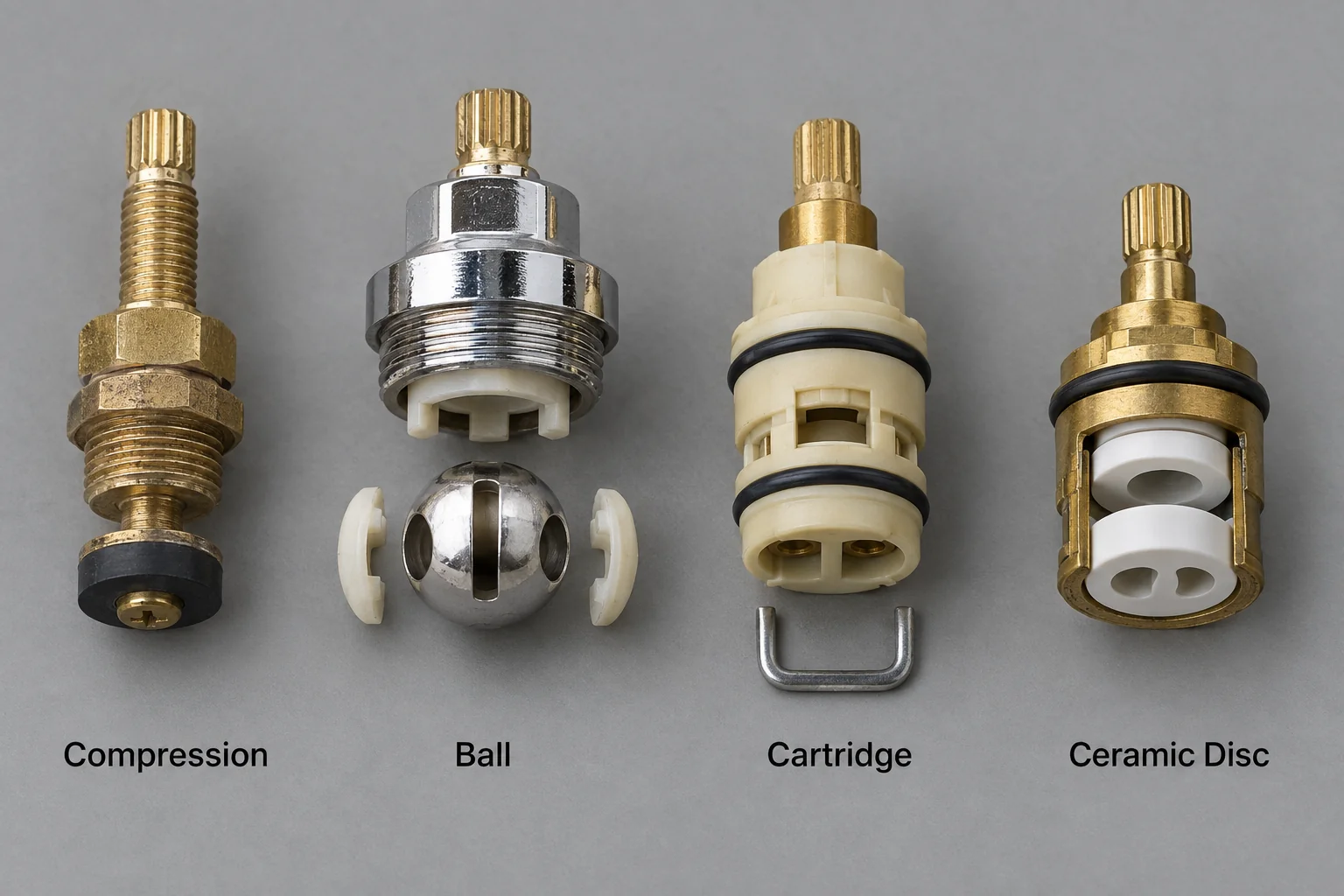
A compression faucet doesn’t hide a sealed cartridge — it reveals loose, serviceable small parts: a stem with a washer on the end, a screw, packing, O-rings, and sometimes a removable seat. That stem/washer/seat repair surface is the giveaway, and it’s why compression is usually the cheapest mechanism to fix (Danco washer assortment, BrassCraft stems).
A ball faucet exposes layered loose parts rather than one piece: a cap, an adjusting ring, a cam, packing, a slotted metal or plastic ball, and separate seats and springs sitting in pockets below where the ball sat (Delta RP77763). That loose ball plus separate seats and springs is the clearest way to tell it apart from a cartridge, which comes out as one piece.
A cartridge faucet exposes exactly that — a self-contained insert held in place by a clip, a retainer nut, or a bonnet nut. Moen’s 1225 instructions describe a copper retaining clip and a cartridge that pulls out after a quarter-turn; Delta’s RP50587 procedure describes a cap, bonnet nut, and a cartridge pulled straight up by the stem (Moen 1225 instructions, Delta RP50587).
A ceramic-disc faucet can look identical to a cartridge faucet once the handle is off, because the discs themselves are usually sealed inside a cartridge or valve body and aren’t visible unless it’s opened or shown in a diagram. That’s the whole reason cartridge-vs-ceramic-disc is the single most common confusion case in this chart.
Why the Valve Type Changes Your Repair
Identifying the mechanism tells you which repair bucket you’re in, and the buckets are genuinely different prices. Compression usually unlocks the cheapest path: washers, O-rings, bibb screws, and packing can often be matched by size, and a full replacement stem is still far cheaper than a new faucet (Danco washer assortment). Ball identification points you toward rebuilding the ball assembly with seats, springs, and a cam-and-packing kit rather than buying a cartridge — a spout drip in many non-DST Delta faucets is solved with seats and springs alone, not a whole new ball (Delta parts identifier).
Cartridge identification usually means buying the exact cartridge, or a verified aftermarket equivalent, for your specific faucet — more expensive than washers but still far cheaper than replacing the whole faucet (Delta single-handle cartridge guide). Ceramic disc identification usually means replacing the whole ceramic cartridge or valve rather than rebuilding the discs themselves — that’s simply how the part is sold (Kohler ceramic valve).
One important caveat that cuts across all four: manufacturer procedures for removal and reinstallation genuinely vary, and skipping the specifics costs you the repair. Moen warns not to force its cartridge retaining clip and not to turn the water back on if the clip won’t seat properly. Kohler’s ceramic-valve procedure calls for tightening only 1/8 to 1/4 turn past hand-tight — overtightening can crack the ceramic. Delta specifies which end of its RP4993 spring goes in first. None of these are optional details; follow the manufacturer’s own instructions for your part once you’ve identified it, not a generic “tighten it down” approach.
Where Universal Parts Actually Work
Compression is where “universal” is most honest. Danco’s 80817 washer assortment covers faucet washers, O-rings, hose washers, and bibb screws in common sizes — genuinely close to universal for small compression parts (Danco washer assortment). Full replacement stems are less universal; BrassCraft organizes them by manufacturer and length rather than selling one stem that fits everything (BrassCraft stems).
Ball parts are “universal” only within a family — mainly Delta and Peerless-style ball valves. Delta’s RP4993 seats-and-springs kit is sold specifically for Delta/non-DST/stainless-ball applications, not every ball faucet on the market, and Danco’s DL-19 ball is a named cross-fit for Delta/Peerless knob-style faucets rather than a fits-anything part (Delta RP4993, Danco DL-19).
Cartridges are not broadly universal, full stop. Danco’s MO-8 replaces the Moen 1225 but explicitly does not work in Posi-Temp or Exact-Temp valves, and Delta’s own cartridge guide lists multiple single-handle cartridge families split by production date, not one part for every faucet with that handle style (Delta single-handle cartridge guide). Ceramic-disc parts are the same story — Pfister’s 910-9000 is a genuine Pfister reversible quarter-turn cartridge, not an all-brand ceramic stem, and Grohe’s ceramic cartridges vary by size and close-direction across its own product lines (Pfister 910-9000).
The honest summary: identifying the mechanism tells you which aisle to shop in. It doesn’t tell you the exact part — that still requires matching the brand, model, and often the production date. Once you’ve narrowed the mechanism, confirm your part with our free Repair Finder before you buy, so a mechanism match doesn’t turn into a second trip to the hardware store.
The Confusion Cases That Trip Up Homeowners
Cartridge vs. ceramic disc. This is the single biggest source of confusion in this whole chart, because manufacturers use “cartridge” as both a mechanism name and a generic part name. Moen’s Duralast cartridges feature ceramic discs; Grohe’s SilkMove ceramic discs sit inside a cartridge; American Standard sells ceramic-disc valve assemblies as replacement valve cartridges (Moen cartridges, Grohe SilkMove, American Standard two-handle cartridge). Don’t treat “cartridge” and “ceramic disc” as mutually exclusive when you’re reading a parts listing — they frequently describe the same physical part.
Ball vs. cartridge on single-handle kitchen faucets. Especially on older Delta-style faucets: non-DST models commonly used a ball assembly, while newer DST models switched to cartridges, with no reliable visual difference from outside the faucet (Delta parts identifier). A single handle should never, by itself, send you to buy a ball repair kit.
Two-handle-vs-compression. Older two-handle faucets are frequently compression, but plenty of modern two-handle faucets use quarter-turn ceramic-disc valves or cartridges instead (This Old House). Motion, not handle count, is what actually tells you which one you have.
Which Mechanism Your Brand Actually Used — and When
Brand history is a useful hint, but it’s a hint, not a lookup. Treat the following as “likely family,” then confirm before you buy:
- Moen is cartridge-first, with modern overlap into ceramic-disc cartridges sold under the Duralast name — current documentation lists multiple cartridge generations, so “Moen equals one cartridge” is never a safe assumption (Moen cartridges, Moen bathroom cartridge guide).
- Delta’s historical signature is the ball faucet, tracing back to the company’s early single-handle history, but current Delta residential repair spans both ball assemblies and several cartridge families depending on the model (Delta history, Delta single-handle cartridge guide).
- Kohler’s current residential lines lean heavily on replaceable cartridges and ceramic-disc valves, with official replacement procedures published for both one- and two-handle faucets (Kohler ceramic disc faucets).
- American Standard has a long ceramic-disc history — its ceramic disk faucet patent was filed in 1972 — and still sells ceramic-disc replacement valve cartridges today (Google Patents US3810602A, American Standard two-handle cartridge).
- Pfister and Grohe both center their current lineups on ceramic-disc cartridges — Pfister’s 910-9000 is a reversible quarter-turn example, and Grohe describes its SilkMove ceramic discs as sitting inside a cartridge body (Pfister cartridges, Grohe SilkMove).
Once you know your brand and mechanism, How to Identify Faucet Brand and Model walks through the model-number hunt that gets you the exact part.
When This Chart Doesn’t Apply
This chart is built for common residential manual sink faucets — the kind with a handle you turn or move by hand. It intentionally leaves out commercial metering faucets, electronic sensor faucets, thermostatic mixing valves, and pressure-balance shower valves, which use additional platforms and vocabulary outside this four-way taxonomy (Chicago Faucets cartridge overview, Delta pressure balance maintenance). If your fixture is a shower or tub valve rather than a sink faucet, or if water temperature won’t mix correctly no matter what you do to the handle, you’re likely dealing with a different system — at that point, or if a mechanism you’ve correctly identified still won’t seal after a proper rebuild, it’s worth calling a licensed plumber rather than guessing your way through a second or third repair attempt.
What to Do Next
Matched your handle motion to a mechanism above? If the symptom that sent you here is a drip rather than curiosity, Why Is My Faucet Leaking covers the other five causes that have nothing to do with valve type. And once you’ve confirmed both the mechanism and the brand, the Complete Guide to Faucet Repair covers the broader repair sequence from shutoff to reassembly.
What’s the fastest way to tell if my faucet is compression, ball, cartridge, or ceramic disc?
Feel the handle. Several full turns that tighten as it closes means compression. A short, smooth quarter-turn with no tightening means ceramic disc. A single handle swinging in an arc around a rounded cap usually means ball. A single handle that lifts, pulls, or pivots usually means cartridge.
Can a two-handle faucet have a cartridge instead of compression stems?
Yes. Modern two-handle faucets commonly use ceramic-disc valves or cartridges instead of the older washer-and-seat compression design, so handle count alone never proves compression — check the motion, not just the count.
Is a ceramic-disc faucet the same as a cartridge faucet?
They’re often the same physical part described two different ways. Several manufacturers sell ceramic-disc assemblies packaged and labeled as “cartridges,” so a cartridge listing can genuinely contain ceramic discs.
Do universal repair kits work for any faucet valve type?
Only reliably for compression washers and small rubber parts. Ball, cartridge, and ceramic-disc parts are cross-compatible only within a specific brand and model family — never assume a “universal” cartridge fits a faucet it doesn’t explicitly list.
How do I know if my faucet valve type isn’t covered by this chart?
If it’s a commercial metering faucet, an electronic sensor faucet, a thermostatic mixing valve, or a shower/tub pressure-balance valve, it falls outside this sink-faucet taxonomy and uses different parts and vocabulary entirely.
Which is cheapest to repair: compression, ball, cartridge, or ceramic disc?
Compression is usually cheapest, since small rubber parts and washers often run under $10. Ball repair kits are typically the next cheapest tier. Cartridge and ceramic-disc replacements cost more because you’re usually buying one complete sealed part rather than small serviceable pieces.
Sources
- Home Depot: Types of Water Valves
- Danco: Plumbing 101
- Danco: Home Washer Assortment (80817)
- Danco: DL-19 Ball for Delta Faucets
- BrassCraft: Faucet Repair Stems
- Delta: History
- Delta: RP77763 Ball Repair Kit
- Delta: RP4993 Seats and Springs
- Delta: RP50587 Cartridge
- Delta: Parts Identifier
- Delta: Single-Handle Cartridge Guide
- Delta: Pressure Balance Valve Maintenance
- Moen: 1225 Kitchen Cartridge Instructions
- Moen: 1225 Cartridge Product Page
- Moen: Cartridges Overview
- Moen: Bathroom Cartridge Guide
- Kohler: Replace the Valve in a Two-Handle Faucet
- Kohler: Replace the Valve in a Single-Handle Faucet
- Kohler: Bathroom Faucets With Ceramic Disc Valves
- Kohler: Valve Cartridge, Ceramic (part 22376)
- American Standard: Two-Handle Faucet Cartridge
- Pfister: 910-9000 Ceramic Disc Cartridge
- Pfister: Cartridges Category
- Grohe: SilkMove Technology
- Chicago Faucets: Cartridge Overview
- Google Patents: US3810602A (American Standard Ceramic Disk Faucet)
- This Old House: The Facts on Faucets
Educational content only. Not a substitute for licensed professional advice. Local plumbing codes vary by jurisdiction. Use of any guidance from this guide is at your own risk.
Get the homeowner’s plumbing repair toolkit checklist — the tools, parts, and decisions every homeowner should have on hand. [Free download — enter your email]
Parts for this repair
As an Amazon Associate, plumbingbythebook earns from qualifying purchases. Links below are affiliate links — they cost you nothing extra.
- Danco 80817 Rubber Washer Assortment (42 pc) — Common flat and beveled washer sizes for compression faucets — the cheapest fix once you've confirmed the multiple-turn, tightens-as-it-closes handle motion.
- Danco 34443 Rubber O-Ring Assortment (200 pc, 12 sizes) — Covers common O-ring sizes across ball, cartridge, and ceramic-disc valves — the small parts that fail most often between full rebuilds.
- Delta RP4993 Ball Faucet Seats and Springs Kit — The seats-and-springs kit for Delta and Peerless-style ball faucets — often fixes a spout drip without replacing the whole ball assembly.
Related guides
![Title card for the article 'Faucet Replacement Parts: The Homeowner's Glossary [2026]' on Plumbing By The Book](https://plumbingbythebook.com/wp-content/uploads/2026/09/article-13-hero-faucet-parts-laid-out-600x400.webp)
Faucet Replacement Parts: The Homeowner’s Glossary [2026]
Faucet replacement parts are the second-most-expensive mistake in DIY faucet work, right behind misidentifying the faucet brand itself.…
![Title card for the article 'How to Read a Delta Faucet Model Number: Model vs. Part Number Explained [2026]' on Plumbing By The Book](https://plumbingbythebook.com/wp-content/uploads/2026/08/article-97-hero-how-to-read-a-delta-faucet-model-number-600x400.webp)
How to Read a Delta Faucet Model Number: Model vs. Part Number Explained [2026]
How to Read a Delta Faucet Model Number: Model vs. Part Number Explained [2026] Knowing how to read…
![Title card for the article 'Where Is the Model Number on My Faucet? A Brand-by-Brand Guide [2026]' on Plumbing By The Book](https://plumbingbythebook.com/wp-content/uploads/2026/08/article-98-hero-where-is-the-model-number-on-my-faucet-600x400.webp)
Where Is the Model Number on My Faucet? A Brand-by-Brand Guide [2026]
Where Is the Model Number on My Faucet? A Brand-by-Brand Guide [2026] Where is the model number on…