
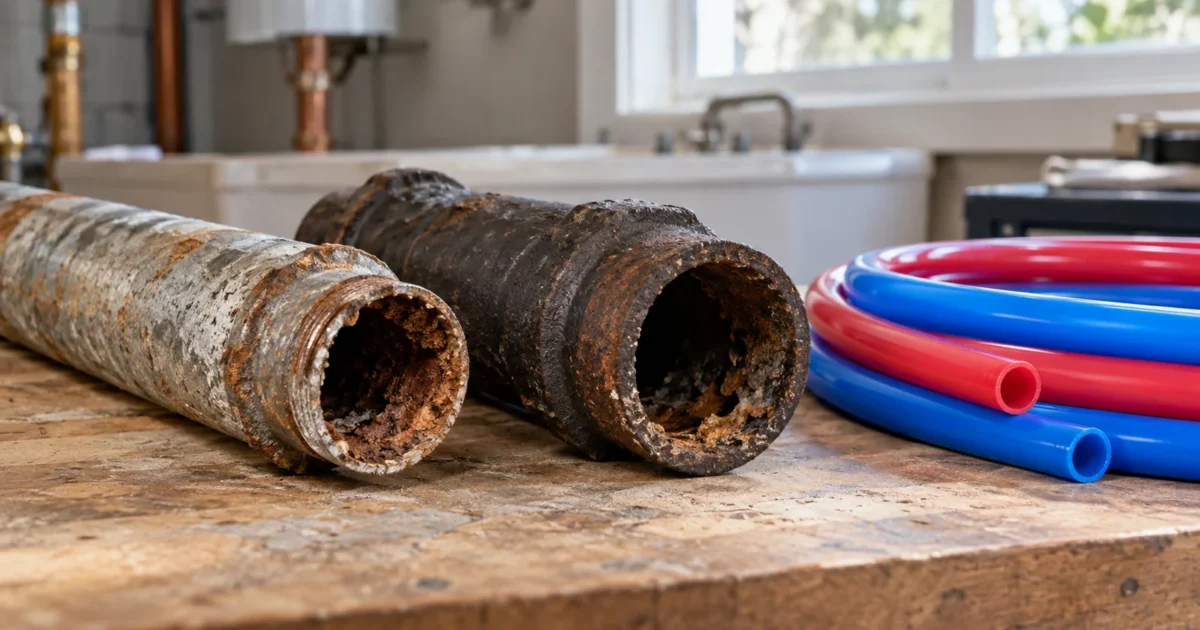
Knowing when to repipe vs repair is a big-ticket decision, and the honest answer depends on which pipe is in your walls. A whole-house repipe runs about $1,500 to $15,000 (averaging around $7,500), per Angi. A single leak repair can be a few hundred dollars. This page is for the homeowner staring at a plumber’s quote for old galvanized, polybutylene, or cast iron pipe and trying to decide between patching it and replacing it.
Short version: polybutylene and system-wide galvanized failure lean toward replacement, while cast iron is a condition-by-condition call. Everything below is a planning range, not a bid.
When to Repipe vs Repair: The Short Answer
Repair when the problem is one accessible failure in an otherwise sound system. Replace when the failures are repeating, spreading, or hidden behind finished surfaces, or when the pipe material itself is the risk.
| Your pipe | Lean toward repair when… | Lean toward replacement when… |
|---|---|---|
| Galvanized steel (supply) | One accessible leak or one clogged, low-flow branch | Symptoms are system-wide: low pressure, rusty water, repeat leaks in an older home |
| Polybutylene (supply) | One leaking run, fitting, or fixture connection, as a stopgap | You are staying long term, or insurers or buyers are flagging it |
| Cast iron (drain, waste, vent) | Camera shows one bad run and the rest is sound | Repeated backups, multiple failures, or a defect map shows widespread damage |
Notice that cast iron is the odd one out. Galvanized and polybutylene are usually pressurized water-supply materials; cast iron is usually drain, waste, vent (DWV), sewer, or storm-drain pipe, according to Lowe’s. For more on the drain side, see our drains and pipes guide.
Three Pipes, Three Different Options
Each pipe material gets the same three-option treatment, because the choices look alike even when the risks do not.
Option A: Spot repair. For galvanized, that means fixing one leak or one clogged branch and leaving the rest in service. For polybutylene, it means replacing one leaking run, fitting, or fixture connection. For cast iron, it means cutting out a cracked section and joining in replacement cast iron, PVC, or ABS with code-appropriate couplings and support. This is the lowest-cost, lowest-disruption path when the defect is isolated and accessible.
Option B: Partial repipe. For galvanized, that might be one branch, the hot-water side, or the worst low-pressure section. For polybutylene, partial replacement is less attractive as a long-term risk strategy, though it is not automatically illegal or impossible everywhere. For cast iron, it is often a valid middle path when camera evidence shows one bad run rather than system-wide failure.
Option C: Whole-system replacement. For galvanized and polybutylene, that means replacing the old supply system with an approved modern material such as PEX, CPVC, or copper. For cast iron, it means replacing the affected DWV, sewer, or stack with PVC, ABS, new cast iron, or another locally approved material.
The Cost Snapshot: Repair vs Replace
These are national planning ranges from cost guides. Your quote will differ by region, access, and what the plumber finds.
| Path | Typical range | Source |
|---|---|---|
| Leaking pipe repair | $175-$550 | Angi |
| Burst pipe repair | $1,000-$4,000 | Angi |
| Main-line water leak repair | $600-$4,500 | Angi |
| Whole-house repipe | $1,500-$15,000 (avg ~$7,500) | Angi |
| Polybutylene replacement | $1,500-$15,000 | HomeGuide |
| Galvanized replacement | $2,000-$15,000 | HomeGuide |
| Under-slab cast iron replacement | $3,000-$20,000 | Angi |
| Sewer line replacement | $1,388-$5,323 typical (avg $3,319) | HomeAdvisor |
| Sewer camera inspection | $271-$1,726 | Angi |
Pipe itself is the small part of the bill. Angi puts PEX at $0.40 to $2 per linear foot, CPVC at $0.50 to $1, and copper at $2 to $8 (Angi). Installed cost is mostly labor, access, fittings, permits, and finish repair.
What Should Drive the Decision
Three criteria carry most of the weight, roughly in this order.
1. Material risk plus system age. Polybutylene carries the strongest replacement signal. Angi says it is no longer used in new construction and is prone to defects, leaks, and bursts (Angi). Galvanized steel is a strong signal when it is original to an older home and symptoms are system-wide. Home Depot notes galvanized pipe was common until the 1960s and is rarely used in new construction today. Cast iron should be judged by condition, location, support, and access rather than age alone.
2. Failure pattern. One accessible leak supports repair. Repeated leaks, recurring clogs, widespread low pressure, rusty water, multiple backed-up drains, or known polybutylene point toward replacement. Angi’s drain guide says repair suits small leaks or minor damage, while replacement is better for corroded, frequently clogged, or outdated pipe such as galvanized steel or old cast iron.
3. Access and collateral damage. The same defect is a different decision in an unfinished basement than under a slab, behind tile, or inside a shared wall. Under-slab cast iron runs $3,000 to $20,000, while accessible sink-pipe work can be in the hundreds (Angi).
One more rule of thumb: according to Angi, if the repair costs more than half the price of replacement, replacement is often the better choice to avoid recurring problems. Treat it as a guide, not a law.
When to Repipe vs Repair: The Honest Math
Repair is usually cheaper up front. Replacement is usually cheaper over 5 to 10 years when failures are systemic, hidden, or likely to affect insurance, water quality, or resale.
The repair path gets expensive when water damage joins the bill. Angi’s 2026 water-damage restoration average is $3,868, with a typical range of $1,383 to $6,369 (Angi). One major leak behind a wall can wipe out years of deferred-repipe savings. Repeat service calls add up too, since Angi lists service-call fees, hourly rates, and emergency surcharges (Angi).
Replacement has its own hidden costs: holes in walls, floors, and ceilings, temporary water shutoff, and finish repair. HomeAdvisor notes that cutting into walls, floors, or ceilings adds construction costs on top of plumbing labor.
Replacement can also carry warranty value, but only under the right conditions. Uponor says AquaPEX and ProPEX fittings carry a 25-year transferable limited warranty when used as a system, and SharkBite says its PEX pipe carries a 25-year warranty when installed per instructions and code (Uponor, SharkBite). Each warranty applies only to that manufacturer’s system and conditions, so ask your plumber to use compatible listed components and document the work.
Galvanized Steel: Repair or Repipe?
Galvanized pipe fails from the inside. A short repair on an otherwise sound system can buy years; a repair on a system with widespread internal corrosion tends to just reset the clock on the next weak point.
There is also a water-quality angle. The EPA says lead particles can attach to galvanized pipe surfaces and later enter drinking water, especially when the galvanized pipe was or is downstream of lead material. If you have galvanized plumbing and any doubt about lead, get your water tested.
A note on scope: the EPA’s galvanized-requiring-replacement rule covers service lines under a water system’s control, not every interior galvanized branch. Do not read the utility-side replacement mandate as a deadline for the pipes inside your house (EPA).
Also, do not patch a pressurized supply line with a DWV coupling. According to Fernco’s FAQ, its flexible couplings are for gravity-flow DWV systems, not pressurized water supply.
Polybutylene: Repair or Repipe?
Polybutylene (PB) is the clearest replacement candidate. This Old House rates PB-to-PEX replacement 5 out of 5 (Hard) and “for a professional.”
Be careful with the word “illegal,” though. Existing lawful plumbing is generally allowed to remain unless it is unsafe or unsanitary, while new work must follow current code (per the 2024 IPC excerpt and NYC’s code). State material tables also differ: Illinois still lists PB tubing under approved water-distribution materials, while Wisconsin’s excerpted table lists PEX and galvanized steel but not PB (Illinois, Wisconsin). The accurate framing: PB is no longer used in mainstream new construction and is often flagged by insurers, buyers, and plumbers, and any replacement must follow your locally adopted code.
The insurance angle is real in some markets. Citizens Property Insurance in Florida says new-business risks over 20 years old with PB are not insurable for its listed residential policy forms (Citizens). Call your own insurer before you decide.
Aging Cast Iron: Repair or Replace?
Cast iron is not simply obsolete. Charlotte Pipe describes no-hub cast iron as a current nonpressure DWV material for sanitary, sewer, storm drainage, waste, and vent applications, and points to its sound-deadening and noncombustible properties. Age alone is not a reason to rip it out.
Get evidence first. A camera inspection ($271 to $1,726 per Angi, commonly $150 to $300 for a standard scope and $300 to $600 for HD) and a written defect map show whether you have one bad run or system-wide failure, before you authorize demolition or excavation.
A repair only holds if the joint is done right. Charlotte Pipe describes 60 inch-pounds of torque for standard no-hub couplings, with heavier couplings potentially needing 80 or 120 depending on the manufacturer (Charlotte Pipe). Coupling choice depends on pipe material, outside diameter, above- or below-ground use, manufacturer instructions, and local code. Nominal size alone is not enough: Fernco’s Proflex tables distinguish couplings by material and outside diameter.
Cast iron material pricing is hard to pin down. HomeAdvisor’s street-price range of $10 to $20 per foot may fit some suppliers, but Charlotte Pipe’s 2026 list sheet shows 4-inch by 10-foot no-hub pipe at $328.60 list, or $32.86 per foot. Local supply and delivery vary, and installed cost is dominated by access and labor.
Edge Cases That Flip the Decision
- Selling soon. Polybutylene may push you toward replacement where insurers are strict, but some sellers choose inspection, disclosure, or a credit instead of a pre-listing repipe. The North Carolina Real Estate Commission says PB’s presence alone is not automatically a material fact there, though known defects, leak history, or water damage can change disclosure duties (NCREC). Rules vary by state, so ask your agent. Planned tenure matters either way: a long-term owner has more reason to eliminate polybutylene or system-wide galvanized risk.
- Historic house or fragile finishes. If the pipe is not actively failing, staged replacement coordinated with remodels can beat one large, destructive project.
- Condo, duplex, or shared plumbing. Cast iron’s sound deadening and noncombustibility matter more in shared buildings (Charlotte Pipe), so the cheapest material may not be the right one.
- Slab foundation. Evidence first: camera, locate, defect map, then decide.
- Rental property. Repeated emergency visits, tenant disruption, and after-hours fees can make “cheap repairs” expensive. Angi lists emergency rates as materially higher than ordinary plumbing work.
Should You DIY It or Hire a Pro?
DIY prep and documentation, yes. DIY repiping, for most homeowners, no. Angi says homeowners can save by preparing access areas, clearing clutter, repairing small drywall areas, and repainting, while leaving polybutylene replacement to pros unless they have advanced plumbing knowledge (Angi). Licensed plumbers also bring permits, warranties, liability insurance, and specialized equipment.
PEX is a listed system, not a swap-in material. Uponor, SharkBite, and Viega all tie warranties and approved installation to compatible pipe, fittings, tools, and instructions (Viega). SharkBite adds that PEX is not approved for continuous UV exposure.
DIY often costs more than it looks like it will. In an Angi survey, 25% of homeowners hired a pro to fix or finish a DIY project, and 86% of those projects cost more than expected, with an average of $862 in extra fees (Angi). That is general DIY data, not a pipe-specific success rate.
Cast iron sits in the middle. An accessible short horizontal drain section may be possible for an experienced homeowner where local code allows. Vertical stacks, under-slab lines, sewer mains, split cast iron, and shared-building work belong to a pro. Professional opinions vary on cutting method, but not on correct coupling fit, calibrated torque, pipe support, and code approval.
When to Call a Pro
When you weigh when to repipe vs repair, call a plumber if:
- You have polybutylene and are considering any replacement. This Old House rates it a job for a professional.
- Rust-colored water, low pressure, and repeat leaks show up together, which points to system-wide galvanized corrosion.
- Backups hit more than one drain, or a camera shows cracks, offsets, or heavy scale in cast iron.
- The pipe is under a slab, in a vertical stack, or in a shared wall. These are not first-time DIY jobs.
- A pressurized supply line is leaking. Shut off the water and call. A DWV coupling is not a fix.
- Your insurer or a buyer’s inspector has flagged the pipe. The fix needs to meet code and be documented.
- Permits apply. Additions, alterations, and repairs generally must meet new-work rules, and material approval varies by jurisdiction.
For a broader look at drain trouble, see when to call a plumber for drain problems and our drain repair guide. For how these numbers compare to other jobs, see the DIY-vs-pro plumbing repair cost study.
How to Choose and Vet a Plumber
For a job this size, get two or three written quotes. A wide spread usually means the bidders are assuming different scopes, so ask each what is included: access holes, drywall and finish repair, permits, fixture reconnection, and haul-away.
Confirm the plumber is licensed and insured, and ask which pipe system and fittings they plan to use. For PEX, the answer should be one compatible listed system with manufacturer-approved components. Ask whether the work will be permitted and inspected, and whether the warranty is transferable. For cast iron, ask how they will document the defect they found, ideally with camera footage, before they price a replacement.
Be cautious of a bid that jumps straight to whole-house replacement without showing you the failure, or one that patches a supply line with a drain coupling.
Is polybutylene pipe illegal?
Not as a blanket rule. Existing lawful systems are generally allowed to remain, and state material tables vary. It is no longer used in mainstream new construction, though, and replacement work must follow your local code.
How much does it cost to repipe a house?
Angi puts a whole-house repipe at $1,500 to $15,000, averaging about $7,500. HomeGuide lists polybutylene replacement at $1,500 to $15,000 and galvanized replacement at $2,000 to $15,000.
Should I repair or replace galvanized pipe?
Repair a single accessible leak or a clogged branch. Lean toward replacement when low pressure, rusty water, and repeat leaks appear system-wide in an older home. Angi’s rule of thumb is to replace when repair costs exceed half of replacement cost.
Can I replace cast iron drain pipe myself?
An accessible short horizontal section may be possible for an experienced homeowner where code allows. Vertical stacks, under-slab lines, sewer mains, and split cast iron are pro jobs. Correct coupling fit, torque, and support are not optional.
Do I need a camera inspection before replacing cast iron?
It is a smart first step. Angi’s sewer-camera range is $271 to $1,726, and the footage gives you a defect map before you commit to demolition or excavation.
Does polybutylene affect home insurance or a sale?
It can. Citizens in Florida says older PB risks are not insurable for its listed policy forms, while North Carolina says PB’s presence alone is not automatically a material fact. Check your insurer and your state’s disclosure rules.
Sources
- Angi – Cost to Install or Replace Plumbing Pipes
- Angi – Cost to Replace Polybutylene Pipes
- Angi – Cost to Replace Cast Iron Pipes
- Angi – Cost to Replace Drain Pipes
- Angi – Plumber Cost
- Angi – Water Damage Restoration Cost
- Angi – Sewer Camera Inspection Cost
- Angi – Is DIY Costing More?
- HomeGuide – Cost of Replacing Polybutylene Pipe
- HomeGuide – Cost to Install New House Plumbing Pipes
- HomeAdvisor – Cost to Repair a Sewer Main
- HomeAdvisor – Plumbing Costs
- This Old House – How to Replace Polybutylene Piping with PEX
- Charlotte Pipe – No-Hub Cast Iron Pipe and Fittings
- Charlotte Pipe – CISPI 310 Guide to No-Hub Cast Iron Connections
- Fernco – Frequently Asked Questions
- Fernco – Proflex Couplings
- Uponor – Customer Support FAQ
- SharkBite – PEX Pipe and Connectors
- Viega – PureFlow System
- EPA – Sources of Lead in Drinking Water
- EPA – Lead and Copper Rule Improvements Fact Sheet
- Home Depot – Types of Plumbing Pipes
- Lowe’s – Pipe and Fitting Buying Guide
- Citizens Property Insurance – Polybutylene Underwriting
- NCREC – Polybutylene Pipes: Is the Mere Presence Material?
- Illinois Administrative Code – Approved Water Distribution Materials
- Wisconsin Administrative Code – Plumbing Materials
Educational content only. Not a substitute for licensed professional advice. Local plumbing codes vary by jurisdiction. Use of any guidance from this guide is at your own risk.
Get the homeowner’s plumbing repair toolkit checklist – the tools, parts, and decisions every homeowner should have on hand. [Free download – enter your email]
Related guides
When to Call a Plumber for Drain Problems [2026]
Knowing when to call a plumber for drain problems comes down to a short checklist: is it one…
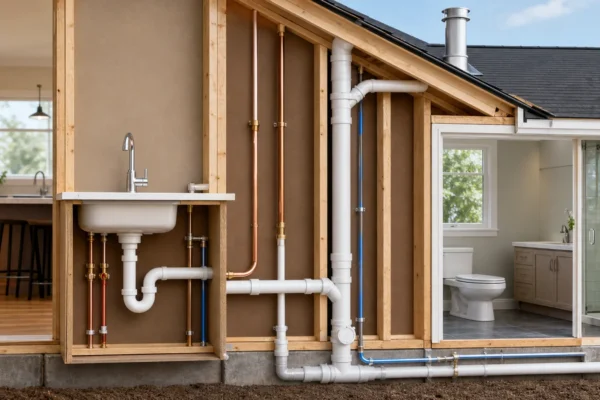
Drains and Pipes Guide: The Complete Homeowner’s Overview of What’s Behind Your Walls [2026]
Drains and Pipes Guide: The Complete Homeowner’s Overview of What’s Behind Your Walls [2026] Water disappears down the…

Why Are My Drains Slow? Causes, Diagnosis, and 3 DIY Fixes [2026]
If you’re asking why are my drains slow, the answer almost always starts with one question: is it…