
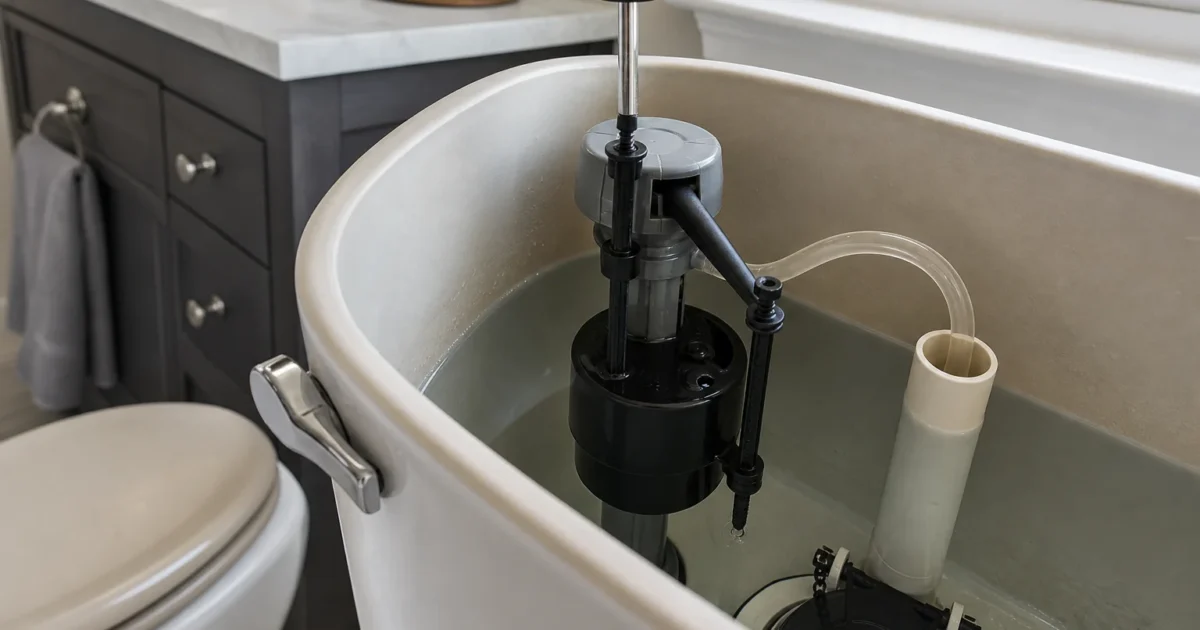
If your toilet is running constantly or flushing weakly, the fix is often a single adjustment screw inside the tank. How to adjust toilet tank water level depends on which fill valve your toilet uses — a float-cup valve such as the Fluidmaster 400A, a twist-lock valve, a top-dial valve, or an older ball-float. The five steps below take about 15 minutes with a screwdriver, and if adjustment alone does the job, it costs nothing.
Different fill valves adjust differently, so it helps to identify your toilet brand and model — the brand and fill-valve type are often linked.
TL;DR: Remove the tank lid. Locate the fill valve. Adjust the float height so the tank fills to about 1/2 inch below the top of the overflow tube — or to the stamped waterline if your tank has one. Flush to confirm. Done.
How to Adjust Toilet Tank Water Level: Find the Right Target First
Before touching anything inside the tank, you need to know where the water should stop — because the entire fix depends on whether you’re moving the float up or down.
The fill valve controls tank water level through a float mechanism. When the float drops during a flush, the valve opens and water refills the tank. When the float rises to the set height, the valve shuts off. If that shutoff point is set too high, water spills into the overflow tube and the toilet runs continuously — wasting water every minute. If it’s set too low, there isn’t enough stored water to complete a full flush.
The target for most toilets is about 1/2 inch below the top of the overflow tube — the tall vertical tube connected to the flush valve in the center of the tank. This Old House suggests a level “about an inch below the top of the overflow tube” (This Old House running-toilet guide). Some tanks also have a stamped or molded waterline on the inside wall; when that line is present, it overrides the 1/2-inch general rule and you follow the manufacturer’s mark instead (TOTO installation manual, Lowe’s weak-flush guide).
A quick diagnostic flush shows you which direction to move: remove the tank lid, flush once, and watch where the water settles. If it creeps up to or past the overflow tube, the float is set too high. If the flush feels weak and the water stops more than an inch below the overflow, the float is too low.
If a running toilet has been wasting water for weeks, our free Water-Waste Calculator can show you the daily and monthly impact so you know what this fix is actually saving you.
Identify Your Fill Valve Type Before Adjusting
Modern toilets use one of four fill-valve designs, and the adjustment method is different for each. Remove the tank lid, set it flat on a towel somewhere safe, and identify which type you have:
Fluidmaster 400A / 400H (float-cup valve) — The most common valve in North American toilets. It’s a vertical cylinder with a round plastic float that slides up and down on the valve body. There’s an adjustment screw at the top. The 400H adds a separate dial to fine-tune the bowl refill (Fluidmaster 400H guide).
Korky 528 / 528MP (twist-lock valve) — A taller fill valve with a similar float mechanism, but height adjustment is done by twisting the upper half counterclockwise to unlock it, sliding the valve body to the target height, and twisting back to lock (Korky 528 instructions).
TOTO fill valve (top-dial adjuster) — TOTO’s proprietary fill valve has a dial at the very top marked “+” to raise the level and “−” to lower it. You turn it with a flathead screwdriver (TOTO installation manual).
American Standard universal fill valve — American Standard’s FAQ puts its adjustment screw “on the side of the fill valve”. Turn the adjustment screw clockwise to raise the level, counterclockwise to lower it; American Standard targets 1/4 to 1/2 inch below the overflow tube (American Standard FAQ).
Old ball-float valve — A horizontal arm with a bulb float at the end. Common on toilets made before the mid-1990s. The TOTO Japan service guide says to bend the float arm at its middle, a little at a time, because bending it at its base can break it (TOTO Japan tank-water service page).
How to Adjust Toilet Tank Water Level: Step-by-Step
You’ll need: a flathead or Phillips screwdriver, a towel, and about 10–15 minutes.
Remove the lid and assess
Lift the tank lid with both hands and set it flat on a towel away from foot traffic — a cracked tank lid can cost $50–$200 to replace. Look inside and identify the fill valve, the overflow tube, and the float mechanism.
If a lot of water is running in the tank, TOTO’s Japanese service guide says to close the shutoff valve before you start (TOTO Japan tank-water service page). If the shutoff valve feels frozen, corroded, or won’t close fully, stop and call a plumber before proceeding — a failed stop valve turns a simple tank adjustment into a house-shutoff job.
Flush and mark the current level
Turn the water on fully if you closed it. Flush the toilet and watch the refill cycle. Use a pencil to mark where the water stops on the inside wall of the tank or on the overflow tube itself. This gives you a reference point and tells you exactly how far to move the float — and in which direction.
Before adjusting, also check whether the fill valve is cycling on and off on its own without anyone flushing. If it is, that pattern — called phantom flushing — points to a leaking flapper rather than a fill-valve calibration problem. Mark the tank level, close the shutoff valve, wait 10 minutes, and check whether the water has dropped. If the level drops while the valve is off, you have a flapper leak, not a water-level issue. Fluidmaster’s troubleshooting points the same way: for a fill valve that “TURNS ON AND OFF BY ITSELF”, its fix is to “CLEAN FLAPPER AND DRAIN SEAT” (Fluidmaster 400A instructions).
Adjust the float for your valve type
Fluidmaster 400A/400H: Turn the adjustment screw at the top of the fill valve — clockwise raises the water level, counterclockwise lowers it. Fluidmaster’s instructions say “Turn the tank water level adjustment screw clockwise to raise the float” and “Flush to reset water level”, so make gradual adjustments and flush between each change (Fluidmaster 400A instructions, Fluidmaster 400H guide). On a 400H, the guide fine-tunes the bowl separately, with a dial: “IF TOO LOW: Turn the dial towards the open position” (Fluidmaster 400H guide). Use the screw, not the dial, for tank height.
Korky 528: Shut off the water supply. Twist the upper half of the valve body counterclockwise to unlock it. Slide the entire valve body up or down until its waterline mark sits about 1/2 inch below the overflow tube. Twist the upper half clockwise until the ribs lock firmly into the pegs. Reinstall the mounting nut as Korky’s instructions say, “Hand tighten only, beveled side up”; Korky’s warranty excludes damage from “over-tightening of mounting nut” (Korky 528 instructions).
TOTO: Use a flathead screwdriver at the top of the fill valve. Turn clockwise toward “+” to raise the water level, counterclockwise toward “−” to lower it. Flush after each adjustment and let the tank fully refill before assessing the result (TOTO installation manual).
American Standard: Turn the adjustment screw clockwise to raise the level, counterclockwise to lower it. Target 1/4 to 1/2 inch below the overflow tube and flush to confirm (American Standard FAQ).
Old ball-float: Gently bend the float arm slightly upward at its midpoint to raise the water level, or downward to lower it. Work in small increments — overbending is difficult to reverse. Never bend at the threaded end closest to the valve body.
Check the refill tube position
Before replacing the lid, verify that the thin refill tube — the small flexible hose running from the fill valve to the overflow tube — is clipped so it discharges into the top of the overflow from above the waterline, not submerged inside it. Korky’s instructions warn: “Make sure the refill tube is not pushed into the overflow tube; this can create a siphon” (Korky: how to replace a fill valve). A siphon drains the tank slowly and makes the valve refill again and again — exactly the symptom you were trying to eliminate.
One exception: Mansfield tower-style flush valves don’t use the standard refill clip. On those toilets, the refill tube inserts into a dedicated hole at the top of the flush-valve cap rather than clipping to the overflow tube.
Test, confirm, and check for drips
Turn the water supply on fully and let the tank fill to the new level. Confirm the fill valve shuts off cleanly. Flush twice and watch where the water settles each time — if it consistently lands at the target line and the valve closes without cycling, the adjustment is complete. Also check below the tank, at the supply connection and the base of the fill valve, for drips — especially if you loosened the mounting nut.
Common Mistakes That Make the Problem Worse
Manufacturer instruction booklets and plumbing forums — particularly Fluidmaster’s own 400A guide and the Terry Love forum — identify the same set of mistakes recurring across DIY attempts:
Misdiagnosing a flapper leak as a water-level issue. Fluidmaster’s 400A instructions specifically call this out: a fill valve that cycles on and off by itself usually means the tank is losing water through the flapper or flush-valve seat, not that the float needs adjustment. The dye test is the fastest way to confirm — and spending time on float adjustment when the flapper is the real culprit wastes an afternoon without fixing anything.
Setting the level too high. Even a level that sits flush with the overflow rim — not visibly running over — can cause slow, continuous drainage into the bowl. The fill valve then cycles on every few minutes to top off the tank. Target a clear gap: Fluidmaster’s guide puts the level “roughly ½ inch below top of overflow pipe” (Fluidmaster 400H guide).
Overtightening plastic mounting or coupling nuts. Both makers say to hand-tighten: Korky’s instructions say “hand-tighten only” (Korky: how to replace a fill valve), and Fluidmaster’s 400H guide says “DO NOT OVERTIGHTEN” and that “Overtightening may crack the fill valve or tank causing flooding” (Fluidmaster 400H guide). Cracked plastic doesn’t seal — it leaks.
Submerging the refill tube inside the overflow. Even 1/2 inch of submersion below the tank waterline creates a siphon. This produces phantom refills that are impossible to resolve with float adjustment alone.
Using the bowl-refill dial instead of the tank-level screw (400H only). The Fluidmaster 400H has two separate controls — one for tank water height and one for bowl refill volume. Its guide says the valve is “pre-set to fill the proper bowl water level in most toilets straight out of the box” and fine-tunes the bowl with the dial: “IF TOO HIGH: Turn the dial towards the closed position” (Fluidmaster 400H guide). Leave the dial alone unless the bowl level is wrong.
When the Problem Isn’t the Water Level
Not every running or cycling toilet needs a float adjustment. Two failure modes look like water-level problems but aren’t:
Phantom flushing — tank refills without anyone flushing. The most common cause is a leaking flapper, not the fill-valve calibration. Water seeps past the rubber seal into the bowl; the tank level drops below the float shutoff; the fill valve kicks on to top it off. Run the food-coloring test (a few dye tablets in the tank, 15 minutes without flushing, check the bowl). Color in the bowl = flapper leak. See our guide to replacing a toilet flapper for the step-by-step fix — it’s a $5–$15 part and 15 minutes of work.
Water level drops after you close the shutoff valve. This eliminates the fill valve as the cause. If the level was correct and water still disappears with the supply shut off, the leak is below the waterline — most commonly the flapper, but possibly a cracked flush-valve seat or overflow tube. Float adjustment won’t solve it.
Fill valve won’t shut off regardless of float position. When the valve keeps running at every float height, the valve itself is clogged, worn, or internally failed. Adjustment won’t help. For a fill valve that “WON’T TURN OFF”, Fluidmaster’s troubleshooting is to “REMOVE CAP AND CHECK FOR DEBRIS” and to “REPLACE FILL VALVE SEAL” (Fluidmaster 400H guide). If that doesn’t stop it, replace the valve.
Call a plumber when: the shutoff valve is frozen or won’t close, the tank shows any visible cracking, the toilet is pressure-assisted (a steel pressure vessel sits inside the tank rather than open water), or the fill-valve mounting nut won’t budge without the tank flexing or shifting. Angi specifically notes that pressure-assisted toilets are rarely a DIY repair and usually need a plumber (Angi toilet repair cost guide).
Replacement Fill Valves and Pricing
When the existing valve won’t hold an adjustment or won’t close cleanly, replacement is the repair — not more adjustment. Home Depot’s guide rates fill-valve replacement “Difficulty: Beginner” (Home Depot fill-valve guide). The common replacements:
| Valve | Best for |
|---|---|
| Fluidmaster 400A | Most standard gravity toilets |
| Fluidmaster 400H PerforMAX | High-efficiency toilets. Its guide adds a separate dial to fine-tune the bowl refill (Fluidmaster 400H guide) |
| Korky 528 QuietFILL | Korky says it fits “most 2-piece and 1-piece toilets” (Korky QuietFILL) |
| Korky 528MP QuietFILL Platinum | Korky calls it “ideal for toilets made since 1994 (1.6 GPF or less)” (Korky QuietFILL Platinum) |
| Kohler GP1138930 | Kohler’s Silent Fill valve kit for a valve with an “All gray stem” (Kohler service parts brochure) |
| TOTO TSU99A.XR | TOTO toilets: a distributor lists it as compatible “for all current TOTO toilet models” (Pacific Plumbing TSU99A.XR) |
If you’d rather have a plumber handle it: Angi puts a running-toilet repair at “$100–$400” and a valve replacement at “$50–$150”, with plumbers charging “$45 to $200 per hour” (Angi toilet repair cost guide). HomeGuide says “A simple toilet valve replacement typically costs $70 to $150” (HomeGuide toilet repair cost guide).
Quick Reference: Symptom → Cause → Fix
| Symptom | Most likely cause | Fix |
|---|---|---|
| Toilet runs continuously | Float set too high — water spills into overflow | Lower the float 1/2 inch at a time |
| Weak or incomplete flush | Float set too low — not enough water stored | Raise the float; flush after each adjustment |
| Intermittent phantom refill | Flapper leak OR siphoning refill tube | Dye test; clip refill tube above overflow waterline |
| Water level correct, toilet still runs | Flapper not sealing or flush-valve seat worn | Replace flapper; inspect seat |
| Fill valve won’t shut off at any float height | Failed or clogged fill valve | Replace fill valve ($8–$25 parts) |
| Drip below tank after adjustment | Cracked or overtightened mounting nut | Replace fill valve and nut |
How much does it cost to adjust toilet tank water level?
If your existing fill valve responds to adjustment, the parts cost is $0 — just a screwdriver and 10 minutes. If the valve has failed, you need a replacement fill valve (see the table above). Angi puts a valve replacement at $50–$150.
How do I know the correct toilet tank water level?
Most toilets target about 1/2 inch below the top of the overflow tube. Some tanks have a stamped or molded waterline mark on the inside wall — when that mark is present, use it instead of the 1/2-inch rule. This Old House suggests a level “about an inch below the top of the overflow tube” (This Old House running-toilet guide). American Standard targets 1/4 to 1/2 inch below.
Why does my toilet keep running after I adjusted the float?
The most common reason is a leaking flapper rather than a fill-valve problem. Run the dye test: add food coloring to the tank, wait 15 minutes without flushing, and check the bowl. Color appearing in the bowl confirms the flapper is leaking — the float adjustment won’t fix that.
Can I adjust a Fluidmaster 400A without shutting off the water?
Yes. For a simple float-screw adjustment, you don’t need to close the supply valve. Shut it off when you change the valve body’s height or replace the whole fill valve.
What happens if the refill tube is pushed down into the overflow tube?
It creates a siphon: water slowly drains from the tank back through the tube, the fill valve keeps cycling to compensate, and you get a continuously running or phantom-flushing toilet. Clip the refill tube so it discharges from above the overflow top — not submerged inside it.
When should I replace the fill valve instead of adjusting it?
Replace it when the valve won’t shut off regardless of float position, when the adjustment mechanism is stripped or cracked, or when the valve produces mineral-fouled or erratic shutoffs. Korky notes that fill valves “typically have a lifespan of 5-7 years, depending on the type of water you have” (Korky: how to replace a fill valve).
Sources
- Fluidmaster 400A Installation Instructions
- Fluidmaster 400H PerforMAX Fill Valve Manual
- Korky 528 QuietFILL Instructions
- Korky: How to Replace a Toilet Fill Valve
- TOTO USA Installation Manual
- TOTO Japan: Tank Water Adjustment Guide
- American Standard: Fill Valve FAQ
- Kohler: How to Fix a Running Toilet
- Lowe’s: Fix a Weak-Flushing Toilet
- Home Depot: How to Replace a Fill Valve
- This Old House: How to Fix a Running Toilet
- This Old House: Common Toilet Tank Failures
- Terry Love Plumbing: Refill Tube Siphon Thread
- Angi: Toilet Repair Cost Guide
- HomeGuide: Toilet Repair Cost
Educational content only. Not a substitute for licensed professional advice. Local plumbing codes vary by jurisdiction. Use of any guidance from this guide is at your own risk.
Parts for this repair
As an Amazon Associate, plumbingbythebook earns from qualifying purchases. Links below are affiliate links — they cost you nothing extra.
- Fluidmaster 400A Universal Fill Valve — The most common toilet fill valve in North America — $9–10 at most hardware stores; adjusts with a single screwdriver.
- Fluidmaster 400H PerforMAX Fill Valve — Upgraded version with a separate bowl-refill dial for HET toilets — $14–15.
- Korky 528 QuietFILL Fill Valve — Twist-lock design for quiet, tool-free height adjustment — $8–9.
Related guides
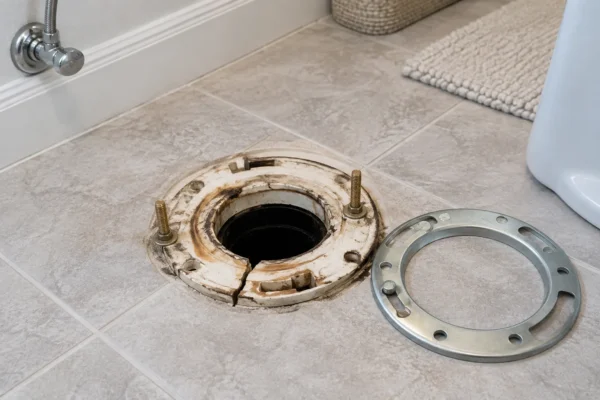
Cost to Repair a Toilet Flange: DIY vs. Plumber [2026]
The cost to repair a toilet flange runs about $145 to $350 with a plumber, according to Angi,…
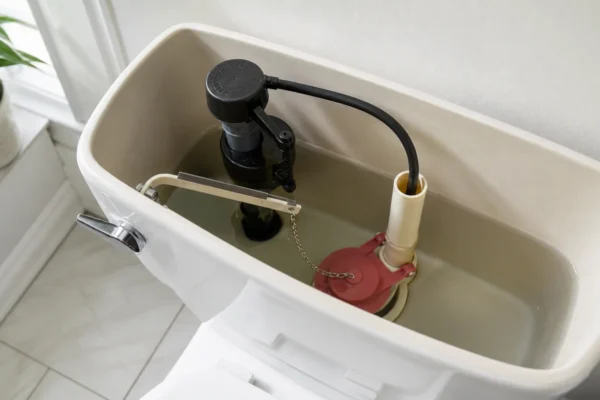
How to Identify Your Toilet Flush Valve [2026]
Pull off the tank lid to fix a running toilet and you’ll find one of two very different…
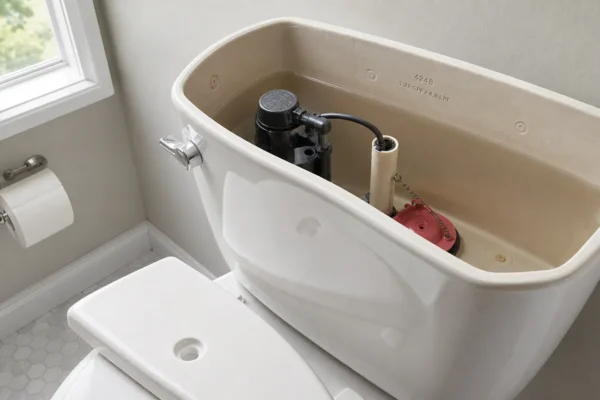
How to Identify Your Toilet Flapper by Brand [2026]
Pop the tank lid to replace a leaking flapper and you’re staring down a hardware-store aisle of red…