
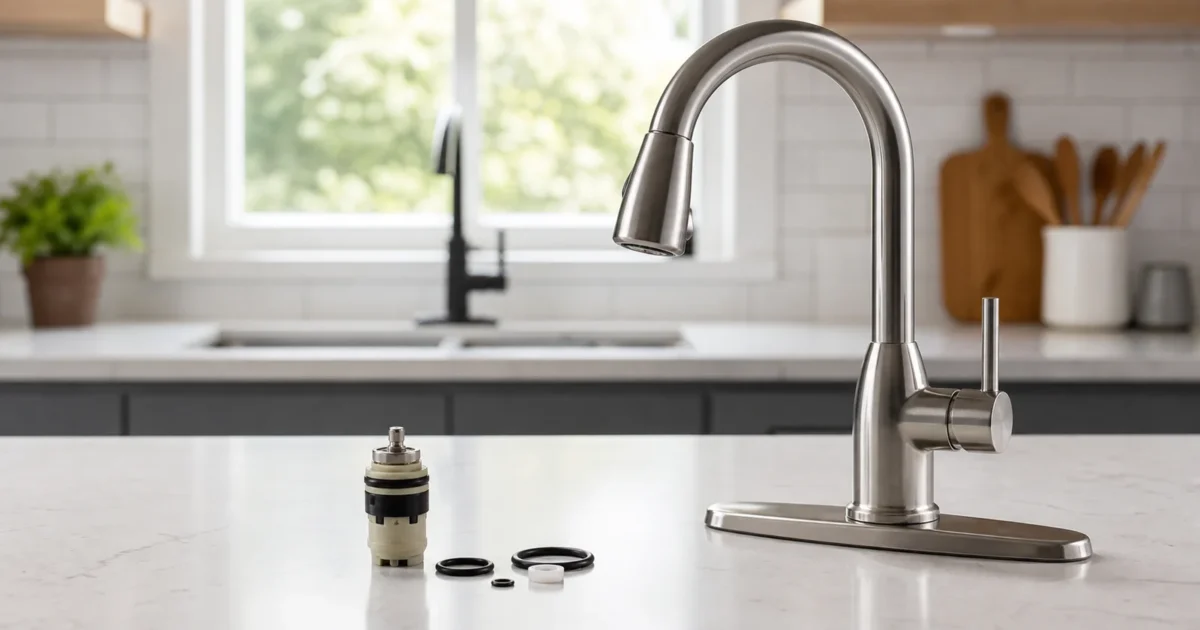
The cost to repair a faucet runs from a few dollars in parts if you do it yourself to $100-$400 if you call a plumber, with most homeowners landing near $270 for a professional visit, according to Angi. But “repair” isn’t the only option on the table — sometimes the honest answer is to replace the whole faucet instead of nursing along a worn one. This page walks through all four paths (DIY repair, pro repair, DIY replacement, pro replacement), what actually drives the price in each, and the specific conditions that should push you toward a plumber instead of a wrench.
For how faucet repair stacks up against other common household repairs, see our data study on what plumbing repairs cost, DIY vs. a pro.
How Much Does It Cost to Repair a Faucet?
DIY faucet repair — replacing a worn washer, O-ring, valve seat, or cartridge while keeping the existing faucet — typically costs $5 to $130 in parts, per Angi’s part-cost breakdown. Hiring a plumber for the same repair costs $100 to $400, averaging around $270 (Angi). If the faucet itself needs to go rather than just an internal part, DIY replacement runs $30 and up for the fixture (This Old House), while professional replacement runs $100 to $600 or more depending on the faucet type and location (HomeAdvisor, This Old House).
| Line item | DIY cost | Pro (parts + labor) | Source |
|---|---|---|---|
| O-rings, washers, gaskets, seals | $1-$10 | included below | Angi |
| Valve seats | $5-$10 | included below | Angi |
| Cartridges | $10-$100 | included below | Angi |
| Ceramic disks / stems | $20-$50 | included below | Angi |
| Pro faucet repair, any type | – | $100-$400 (avg ~$270) | Angi |
| Bathroom faucet repair (by location) | – | $60-$200 | Angi |
| Kitchen faucet repair (by location) | – | $100-$250 | Angi |
| DIY faucet replacement (fixture only) | $30-$200+ | – | This Old House / Home Depot |
| Pro bathroom faucet replacement | – | $170-$360 | HomeAdvisor |
| Pro kitchen faucet replacement | – | $200-$500+ | HomeAdvisor |
These are ranges, not quotes — the number you’ll actually pay depends on the faucet type, whether hard water has seized any parts, and whether the job stays a simple repair or grows into a replacement. To estimate your specific job, use our free Plumbing Repair Cost Estimator.
What Drives the Cost (the Honest Spread)
The part itself is rarely the expensive piece. This Old House rates a basic leaky kitchen faucet repair as easy, costing $4-$8 and taking 20-30 minutes, and Home Depot calls cartridge replacement an intermediate job doable in under two hours. What actually moves the price is labor and risk. A plumber’s bill is dominated by hourly rates of $45-$200 (Angi), plus HomeAdvisor’s typical service-call fee of $100-$250 (which usually covers the first hour) and trip fees of $50-$300 depending on distance (HomeAdvisor). That’s why a 20-minute cartridge swap can still price out like a full service call once a plumber is on-site.
Hard water is the other cost driver. The USGS confirms hard water causes mineral buildup in plumbing fixtures (USGS), and that buildup is exactly what seizes a cartridge or stem in place. Trade-forum professionals on Terry Love describe stuck cartridges requiring specialized pullers, and failed removal attempts that scratch or gouge the valve body — turning a job that should have cost $10-$100 in parts into a valve-body replacement instead (Terry Love). Manufacturer warranties can offset the parts side: Delta, Moen, and Kohler all offer limited lifetime coverage on non-electronic faucet parts and finishes for the original owner, but all three exclude labor (Delta, Moen, Kohler) — so the warranty rarely makes the whole job free, just the part.
Repair vs. Replace — the Honest Math
Repair is almost always the cheaper first move on a faucet under about 10-12 years old with a single, identifiable failure — the part alone runs $1-$100, and This Old House and Home Depot both rate the basic jobs as easy to intermediate (Angi, This Old House). The math flips toward replacement as the faucet ages and the failures stack up. Angi puts typical bathroom faucet life at 15-20 years, and its repair-vs-replace guide names recurring repairs, extensive corrosion, and worn threads as the specific signals that another repair isn’t worth it (Angi).
Run the break-even over a real horizon rather than one repair at a time. A single DIY repair on a younger faucet costs $5-$100; two repeat repairs over 10 years on an older one run roughly $10-$200 in parts before your time is counted (Angi). Compare that to a clean DIY replacement at $30-$200+ for the fixture (This Old House, Home Depot) that also resets the seals, cartridge, and finish all at once. Once a faucet is old enough that a second or third repair is on the table, the replacement often buys more useful life per dollar than another patch — and a new WaterSense-labeled faucet can save the average family about $250 in water and electricity costs over its lifetime on top of that (EPA WaterSense).
Should You DIY It or Hire a Pro?
The savings case for DIY repair is real but conditional. Parts run $1-$100 against a $100-$400 professional visit — call it $70-$300 saved on a straightforward job (Angi). That gap only holds up if you can shut off the water, correctly identify the failed part, and get the faucet back together without stripping a screw or misplacing an O-ring — Moen’s own service documentation warns that O-rings and grommets must land in the correct grooves or the repair will leak (Moen).
Before you buy a part, find your exact cartridge with our free Repair Finder so the first part you buy is the right one — a mismatched cartridge is the most common way a cheap repair turns into a second trip to the store.
Professional repair is worth the premium when the failure is unclear, the fixture is old or corroded, or you simply can’t risk a mid-repair mistake turning off your only sink. It also carries a workmanship warranty in many cases — This Old House recommends asking plumbers about labor and parts warranties up front (This Old House) — while a manufacturer’s own warranty on the part still excludes labor (Delta).
When to Call a Pro
A few conditions should override the DIY math regardless of the dollar savings:
- Water is leaking below the sink, into a cabinet, or behind a wall. This moves from a repair decision to a damage-control one — HomeAdvisor lists water damage restoration at $1,360-$6,300, separate from the plumbing repair itself (HomeAdvisor).
- A cartridge or stem is seized and won’t move with reasonable force. Forcing it is how a $10-$100 part turns into a scratched or gouged valve body and a much bigger bill (Terry Love).
- The shutoff valves don’t fully close, are frozen, or are missing. You need a working shutoff before it’s safe to open the valve body at all.
- You live in a rental, condo, or multi-unit building. Landlords typically handle plumbing repairs and maintenance (FindLaw), and Delta’s own warranty treats multi-family use differently — 10 years, versus a lifetime for an owner-occupied home (Delta) — because a failed DIY shutoff there can affect other units.
- The faucet has electronics, sensors, or a touchless feature. Delta and Moen both cap electronic-parts coverage at 5 years, well short of their lifetime coverage on standard mechanical parts (Delta, Moen), and generic repair parts don’t apply.
- The faucet or fixture is historically significant. The National Park Service’s preservation standards favor repair and sensitive, like-for-like replacement over a standard swap (NPS).
DIY stays reasonable when the shutoffs work, the part is correctly identified, and you can tolerate an hour or two under the sink. Past that line, the $70-$300 you might save in labor is smaller than the cost of a mistake.
How to Choose and Vet a Plumber
If the job is past the DIY line, a few minutes of vetting protects the quote. Describe the actual symptom — “single-handle bathroom faucet, drips from the spout when off” — so the estimate reflects the real job instead of a worst-case guess. Ask directly whether the plumber is licensed and insured, and get the price in writing before work starts; This Old House recommends confirming labor and parts warranties as part of that conversation. A like-for-like repair or direct faucet replacement in the same location typically doesn’t require a permit — NYC and Philadelphia both exclude simple faucet repair or replacement from permitting when valves and piping aren’t altered (NYC Buildings, Philadelphia) — but ask if the scope has grown into moving a fixture or adding a line, since that’s what triggers one. Get two or three quotes; a wide spread usually means one plumber is pricing in a stuck cartridge or corrosion risk that another isn’t.
If you’d rather confirm the cause before calling anyone, our Complete Guide to Faucet Repair and Why Is My Faucet Leaking cover the diagnostic step, How to Identify Faucet Brand and Model walks through identification, and our cost to replace a faucet cartridge breakdown digs deeper into the single most common faucet repair.
Is it worth repairing a faucet myself?
Usually, if the faucet is under about 10-12 years old, the shutoffs work, and you can identify the failed part. Parts run $1-$100 versus a $100-$400 pro visit, saving roughly $70-$300 (Angi). If the part is seized or the shutoffs are unreliable, the risk outweighs the savings.
How much does a plumber charge to repair a faucet?
Plan on $100-$400, averaging near $270, per Angi. Bathroom faucet repairs run $60-$200 and kitchen faucet repairs run $100-$250 on average, with plumber labor billed at $45-$200 per hour (Angi).
Should I repair the faucet or replace it entirely?
Repair if this is the first failure on a faucet under roughly 15 years old with working shutoffs. Replace if the faucet is near or past 15-20 years old, has recurring repairs, visible corrosion, or worn threads — Angi’s own guidance names those as the specific replacement triggers (Angi).
How long does a faucet repair take?
A basic repair like a washer or O-ring swap can take 20-30 minutes (This Old House); cartridge replacement is rated intermediate and typically under two hours (Home Depot). A seized part or unfamiliar brand can push that well past two hours.
Do I need a permit to repair or replace a faucet?
No, in most cases. A like-for-like repair or direct replacement in the same location typically isn’t permitted work in cities like New York and Philadelphia, as long as valves and piping aren’t altered (NYC Buildings, Philadelphia). Moving a fixture or adding a supply line can change that.
Does a manufacturer’s warranty make the repair free?
Sources
- Angi – Plumber Cost to Fix a Leaky Faucet
- Angi – Should I Repair or Replace a Leaky Faucet
- Angi – How Long Do Bathroom Faucets Last
- HomeAdvisor – Plumber Cost
- HomeAdvisor – Who to Hire for Faucet Replacement
- This Old House – How to Repair a Leaky Faucet
- This Old House – How to Replace a Faucet
- This Old House – Plumbing Cost
- Home Depot – How to Replace a Cartridge in a Faucet
- Delta – Faucet Warranty
- Moen – Cartridge Service Kit Repair Guide
- Kohler – Faucet Warranty
- EPA WaterSense – Statistics and Facts
- USGS – Water Hardness
- Terry Love – Stuck Cartridge Discussion
Educational content only. Not a substitute for licensed professional advice. Local plumbing codes vary by jurisdiction. Use of any guidance from this guide is at your own risk.
Get the homeowner’s plumbing repair toolkit checklist – the tools, parts, and decisions every homeowner should have on hand. [Free download – enter your email]
Related guides
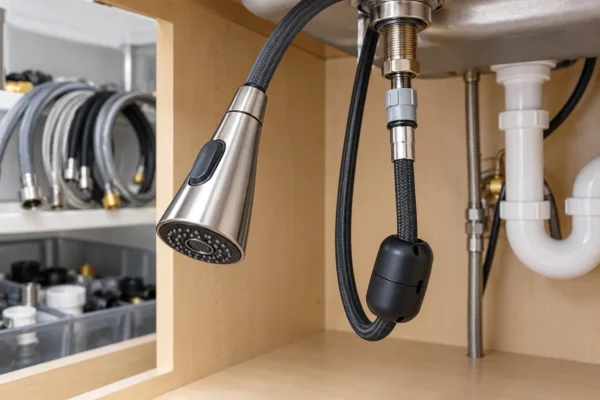
Replacement Hose for Pull-Down Kitchen Faucet: How to Tell Which Fits
You have a pull-down kitchen faucet that won’t retract, drips under the sink, or has a cracked hose,…
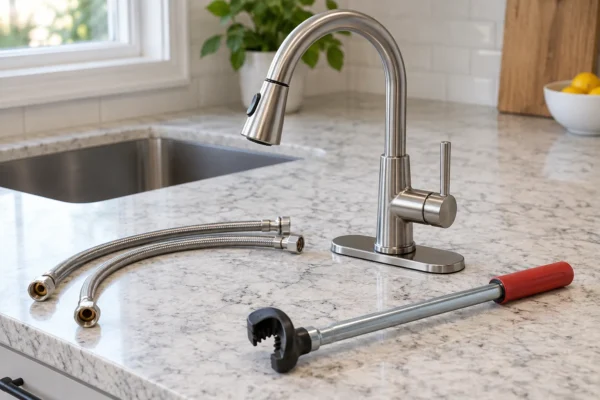
Cost to Install a Faucet: What the Labor Actually Runs [2026]
The cost to install a faucet with a professional is usually a low-hundreds job: Home Depot lists an…
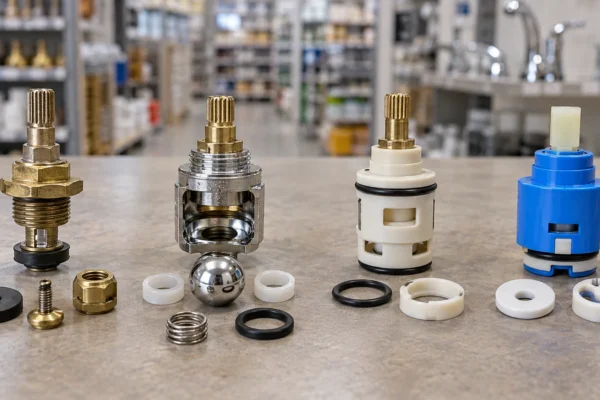
Faucet Valve Type Identification Chart: Cartridge, Ball, Compression, and Ceramic Disc [2026]
This faucet valve type identification chart covers the four mechanisms hiding inside almost every residential sink faucet —…