
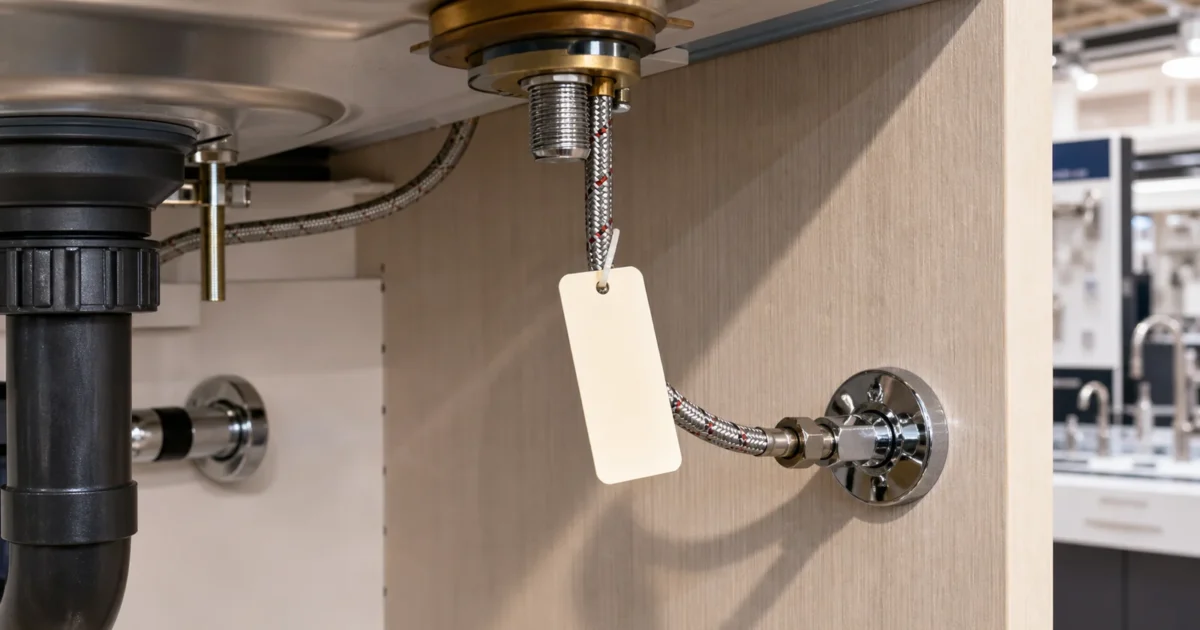
Buying the wrong pfister faucet cartridge is exactly as expensive as it sounds. You pull apart a dripping single-handle kitchen faucet, order what looks right from a photo, wait two days for delivery — and the stem is too short. Start over. The only protection against that loop is knowing the exact cartridge part number before you order, which means knowing your faucet’s model number, the model’s cartridge part number from the parts diagram, or — as a last resort — the removed cartridge itself.
Pfister (formerly Price Pfister) makes cartridges for kitchen faucets, single-handle bathroom faucets, widespread lavatory faucets, and tub and shower valves, and those cartridges are not interchangeable across those families. A ceramic disc cartridge from a widespread bathroom faucet won’t fit a single-handle kitchen faucet, and even within the same product family, different model generations use different pfister faucet cartridge numbers. “It’s a Pfister” is step one — not the answer.
This guide walks you through four methods in order from fastest to most involved. Most homeowners solve it in Method 1 or Method 2 without touching a wrench.
Method 1: Find the Pfister Model Number First
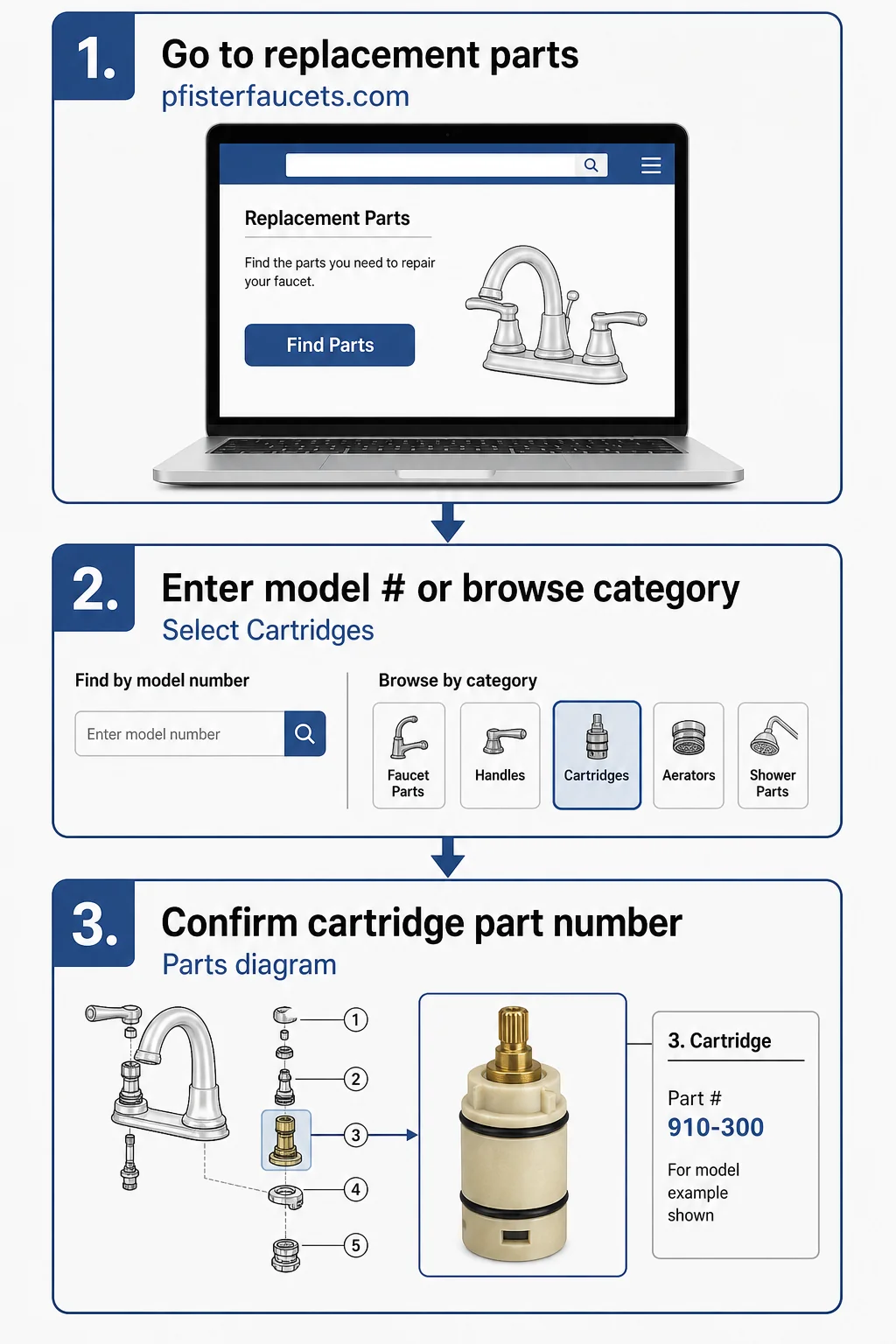
The Pfister model number is the shortest path to the correct replacement cartridge. Once you have it, Pfister’s own parts page routes you directly to the product’s parts diagram and the exact cartridge part number.
Where to look for the model number:
Start under the sink. For most lavatory and kitchen faucets, the Pfister model number is on one of three surfaces: the underside of the faucet shank (the threaded post that passes through the countertop above the mounting nut), a small hang-tag attached to a braided supply line or quick-connect hose weight, or the back of the spout body.
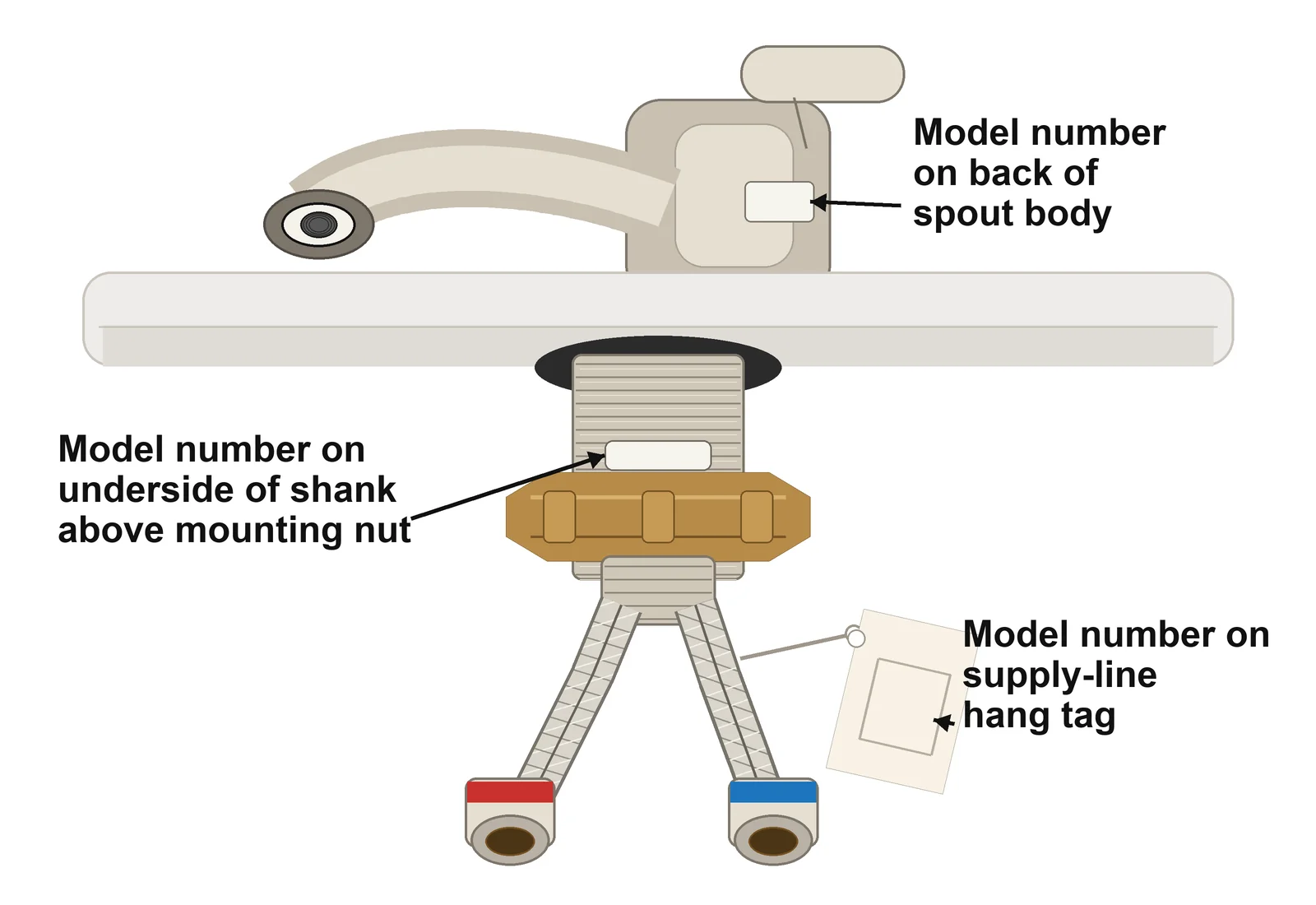
If you kept the original box, installation guide, or receipt, the model number will be on all three. Pfister product pages confirm this — the Avalon widespread lavatory faucet carries the model LG49-CB1C in the product header, where the suffix C indicates polished chrome. That suffix matters: the finish suffix can affect trim parts even when the internal cartridge is the same across finishes.
On a tub or shower valve, body markings may be behind the escutcheon. If the trim has never been removed and the water can be shut off safely, pulling the trim reveals the valve body where a series code or model number may be stamped.
What a Pfister model number looks like: a letter-digit combination such as LG49-CB1C for a widespread lavatory, or a similar alphanumeric string. It is not the UPC, not the serial number, not the bar code.
Once you have the model number: go to Pfister Replacement Parts, enter the model number, and open the parts diagram for that product. The diagram labels every component — including the cartridge part number your faucet requires. Pfister’s warranty support also asks for the model number and purchase information when homeowners contact them about parts, so having it ready speeds up any support call.
Method 2: Confirm the Brand Mark and Use Pfister’s Category Browser
If the model number isn’t visible, Pfister’s replacement-parts page still lets you browse by fixture category — which narrows the cartridge options before you pull anything apart.
Pfister branding clues to look for:
The Pfister name (or its former name, Price Pfister) appears on the handle button, handle cap, escutcheon, aerator housing, or a supply-line tag on many fixtures. Older units may say “Price Pfister” in full; newer products use “Pfister” only. Per Wikipedia, the company’s name change from Price Pfister to Pfister is the same brand lineage with the same parts support path, so either name points you to pfisterfaucets.com.
Pfister-specific terminology that confirms the brand — even when the logo isn’t visible:
- Pforever Seal — Pfister’s name for the ceramic disc valve technology used on products like the Avalon series. If you see this term in your installation paperwork, you have a Pfister.
- Pfast Connect, TiteSeal, Push & Seal — Pfister-specific assembly system names that appear in installation guides and product descriptions.
- Shower valve series codes — Pfister’s installation-and-repair video library separates cartridge procedures by series:
OX8,JX8,VB8, andJV8. If any of those codes are stamped or cast on the shower valve body after you remove the trim plate, that is a strong Pfister identifier — and the correct series code is the information Pfister needs to route you to the right shower cartridge.
Using the category browser: The Pfister Replacement Parts page organizes parts by product type — kitchen, bathroom, tub and shower, valves, and replacement parts. Navigate to “Cartridges” within the fixture category that matches your faucet. The cartridge listings include product images and descriptions that help narrow options. Pfister’s own guidance is to contact customer service before purchasing out-of-warranty parts if you’re unsure — a 10-minute support conversation can prevent a return.
Before you order, find your exact cartridge with our free Repair Finder so you don’t make a second trip to the hardware store.
Method 3: Remove and Read the Old Cartridge
When the model-number path and brand-clue path both fail, the old cartridge is the most reliable identifier — if you can read the numbers stamped or molded into it.
Before removing: shut off the angle stop valves under the sink. If the stops don’t fully close, shut off at the main. Open the faucet handle to release pressure. Set a towel under the work area.
After removing, inspect in this order:
- The top cap or retainer nut — numbers are sometimes stamped here
- The barrel (the cylindrical body) — mold seams sometimes carry part numbers
- The stem end — check for any stamped digits at the very top where the handle attaches
- The molded plastic body — look from multiple angles under direct light; numbers can be recessed in the plastic
If the cartridge has no readable number: photograph it from five angles before doing anything else — straight-on from the top, straight-on from the bottom (showing the water inlet ports), two side views, and a close-up of the stem end. Also note: overall length, stem diameter, the color and position of any orientation marks, the style of retaining clip or retaining nut, and the number of ports on the bottom. A plumbing supply counter can match a removed cartridge to the correct replacement using that information — especially if you bring the cartridge in person.
Pfister’s own support video library reinforces how many distinct cartridge removal paths exist: separate videos cover single-handle kitchen faucet cartridges, ceramic disc cartridges for single-handle kitchen faucets, ceramic disc cartridges for widespread bathroom faucets, hot-and-cold cartridges for widespread bathroom faucets, and shower-valve cartridges by series. That range tells you that guessing which Pfister cartridge fits based on shape alone carries real risk.
Method 4: When the Brand Mark and Model Number Stay Hidden
Some faucets give up nothing — no visible logo, no under-sink tag, no paperwork. When that happens, work through these paths before spending money on parts.
Manufacturer support first. If there’s any reason to believe the faucet is Pfister, contact Pfister support from the replacement-parts page — it carries “Ask a Question” and “Contact Us” links. Pfister’s warranty process asks for the model number, purchase date, and contact information, but support staff can sometimes identify a cartridge from photos and a fixture description even without all of that.
Rule out competing brands. The Delta product identifier lets you answer step-by-step questions (room, product type, description) to narrow to a product and parts diagram — useful for ruling out Delta before assuming Pfister. The Kohler service parts page offers Scout, a photo-identification tool (labeled beta by Kohler) that accepts an uploaded photo to help find the model number — confirm any Scout result against the parts diagram. Moen’s replacement parts page provides the same entry point for Moen-suspected fixtures.
Aftermarket cross-reference as a fallback. Danco and BrassCraft both sell aftermarket parts for common Pfister, Delta, Moen, and Kohler valves and can cross-reference a removed cartridge from photos or a physical comparison at the store. For older or discontinued models, the aftermarket path may be the only parts-available option.
When replacement makes more sense than identification. If two wrong cartridges would cost more than a basic new faucet plus installation, replace the faucet. This is the honest math for builder-grade faucets where the trim is corroded, the valve body is damaged, or the parts are discontinued. Home Depot and Lowe’s both carry Pfister, Danco, and BrassCraft cartridges across their replacement-parts sections, but the homeowner still needs a confirmed part number or a matching physical cartridge before buying from those channels.
Pfister Faucet Cartridge: Quick Decision Tree
| Situation | Fastest action |
|---|---|
| Have the original box or installation guide | Read the model number → enter at Pfister Replacement Parts → open parts diagram |
| See “Pfister” or “Price Pfister” branding, no model number | Browse Pfister Replacement Parts by fixture category + Cartridges; call Pfister support if still unclear |
| No brand mark visible, faucet still assembled | Use Delta product identifier or Kohler Scout to rule out those brands; then call Pfister support |
| Shower trim removed, series code visible (OX8 / JX8 / VB8 / JV8) | Use the series code at Pfister’s installation and repair video library or support page to find the shower cartridge |
| Cartridge removed, readable number on barrel or stem | Enter the number at the manufacturer’s parts page or take to a plumbing supply counter |
| Cartridge removed, no number visible | Photograph five angles + note dimensions → take photos and cartridge to a plumbing supply counter |
| Brand unconfirmed after all of the above | Call a plumber for a one-time identification visit — cheaper than a third wrong cartridge order |
Matched your situation above? Confirm the part number on your model's parts list, then search:
As an Amazon Associate, plumbingbythebook earns from qualifying purchases. Links below are affiliate links — they cost you nothing extra.
Not sure which part you have? The faucet & valve finder narrows it to the exact part in a few questions.
When to Call a Plumber for Cartridge Identification
There are situations where the right call is a 30-minute plumber visit rather than three hours of research and two wrong parts orders.
Call a plumber when:
- The shutoff valves won’t close fully. If you can’t isolate the water supply, cartridge removal becomes a much more urgent job and risks flooding the cabinet or subfloor.
- The shower valve is behind finished tile. Getting to the cartridge for a visual identification may require cutting drywall or tile — a job where knowing the exact part before the first cut pays for itself.
- The retaining nut or cartridge is seized. A stuck cartridge sometimes signals that the valve body itself is degraded. A plumber can assess whether the valve is serviceable or needs full replacement. Delta’s notes on the RP50587 cartridge, for comparison, describe a standard removal involving an Allen wrench and bonnet nut — routine on an accessible, non-seized valve; far less routine if the hardware is corroded.
- The leak is behind the wall or under the floor. Cartridge identification is the wrong problem to be solving at that point.
Cost context: According to HomeAdvisor’s 2026 plumber cost data, professional plumber services typically range from $182 to $500, with service-call fees of $100 to $250 including the first hour and trip fees ranging $50 to $300 by market. A focused identification visit — where the plumber identifies the cartridge, gives you the part number, and may reinstall the trim — can cost less than two wrong cartridge orders and the time spent on them. Pfister’s own support page explicitly recommends contacting customer service before purchasing out-of-warranty parts if there is any uncertainty — the same logic applies to calling a plumber for a stuck or inaccessible cartridge.
What’s Next
Once you have the Pfister cartridge part number, the next step is ordering the genuine OEM part from Pfister’s replacement-parts page or a trusted plumbing supplier and following Pfister’s cartridge-replacement video for your fixture type. For a Pfister widespread bathroom faucet, note that the hot and cold cartridges are separate parts with separate part numbers — confirm both from the parts diagram before ordering.
If you’re still trying to confirm your faucet’s brand before reaching the cartridge, our guide to identifying faucet brand and model covers the brand-level identification step across all major manufacturers — including Pfister, Delta, Moen, and Kohler — and walks through how to use each brand’s online identifier.
How do I find the model number on a Pfister faucet?
Check under the sink first — the Pfister model number is usually on a hang-tag attached to a flexible supply line, stamped on the underside of the faucet shank above the mounting nut, or printed on the back of the spout body. If you have the original box or installation sheet, the model number appears on both. Once you have it, enter it at Pfister Replacement Parts to reach the parts diagram for your exact model.
Is Price Pfister the same brand as Pfister?
Yes — Price Pfister is the former name of the company now sold and supported as Pfister. The parts support path is the same: pfisterfaucets.com. Older boxes, forum posts, and some store listings still use the Price Pfister name, but it refers to the same brand lineage.
Can I use an aftermarket cartridge instead of a genuine Pfister part?
Aftermarket cartridges from Danco and similar suppliers are available for many common Pfister models and are often less expensive than OEM parts. The risk is dimensional variability — an aftermarket cartridge that’s close but not exact can leak at the ceramic seal surface. Use the supplier’s cross-reference guide to confirm the match, and prefer OEM parts when the price difference is small.
What do the Pfister shower valve series codes (OX8, JX8, VB8, JV8) mean for cartridge identification?
Those codes identify the valve body series — and the correct cartridge depends on the series, not just the trim style. Pfister’s installation and repair video library organizes cartridge replacement procedures by series. If you can see one of those codes stamped on the valve body after removing the shower trim, use it when calling Pfister support or searching the parts page; it tells support exactly which cartridge family applies.
What should I do if I removed the Pfister cartridge but can’t read a part number on it?
Photograph the cartridge from five angles: top (stem end), bottom (inlet ports), two sides, and a close-up of the stem top. Note the overall length, stem diameter, number of bottom ports, retaining clip style, and any color-coded orientation marks. Take the photos and the cartridge to a plumbing supply counter — staff can usually match it by physical dimensions and shape, especially if you also know the faucet fixture category (kitchen single-handle, widespread lavatory, shower).
Sources
- Pfister Replacement Parts — Pfister’s official replacement-parts and cartridge lookup page; organized by fixture category and accepts model-number entry
- Pfister Installation and Repair Videos — Pfister’s cartridge-removal video library, separated by fixture type and shower valve series (OX8, JX8, VB8, JV8)
- Pfister Avalon LG49-CB1C Product Page — example of a Pfister product page showing model number, Pforever Seal feature, and parts diagram link
- Delta Find Parts and Identify Product — Delta’s model-number search and guided product identifier; useful for ruling out Delta when brand is uncertain
- Delta RP50587 Cartridge Page — example of a manufacturer cartridge page with part number, valve type, and product images
- KOHLER Service & Replacement Parts — Kohler’s parts workflow including Scout photo-identification; useful for ruling out Kohler when brand is uncertain
- Moen Replacement Parts — Moen’s official replacement-parts entry point
- American Standard Parts Support — American Standard’s parts and support page
- Danco Faucet Parts — aftermarket cartridges and stems with cross-reference guides for common faucet brands including Pfister
- BrassCraft Faucet Repair — aftermarket faucet repair parts for older and generic fixtures; useful when OEM identification fails
- Home Depot Faucet Cartridges — retail channel for Pfister, Danco, and BrassCraft cartridges (confirmed part number required before buying)
- Lowe’s Faucet Cartridges — retail channel; same caveat as Home Depot
- HomeAdvisor 2026 Plumber Cost — service-call and hourly plumber cost data cited in the “when to call a plumber” section
- HomeGuide 2026 Plumber Cost — secondary plumber-cost reference
- Pfister (firm) — Wikipedia — documents the Price Pfister to Pfister name transition
- The Spruce: Types of Faucets Overview — faucet type classification (compression, ball, cartridge, ceramic disc) for generic valve-type background
Educational content only. Not a substitute for licensed professional advice. Local plumbing codes vary by jurisdiction. Use of any guidance from this guide is at your own risk.
Get the homeowner’s plumbing repair toolkit checklist — the tools, parts, and decisions every homeowner should have on hand. [Free download — enter your email]
Parts for this repair
As an Amazon Associate, plumbingbythebook earns from qualifying purchases. Links below are affiliate links — they cost you nothing extra.
- Danco Pfister Replacement Cartridge (Hot or Cold) — Danco makes OEM-compatible aftermarket cartridges for many Pfister widespread and single-handle faucets — a practical fallback when the OEM part ships slow or is discontinued. Confirm the cross-reference match before ordering.
- Pfister Genuine Replacement Cartridge — Search for genuine Pfister cartridges on Amazon — confirm the part number from your faucet’s product page or parts diagram first so you buy the exact match.
Related guides
Frost-Free Outdoor Faucet Stem: How to Identify Yours Before You Order
Your outdoor faucet drips from the spout or the handle, and the repair parts aisle is full of…
Replacement Hose for Pull-Down Kitchen Faucet: How to Tell Which Fits
You have a pull-down kitchen faucet that won’t retract, drips under the sink, or has a cracked hose,…
Cost to Install a Faucet: What the Labor Actually Runs [2026]
The cost to install a faucet with a professional is usually a low-hundreds job: Home Depot lists an…