
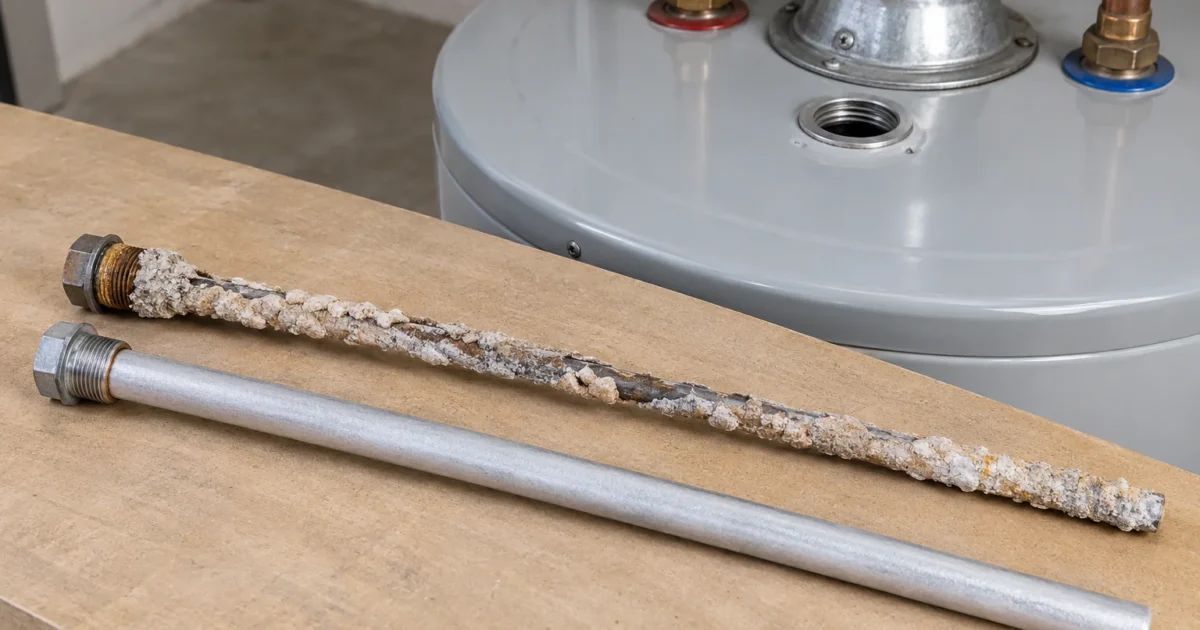
The old rod is spent, or the hot water smells like rotten eggs, or you are finally maintaining the tank. Either way you need a new rod that screws into the same opening without leaving you short of overhead room. The part is not generic. A water heater anode rod is matched by the maker’s model and serial number, by where the rod sits in the tank, and then by length, material and clearance. A matching thread alone does not settle it.
The short answer: copy the full model and serial number, find the maker’s parts drawing, work out whether your rod has its own opening or shares the hot-water outlet, and take the part number from the drawing. This page walks that lookup, charts the rods the makers document, and says where the sources disagree. It does not cover tankless heaters or RV heaters.
Start With the Complete Model and Serial Number
Brand alone does not identify the rod. A.O. Smith directs owners to its serial-number parts lookup, and Bradford White’s parts books require model and serial information (Bradford White AeroTherm parts book). Copy both from the rating plate before you shop.
According to Bradford White’s My Water Heater resource, it shows where the rating plate sits, how to read the model and serial numbers on it, and how to decode the manufacture year and month from the serial number. Rheem’s serial bulletin documents several serial formats, including older month/year ones and later plant/week/year ones, so no single “first four digits” rule decodes them all. The research found no universal character decoder that tells you the anode material by brand.
Keep three measurements apart, because they describe different features: the thread size, the rod’s diameter, and the wrench size of the hex head. Matching one tells you nothing about the others.
Outlet Anode or Plug Anode: How to Tell
The second question is where the rod lives. Bradford White distinguishes an outlet-device anode, combined with the hot-water outlet, from a plug-style anode that sits in a separate opening (Bradford White segmented-anode bulletin). Even within one product family the arrangement can differ. Bradford White’s ICON E parts book assigns outlet-style parts to some models and plug-style parts to others.
Do not read too much into what you can see from the top. According to Rheem’s replacement bulletin, a separate anode head may be concealed beneath a cap and insulation. Not seeing a hex head therefore does not prove the rod is in the outlet. Retailer wording misleads in the same way: Bradford White 415-38508-08 appears under titles that say “with heat trap” (SupplyHouse), yet Famous Supply describes it as a hex-head aluminum rod, so that phrase does not establish outlet-anode construction.
A measuring worksheet is our suggestion, not a maker’s protocol: note the overall assembly length, the rod length below the fitting, the nipple length, the remaining diameter and the clear space above the opening. A depleted rod cannot reliably show its original diameter, so compare against the authorized service part rather than expecting an exact match to the consumed rod.
That last point matters for length. State’s replacement catalog, hosted by a distributor, assigns the 32-inch service rod 100108660 to original lengths of 32 to 43 inches, the 9-inch 100108677 to originals of 9 to 15 inches, and the 44-inch 100109223 to originals of 44 inches or longer (State catalog). Our reading is that an authorized replacement can be shorter than the original, so do not insist the new rod match the old one’s length. Confirm the part against your serial number instead.
Water Heater Anode Rod: The Fit Chart
Each row pairs a tank family with the part its cited source names. These are documented examples, not an exhaustive inventory, and not a check of current stock. “Not found” means the research did not establish a detail, not that the part is incompatible.
| Maker and tank family | Style and thread | Part and material | What the source says |
|---|---|---|---|
| Rheem / Ruud / Richmond: PROE50 T2 RH95; PROG50-38N RH60; PROG50-42N RH67 PV; PROG50-38U RH60 EC1; PROG50-38U RH62 EC1 | 3/4-inch NPT | SP11309C, magnesium, 44-3/8 in long, 0.750 in diameter | Rheem’s service sheet gives the material and dimensions. The thread and the model list come from Home Depot, not Rheem. |
| Bradford White atmospheric gas RG130T*(N,X), RG140T*(N,X), RG150T*(N,X); ICON E ERE240S%-CTA, ERE250S%-CTA | Segmented, outlet device; 3/4-inch NPT, 3-1/2-inch nipple | 415-55482-00 magnesium, 415-55484-00 aluminum, 415-55486-00 A420 | Part numbers from Bradford White’s segmented bulletin; model coverage per its atmospheric-gas and ICON E books. The overall length was not found. |
| Bradford White ICON E ERE240LN%-CTA, ERE250L(N)%-CTA, ERE255T%-CTA | Segmented, plug; 3/4-inch NPT | 415-55483-00 magnesium, 415-55485-00 aluminum, 415-55487-00 A420 | Model assignment according to the ICON E book, pages 9 and 13; the 3/4-inch NPT connection is from the segmented bulletin, not the book. The book notes an alternate ERE250T construction, so follow the exact drawing. |
| Bradford White AeroTherm RE2H50S*-1NCTT | Separate hex head; 3/4-inch NPT | 415-47782-06 magnesium, 40 in long, 0.840 in diameter | Model-to-part assignment from the AeroTherm book; length and diameter from SupplyHouse. |
| Bradford White AeroTherm RE2H80T*-1NCTT | Separate hex head; 3/4-inch NPT | 415-47782-12 magnesium, 52 in long, 0.840 in diameter | Same book; dimensions from SupplyHouse. |
| Bradford White AeroTherm RE2H65T*-1NCTT | Not found | 415-47782-07; material not found | Same book, which gives the part number but not its material or thread. Supplier pages disagree on the length, so confirm it before you order. |
| A.O. Smith condensing gas Series 120-121, 40 gallon | Primary rod plus secondary outlet anode; primary 3/4-inch NPT | Primary 100108660, 32 in long, 0.84 in diameter; secondary 100300397, 16 in long, 0.80 in diameter, 5-inch nipple; magnesium | According to the Series 120-121 table. The secondary rod’s thread was not found. Do not carry this to other series. |
| A.O. Smith Series 120-121, 50 gallon | Same arrangement | Primary 100109223, 44 in long, 0.84 in diameter; same secondary 100300397; magnesium | Same table, same limits. |
| State XVR-40-YOCT Series 300; XCVT-40-YRRT Series 300; GSX-40-BCS Series 400 | Screw-in; 3/4-inch NPT | 100108660 magnesium, 32 in long, 0.84 in diameter | Ferguson makes this compatibility claim. The research did not locate an independent maker assignment. |
Three more notes from the same sources. Bradford White’s atmospheric-gas parts book directs ordering the outlet heat-trap insert with the anode, and its ICON E book identifies insert 239-45167-00. SupplyHouse identifies 224-38508-08 as an identical alternative number for 415-38508-08, though the exact dimensions of that rod are disputed between listings. And the segmented bulletin says Bradford White keeps solid rods in its service range, so a solid rod is not automatically obsolete for your tank. Exact tank assignments still come from the parts book.
Aftermarket numbers need extra care. Corro-Protec’s English table lists powered models 96387 for dedicated-port installations and 96383 for outlet installations, both 3/4-inch NPT. SupplyHouse staff suggested a flexible aluminum/zinc rod, 1027400, at 42 inches for the RE2H50S* application; that is retailer advice, not a Bradford White supersession. Reliance’s older catalog calls its 29-inch aluminum 9000029 broadly compatible but does not establish every model’s configuration.
Found your tank in the chart? Confirm the exact rod against the maker's parts book for your model and serial number before you buy, because a matching thread does not decide it:
As an Amazon Associate, plumbingbythebook earns from qualifying purchases. Links below are affiliate links — they cost you nothing extra.
Magnesium, Aluminum, A420 or Powered: What the Makers Say
No source supports a universal ranking, so this section reports what each maker says. Rheem’s bulletin 1201 and the GeoSpring G3 manual both support the idea that softened water can use up a sacrificial anode faster. They point toward inspecting to suit your water, not toward a fixed replacement interval. The replace-now criteria differ by maker: according to Bradford White’s service manual, any exposed core or substantial depletion calls for replacement, while Rheem’s bulletin 1201 uses more than six inches of exposed core at either end.
Sulfur smell. Bradford White says an A420 replacement may minimize hydrogen-sulfide odor, but it emphasizes bacterial control alongside it (Bradford White). A.O. Smith warns that untreated distribution piping can reinfect treated parts of the system (A.O. Smith bulletin 22). So choosing a rod and treating the water are related but separate decisions.
Aluminum is not an automatic hard-water answer. A.O. Smith describes an aluminum-hydroxide gel associated with aluminum anodes and relatively high-pH water, about pH 8 or above, and lists magnesium replacement among its remedies (A.O. Smith bulletin 14). Hardness and pH are different questions.
What single sources add. According to Rheem, magnesium is its longstanding standard, and conductivity affects protective current and consumption. Bradford White offers magnesium, aluminum and A420 in its segmented range, as the chart shows.
Powered rods. According to Corro-Protec, its powered rod needs grounding and continued power, and it publishes an installation guide for it (Corro-Protec guide). APCOM literature also describes a powered system for softened-water and odor applications (APCOM brochure). The two makers’ electrical specifications differ: APCOM’s brochure lists a 120 VAC power supply with 12 VDC output to its control module, while Corro-Protec’s English table gives a 24V output for its 40-to-89-gallon model and its Spanish page gives 12V for the same model. Go by the label, adapter and instructions in the kit you actually buy. Warranty claims about powered rods also conflict between pages. Read the maker’s complete warranty terms, not a headline figure, and do not assume your tank warranty is either voided or protected.
When Your Heater Limits the Choice
Finding one rod does not prove you have found all of them. The American hybrid manual identifies one anode in its 50-gallon configuration and two in its 66- and 80-gallon configurations. The A.O. Smith table above lists a primary and a secondary outlet rod.
Some tanks add electronics. The GeoSpring G3 manual requires approved replacement protection, and an aftermarket fit claim alone does not establish approval. A.O. Smith’s 2012 residential product catalog, hosted by a retailer, lists a maintenance-free powered anode on the Voltex PHPT-60 and PHPT-80; that does not describe later Voltex generations. Rheem’s Marathon guide is the exception in the other direction: its nonmetallic tank has no replacement anode requirement.
Taking the rod out for good is not a supported fix for odor. Rheem’s bulletin 1201 says not to remove the anode except for inspection or replacement, because operating with it removed will greatly shorten the life of the glass-lined tank and will exclude warranty coverage. Those warranty consequences are Rheem’s wording, not a rule for every brand.
Low Clearance, Stuck Rods and Safety Steps
Bradford White permits cutting its listed segmented replacements to fit the space. That approval is product-specific; it does not mean every solid, sensing or powered assembly may be shortened. Retailer figures show how much clearance can differ. Water Connection calls for four feet above the heater for its rigid 44-inch AR100, while Lowe’s lists 12 inches of installation clearance for the segmented 44-inch AR103. Treat those as labels on two products, not a rule for all flexible rods. For the disputed Bradford White listings, do not trust a stated clearance; get the exact figure confirmed before ordering.
For the hex head, Rheem’s general procedure specifies a 1-1/16-inch socket, while Corro-Protec specifies 1-3/16 inch for its powered rod. Water Connection recommends a six-point socket if a twelve-point one starts stripping its AR100 head. Corro-Protec suggests a breaker bar or impact wrench for hard removal, then its online removal tips and help page, or an authorized reseller that offers installation, and says you may cut the old rod during extraction while holding the lower part with pliers. That applies to the old rod, not to a new powered electrode. Opinions vary on stuck rods, so if access or removal goes beyond what the documented procedure covers, stop and call a professional.
Before the port is opened, follow your maker’s sequence. Rheem’s bulletin 1232 has you turn off the breaker or gas supply, close the cold inlet, open a hot faucet and drain about two gallons. It warns about scalding, and requires refilling and purging before restart, with leak checks immediately and again after 24 hours. Bradford White’s service manual instead instructs draining the heater. Sealing, torque and sensing-wire handling also differ by maker: the GeoSpring manual, for one, gives a specific torque. Those differences mean the instructions for your exact model control the job, not any number on this page.
RV tank heaters are outside this page. Suburban documents a replacement anode for its RV tank heaters (Suburban), which does not mean every RV heater has one.
If You Still Cannot Tell Which Rod
When the rating plate is unreadable or the parts book gives more than one arrangement, gather the full model and serial number, a photo of the top of the tank with the cap and insulation moved aside, and your measurements. Take them to the maker’s parts line or to a parts seller who asks about your model, not just the brand.
Rank the evidence in this order: the maker’s model-specific parts book first, then a maker’s bulletin, then a retailer’s listing. Retailers can say what their own listing claims. They do not stand in for the tank maker’s approval, and neither does an anode maker’s own fit claim. Retailer staff advice stays advice.
What to Do Next
Write down the full model and serial number, decide whether your rod is in the outlet or a separate opening, and match both to the maker’s parts book before you order.
If the rod is the easy part and the water is the problem, remember that a new rod will not fix a bacterial smell on its own. For the wider picture on fixing what is behind your walls and under your sinks, start at the Plumbing By The Book home page.
Does a matching thread mean the rod fits?
No. Bradford White separates outlet-device rods from plug-style rods even though both list a 3/4-inch NPT thread, and the nipple, material and service procedure differ.
Can I take the anode rod out to stop the rotten egg smell?
Rheem warns that running the heater with the anode removed greatly shortens tank life and excludes warranty coverage. Bradford White pairs an A420 replacement with bacterial control instead.
Can I use a flexible rod if I have little room above the tank?
Bradford White permits cutting its listed segmented replacements. Other flexible rods list their own clearance, such as the 12 inches Lowe’s gives for the AR103, so check the product.
How often should the rod be replaced?
The makers cited here tie inspection to water conditions rather than a fixed interval, and softened water can use a rod up faster. Bradford White and Rheem give different criteria for when an exposed core means replacement.
Does every water heater have an anode rod?
No. Rheem’s Marathon has a nonmetallic tank with no replacement anode requirement. Separately, the American hybrid manual and the A.O. Smith Series 120-121 table cited above each show tanks with two rods, so some tanks carry more than one.
Does a powered anode need electricity?
According to Corro-Protec, yes: its powered rod needs grounding and continued power. Check the instructions in the kit for the exact electrical requirements.
Sources
- A.O. Smith: Parts lookup
- A.O. Smith: Technical bulletin 14
- A.O. Smith: Technical bulletin 22
- A.O. Smith: Series 120-121 manual
- A.O. Smith: 2012 residential product catalog (retailer-hosted)
- American Water Heater: Hybrid manual 100323093
- State: Replacement catalog (distributor-hosted)
- Bradford White: My Water Heater
- Bradford White: Atmospheric gas parts book
- Bradford White: ICON E parts book
- Bradford White: AeroTherm parts book
- Bradford White: Service manual 238-54469
- Bradford White: Segmented anode bulletin
- Bradford White: Hydrogen sulfide odor guidance
- Bradford White: GeoSpring G3 owner’s manual
- Rheem: Common service parts sheet
- Rheem: Cathodic protection bulletin 1201
- Rheem: Serial number bulletin
- Rheem: Anode replacement bulletin 1232
- Rheem: Marathon guide
- Suburban: Replacement anode for RV tank heaters
- APCOM: Product Preservers brochure
- Corro-Protec: Water heater anode rod technical table
- Corro-Protec: Spanish product page
- Corro-Protec: Installation guide
- Water Connection: Magnesium anode rod AR100
- Home Depot: Rheem SP11309C
- SupplyHouse: Bradford White 415-47782-06
- SupplyHouse: Bradford White 415-47782-12
- SupplyHouse: Bradford White 415-38508-08
- Famous Supply: Bradford White 415-38508-08
- Ferguson: State 100108660
- Lowe’s: Water Connection AR103
Educational content only. Not a substitute for licensed professional advice. Local plumbing codes vary by jurisdiction. Use of any guidance from this guide is at your own risk.
Parts for this repair
As an Amazon Associate, plumbingbythebook earns from qualifying purchases. Links below are affiliate links — they cost you nothing extra.
- Rheem SP11309C Magnesium Anode Rod (search by part number) — Rheem's service sheet lists SP11309C as a magnesium rod, 44-3/8 inches long and 0.750 inch in diameter. Home Depot's listing, not Rheem's, names the Rheem and Richmond tank models it fits, so confirm your full model number first.
- Corro-Protec 96387 Powered Anode Rod, Dedicated Port (search by model number) — Corro-Protec lists model 96387 for a dedicated anode port, 3/4-inch NPT. According to Corro-Protec it needs grounding and continued power. Whether your tank maker accepts a powered rod is a separate question, so check your manual first.
- Corro-Protec 96383 Powered Anode Rod, Hot-Water Outlet (search by model number) — Corro-Protec lists model 96383 for a hot-water-outlet installation, 3/4-inch NPT. According to Corro-Protec it needs grounding and continued power. Confirm that your rod sits in the outlet, not in its own port, before you order.
Related guides
Refrigerator Water Filter Bypass Plug: Which One Fits Your Fridge, and When You Need One
You took the filter out because the house already has filtration, or the cartridge keeps running out, and…

What Homeowners Really Want When Plumbing Breaks: A Search-Intent Study of 227 Questions [2026]
When a plumbing fixture fails, conventional wisdom says the homeowner’s problem is the repair itself. The data says…

Most Common DIY Plumbing Problems, Ranked: What 227 Real Homeowner Questions Show [2026]
An analysis of 227 real homeowner plumbing posts: toilets are the #1 problem (36%), leaks the most common…