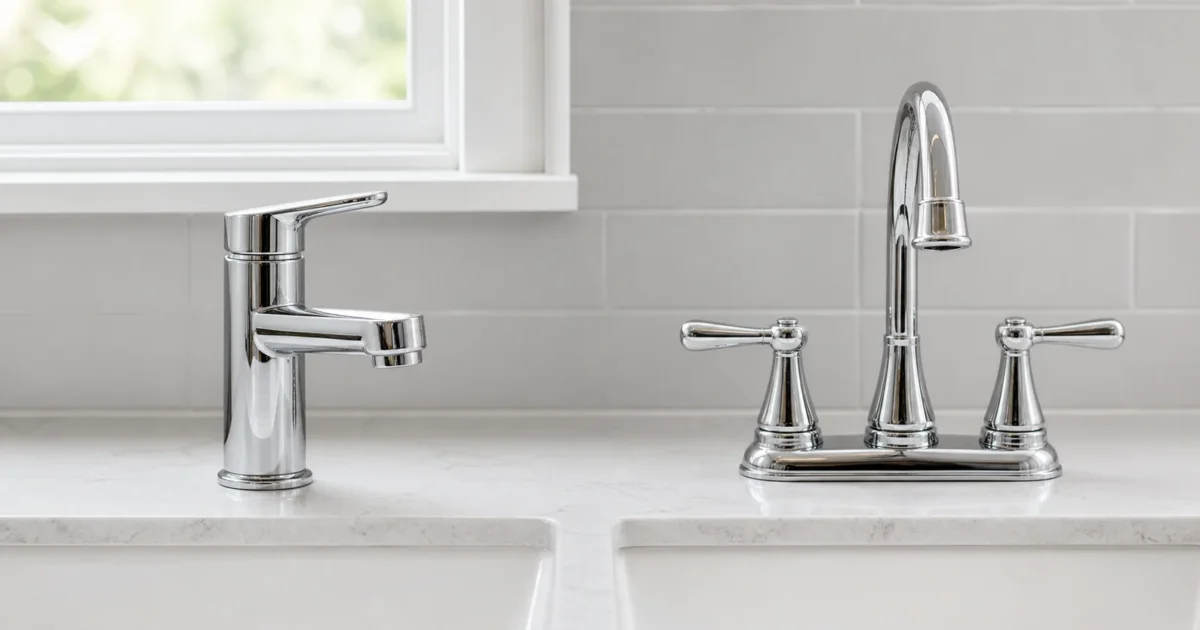
Single-handle vs two-handle faucet repair isn’t a coin flip — the honest answer depends on the faucet’s age, whether you know the brand and model, and what’s actually failed. For a modern faucet with a known brand and model, a single-handle cartridge design is usually the faster fix, because one cartridge or valve assembly handles the whole job (Home Depot, Kohler Assist). For an older, basic two-handle compression faucet, a washer or O-ring swap can be just as fast and much cheaper, because the parts cost only a few dollars and don’t require identifying a model-specific cartridge (Angi, This Old House).
This guide is for the homeowner standing over a dripping faucet trying to decide whether the single lever or the two knobs are the easier repair — or for anyone choosing which style to install when the old one finally gets replaced.
Single-Handle vs Two-Handle Faucet: Which Is Easier to Repair?
For a first-time leak on a modern, identifiable faucet, single-handle is usually the easier and faster repair, because there’s one cartridge to find, pull, and replace (Home Depot). For an older faucet with a simple compression design, two-handle repair is usually the cheaper repair, and often just as fast, because washers and O-rings are inexpensive and generic (Angi).
| Faucet type | Typical repair scope | DIY parts cost | Pro repair cost | Source |
|---|---|---|---|---|
| Single-handle cartridge | Shut off water, remove handle, cap/bonnet, retaining nut, pull one cartridge, replace, reassemble | $10-$100 (cartridge) | $100-$400 | Home Depot, Angi |
| Two-handle compression | Remove handle, stem, replace washer/O-ring/seat, reassemble, repeat on the other side if needed | $2-$25 (washer/O-ring/seat) | $100-$400 | Angi, This Old House |
| Two-handle cartridge | Same steps as single-handle, but potentially doubled for the hot and cold sides | $20-$100 (one or two cartridges) | $100-$400, more if both sides fail | Delta, Delta |
These are national parts and labor ranges, not a quote for your faucet — the exact number depends on brand, whether the cartridge is stuck, and whether a plumber is doing the work.
What Actually Differs Between the Two Designs
A single-handle faucet uses one control to manage both flow and temperature, and Home Depot describes single-hole kitchen faucets as having “just one handle for both hot and cold water” (Home Depot). The repair scope is short: shut off the hot and cold supply valves, remove the handle, remove a cap or bonnet/retaining nut, pull the cartridge or valve, replace O-rings or the cartridge, then reassemble and test (Home Depot). Kohler’s single-handle instructions follow the same pattern — remove the plug button and handle, remove the bonnet and mounting nut, replace the valve, then test for leaks (Kohler Assist). The advantage is that one part usually services the whole handle function. The disadvantage is that the cartridge is often model-specific, and a mineral-locked or corroded cartridge may need a puller or a manufacturer-specific procedure to remove (Home Depot, This Old House).
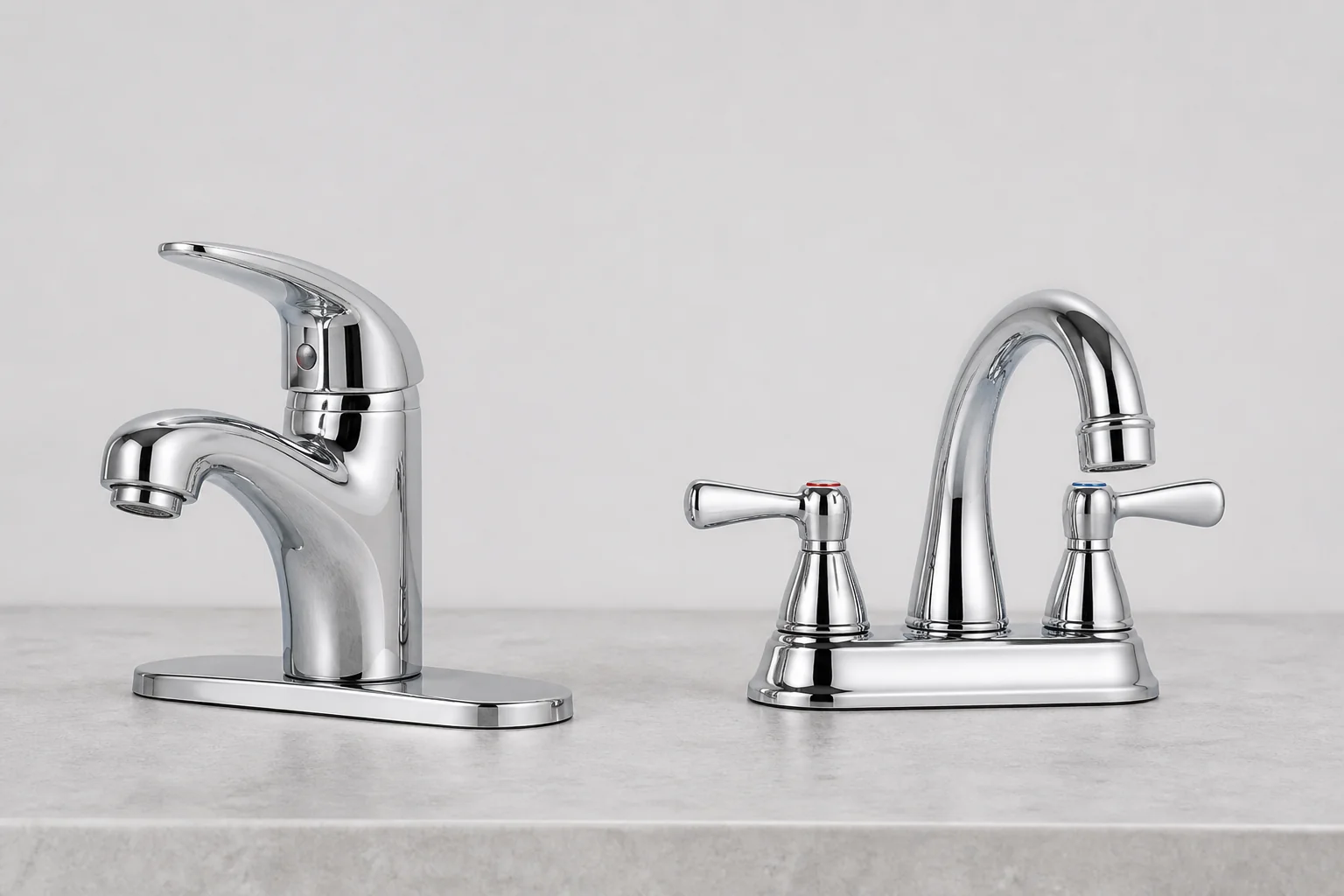
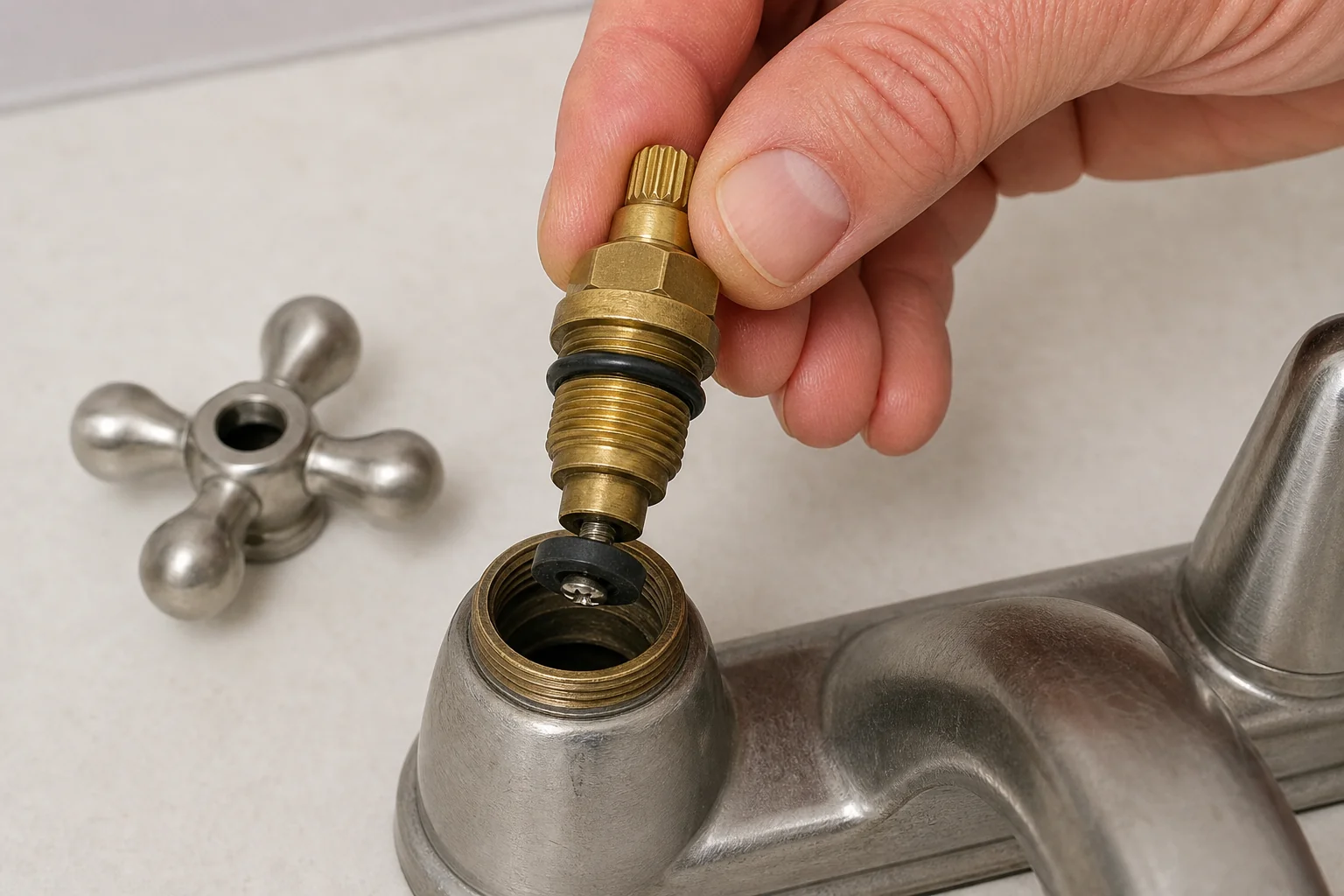
A two-handle faucet separates hot and cold into two controls, and Home Depot describes centerset faucets as having separate handles for hot and cold water (Home Depot). A two-handle cartridge faucet repairs like a single-handle repair, but potentially duplicated by side (Kohler Assist). A two-handle compression faucet is a different job entirely: remove the handle, remove the stem, replace the washer and O-ring, inspect or replace the valve seat, and reassemble — then repeat on the other side if the first wasn’t the source of the leak (This Old House, Home Depot). Delta’s two-handle spout-drip guide troubleshoots the hot valve first and only moves to the cold valve if the drip continues (Delta) — that’s a real advantage: two-handle faucets can often be diagnosed and repaired one side at a time. The disadvantage is part count and repetition, since two-handle faucets can require two cartridges, two stems, or two washer/O-ring sets depending on the design (Delta, This Old House).
What Drives the Decision
The sink or countertop hole pattern carries the highest weight, because single-hole, centerset, and widespread faucets all require different drilling, and a multi-hole faucet won’t simply fit a one-hole sink without modifying the counter (Home Depot, Angi). Faucet age and repair history carry very high weight: Angi says a first leak usually favors repair, while recurring repairs over a couple of years — or extensive corrosion and worn threads — make replacement the more cost-effective call, regardless of handle count (Angi).
Parts availability and model identification carry high weight. Home Depot advises bringing the old cartridge, O-ring, or spring to the store so the replacement matches, and Pfister tells homeowners to identify the exact product page and parts diagram before ordering (Home Depot, Pfister). A two-handle faucet with generic washers can be easier to service when the brand is unknown, while a two-handle faucet with an obscure ceramic cartridge can be harder to source than a common single-handle Moen, Delta, or Kohler cartridge (Lowe’s).
Water quality carries medium-high weight — This Old House notes hard or acidic water accelerates wear on single-lever valve-stem assemblies, and mineral buildup raises the odds that a cartridge, sleeve, or mounting nut will be hard to remove on either design (This Old House, EPA WaterSense). DIY skill and tolerance for downtime carry medium weight: Home Depot rates cartridge replacement as intermediate and under two hours, and Angi’s 2026 DIY survey found only 5% of homeowners consider themselves DIY experts, with 70% running into issues on a DIY project and 25% eventually hiring someone to finish it (Home Depot, Angi).
Accessibility matters too — accessible lavatory controls must be operable with one hand and no more than five pounds of force, and a lever-style single-handle often makes that easier, though compliant two-handle levers can also qualify (U.S. Access Board).
Total Cost of Ownership Over 5-10 Years
A successful DIY single-handle repair runs about $10 to $100 for the cartridge, using Angi’s cartridge range and retail examples like a $40 Moen brass replacement cartridge at Home Depot (Angi, Home Depot). A pro single-handle repair lands in Angi’s $100 to $400 leaky-faucet range, with $270 as a national midpoint (Angi). Over 10 years, the total stays low if one cartridge event solves it, but climbs fast if the cartridge is stuck or the leak recurs, since Angi flags recurring repairs and corrosion as the point where replacement starts to make more sense (Angi).
A DIY two-handle compression repair can be very cheap — Angi prices washers at $2 to $5, O-rings at $1 to $5, and valve seats at $5 to $10, and Lowe’s sells a 10-pack of rubber washers for $3.58 (Angi, Lowe’s). A DIY two-handle cartridge or stem repair costs more, since Angi prices stems at $10 to $50 and cartridges at $10 to $100, and a pro two-handle repair still falls in the same $100 to $400 range — but the job can duplicate parts and labor if both handles need service (Angi). Over 10 years, two-handle repair usually stays cheapest when the parts are generic and access is good, but rises if both hot and cold sides need repeated attention or the valve seat is pitted and non-removable (Home Depot).
Handle count alone doesn’t change the water bill — flow rate comes from the faucet’s aerator specification, not whether it has one handle or two (EPA WaterSense). A WaterSense-labeled faucet caps flow at 1.5 gallons per minute versus the federal 2.2 gpm standard, and EPA estimates that swapping to WaterSense faucets and aerators can save an average family $250 over the fixture’s lifetime — a factor worth weighing at replacement time regardless of which handle style you pick (EPA WaterSense, EPA WaterSense, Department of Energy).
The Hidden Costs Nobody Mentions
Single-handle’s hidden cost is a stuck cartridge: Home Depot says difficult cartridges may need a special tool, and This Old House and trade forums confirm that a forced removal can turn a short repair into a valve-body problem (Home Depot, This Old House, Terry Love Forum). Converting a three-hole sink down to a one-hole single-handle faucet can also leave a visible outline on the deck around the old base, even with an escutcheon plate covering the extra holes (Home Depot, Lowe’s).
Two-handle’s hidden cost is repetition and, on compression models, a damaged valve seat — Home Depot notes a replaced washer won’t stop the leak if the seat is pitted, and a non-removable seat may need resurfacing or a full faucet swap (Home Depot). Widespread two-handle faucets also add under-sink complexity, since the spout and handles are separate pieces needing multiple mounting holes and connections (Home Depot). And a worn, dated two-handle or single-handle fixture is a cosmetic drag either way — Angi notes that replacing a peeling or outdated faucet is one of the cheapest ways to lift a room’s appearance (Angi).
Edge Cases That Flip the Decision
| Situation | Better pick | Why |
|---|---|---|
| Modern faucet, known brand/model, first leak | Single-handle repair | One cartridge, under-two-hour intermediate job (Home Depot) |
| Old faucet, simple drip, unknown brand | Two-handle (compression) repair | Washers, O-rings, and seats are generic and cheap (Angi) |
| Rental or multi-family property | Standardized two-handle centerset, or a widely stocked single-handle | Uniform spare parts matter more than theoretical repair ease during tenant turnover (Delta) |
| Unknown brand, discontinued model | Lean two-handle, or lean replace | Cartridge parts are model-specific and hard to source without a model number (Pfister) |
| Hard water, stuck handle, or corroded shutoffs | Pro evaluation before disassembly | Corrosion accelerates wear and complicates removal on either design (This Old House) |
| One-hole sink or tight vanity | Single-handle | One-hole faucets fit one-hole sinks without modifying the counter (Lowe’s) |
| Accessibility is a priority | Lever-style single-handle, or ADA-suitable two-handle levers | Controls must be one-hand operable without tight grasping, pinching, or twisting (U.S. Access Board) |
| Pending home sale, faucet looks dated | Replace with a matching-hole WaterSense model | Replacement improves appearance cheaply and cuts flow to the federal 1.5 gpm WaterSense max (Angi, EPA WaterSense) |
Should You DIY It or Hire a Pro?
Single-handle cartridge repair is a reasonable DIY project when the brand is known, the shutoff valves work, and the correct cartridge is available — Home Depot rates it intermediate and under two hours (Home Depot). This Old House says the actual swap can take about 20 minutes once you have the right part, but finding that part is often the longer step, since parts aren’t interchangeable across brands or even across models from the same brand (This Old House). If you’re not sure which cartridge your faucet uses, find your exact cartridge with our free Repair Finder before you buy anything.
Two-handle washer, seat, or stem repair is a reasonable DIY project when only one side leaks and the parts are accessible from above the sink, but it involves more small-part handling than a single cartridge swap — the washer, O-ring, packing nut, stem, and valve seat may all come into play (Delta, This Old House). No source in this research gives a faucet-specific DIY success rate broken out by handle style — the closest data is Angi’s 2026 survey, where 70% of homeowners hit issues on a DIY project and 25% ended up hiring someone to finish it, with plumbing work among the most common categories pros were called in to correct (Angi). The honest takeaway isn’t that one design DIYs more successfully than the other — it’s that success on either one depends on working shutoffs, correct part identification, and hardware that isn’t seized.
When to Call a Pro
- The cartridge, handle, or stem won’t move with reasonable force — forcing it risks damaging the valve body on either design (Terry Love Forum).
- The shutoff valves don’t fully close, or an older valve feels corroded — This Old House warns that aged shutoffs can crumble when handled (This Old House).
- The compression faucet’s valve seat is pitted but not removable — Home Depot says that may require resurfacing or a full fixture swap (Home Depot).
- Both sides of a two-handle faucet keep leaking after a first repair attempt, or the faucet is a widespread model with poor under-sink access (Home Depot).
- The faucet you’re repairing is actually a shower or tub valve rather than an accessible sink faucet, where a misfit means opening a wall instead of a cabinet.
How to Choose and Vet a Plumber
If you’re past the DIY line, ask the plumber whether the quote assumes a straightforward cartridge or washer swap or whether they’re already pricing in a stuck-part risk — that’s the variable that swings a bill from $100 toward $400 (Angi). Confirm they’re licensed and insured, get the price in writing, and get two or three quotes; a wide spread between them often means one plumber is pricing in more risk than another.
If you haven’t identified your faucet yet, our Complete Guide to Faucet Repair and How to Identify Faucet Brand and Model cover identification from scratch. If you’ve already confirmed a Moen 1225 single-handle cartridge, our step-by-step replacement guide walks through the DIY procedure, and for the pure cost breakdown on a cartridge swap, see Cost to Replace a Faucet Cartridge or the broader Cost to Repair a Faucet guide.
Single-handle vs two-handle faucet: which is easier to repair?
For a modern, identifiable faucet, single-handle is usually easier because one cartridge handles the whole repair. For an older basic compression faucet, two-handle repair can be just as easy and cheaper, since washers and O-rings are generic and inexpensive (Home Depot, Angi).
Is a two-handle faucet cheaper to repair than a single-handle faucet?
Often, yes, for a simple compression repair — Angi prices washers at $2 to $5 and O-rings at $1 to $5, versus $10 to $100 for a single-handle cartridge. But a two-handle cartridge or stem repair can cost as much as a single-handle repair, and can duplicate if both sides need service (Angi).
Does a two-handle faucet use more water than a single-handle faucet?
No. Flow rate comes from the faucet or aerator’s gallons-per-minute rating, not the number of handles — a WaterSense-labeled faucet caps flow at 1.5 gpm regardless of handle style (EPA WaterSense).
Can I replace a two-handle faucet with a single-handle faucet?
Sometimes. A single-hole faucet can cover extra holes from an old three-hole two-handle setup with a deck plate or escutcheon, but the sink or countertop’s existing hole pattern has to be checked first, since drilling a stone counter is a much bigger job (Home Depot, Angi).
What if I don’t know the brand or model of my faucet?
When should I call a plumber instead of repairing the faucet myself?
Call a pro when the cartridge or stem won’t move without force, the shutoff valves are corroded or won’t close, the valve seat is pitted and non-removable, or both sides of a two-handle faucet keep leaking after a first repair (Home Depot, This Old House).
Sources
- Home Depot – Best Kitchen Faucets for Your Home
- Home Depot – How to Replace a Cartridge in a Faucet
- Home Depot – How to Replace Valve Seats
- Home Depot – How to Install a Kitchen Faucet
- Home Depot – Moen Brass Single-Handle Replacement Cartridge
- Kohler Assist – Replace the Valve in a Single-Handle Faucet
- Kohler Assist – Replace the Valve in a Two-Handle Faucet
- Pfister – My Single-Handle Bath Faucet Is Leaking/Dripping
- Pfister – Parts and Support FAQ
- Delta – Two-Handle Faucet Leak Guide
- Delta – Two-Handle Cartridges (Common Parts)
- Delta – Faucet Warranty
- Lowe’s – Bathroom Faucet Buying Guide
- Lowe’s – How to Replace a Faucet
- Lowe’s – Faucet Stems and Cartridges
- Lowe’s – Danco 10-Pack Rubber Flat Washer
- This Old House – How to Stop Kitchen Faucet Leaks
- This Old House – Fixing Running Toilets and Dripping Faucets
- Angi – Plumber Cost to Fix a Leaky Faucet
- Angi – Should I Repair or Replace a Leaky Faucet
- Angi – How to Replace a Kitchen Faucet
- Angi – 2026 DIY Dreams vs. Reality Survey
- EPA WaterSense – Bathroom Faucets
- EPA WaterSense – Statistics and Facts
- EPA WaterSense – Home Maintenance
- Department of Energy – Best Management Practice 7: Faucets and Showerheads
- U.S. Access Board – ADA Guide, Chapter 6: Lavatories and Sinks
- Terry Love Forum – Cartridge Replacement / Water Shutoff Question
Educational content only. Not a substitute for licensed professional advice. Local plumbing codes vary by jurisdiction. Use of any guidance from this guide is at your own risk.
Get the homeowner’s plumbing repair toolkit checklist – the tools, parts, and decisions every homeowner should have on hand. [Free download – enter your email]
Parts for this repair
As an Amazon Associate, plumbingbythebook earns from qualifying purchases. Links below are affiliate links — they cost you nothing extra.
- Universal Faucet Cartridge Puller Tool — For a single-handle cartridge that won't pull by hand — the tool Home Depot and This Old House both point to before you resort to force.
- Two-Handle Faucet Repair Kit (Washers, O-Rings, Seats) — A basic assortment of the small parts a two-handle compression faucet actually needs — cheap insurance against a second trip to the store.
Related guides
Faucet Valve Type Identification Chart: Cartridge, Ball, Compression, and Ceramic Disc [2026]
This faucet valve type identification chart covers the four mechanisms hiding inside almost every residential sink faucet —…
![Title card for the article 'Faucet Replacement Parts: The Homeowner's Glossary [2026]' on Plumbing By The Book](https://plumbingbythebook.com/wp-content/uploads/2026/09/article-13-hero-faucet-parts-laid-out-600x400.webp)
Faucet Replacement Parts: The Homeowner’s Glossary [2026]
Faucet replacement parts are the second-most-expensive mistake in DIY faucet work, right behind misidentifying the faucet brand itself.…
![Title card for the article 'How to Read a Delta Faucet Model Number: Model vs. Part Number Explained [2026]' on Plumbing By The Book](https://plumbingbythebook.com/wp-content/uploads/2026/08/article-97-hero-how-to-read-a-delta-faucet-model-number-600x400.webp)
How to Read a Delta Faucet Model Number: Model vs. Part Number Explained [2026]
How to Read a Delta Faucet Model Number: Model vs. Part Number Explained [2026] Knowing how to read…