Drains and Pipes Guide: The Complete Homeowner’s Overview of What’s Behind Your Walls [2026]
Water disappears down the drain a hundred times a week without a second thought — until it doesn’t. A slow shower, a gurgling kitchen sink, a wet cabinet floor, a smell you can’t quite place — suddenly the hidden plumbing in your walls matters a great deal. This drains and pipes guide walks you through how your home’s two plumbing systems work, what the ten most common problems look like, what repairs cost in 2026, and which jobs you can handle yourself versus which ones require a licensed plumber.
Quick answer: Most homeowners can handle hair clogs, toilet flapper replacements, and P-trap leaks with basic tools in under an hour. The clearest line between DIY and pro: one fixture slow or leaking (almost always yours to fix) versus multiple fixtures backing up at the same time (that’s the main sewer line — call a plumber).
How Your Home’s Drain and Pipe System Actually Works
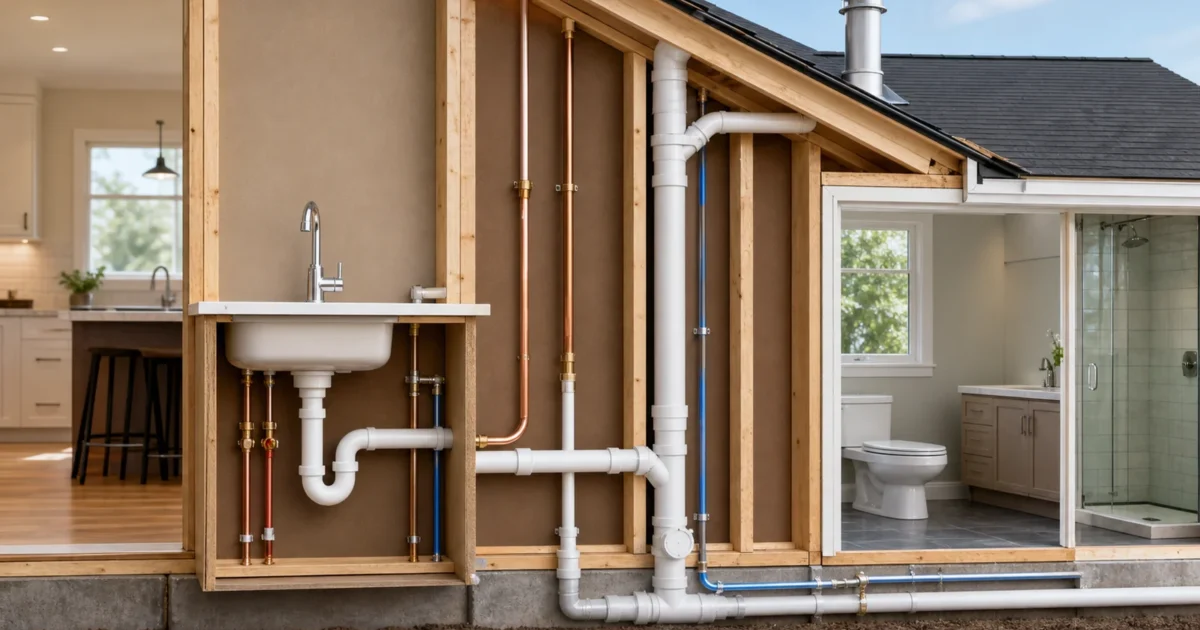
A home’s plumbing is two separate systems operating behind the same walls. Understanding both — even at a basic level — is what separates a homeowner who can diagnose their own problem from one who calls a plumber for a $5 part.
The supply system brings pressurized clean water in. It starts at the service line — typically copper or PEX in most US homes — passes through the main shutoff valve, then branches into cold-water lines and a hot-water loop routed through the water heater. Every fixture has its own shutoff valve where the supply line meets the wall or under-cabinet floor. The main shutoff is usually near the water meter or where the service line enters the foundation; finding it before you have a leak is non-negotiable.
According to InterNACHI’s home inspection life expectancy chart, copper water lines last about 70 years, PEX about 40 years, and plastic water lines around 75 years under normal conditions — though these are guidelines, not guarantees.
The drain-waste-vent (DWV) system carries used water away by gravity, not pressure. Every fixture drains into a P-trap — that curved pipe visible under the sink, or hidden inside the wall behind the tub. The P-trap holds a small pocket of water that blocks sewer gas from entering the room. From the trap, waste runs through a fixture arm into a larger branch drain, then into vertical stacks, then the building drain below the lowest floor, and finally into the municipal sewer line or septic system. Toilets have their trapway built into the porcelain bowl itself — that’s why there’s always water visible in the bowl between flushes.
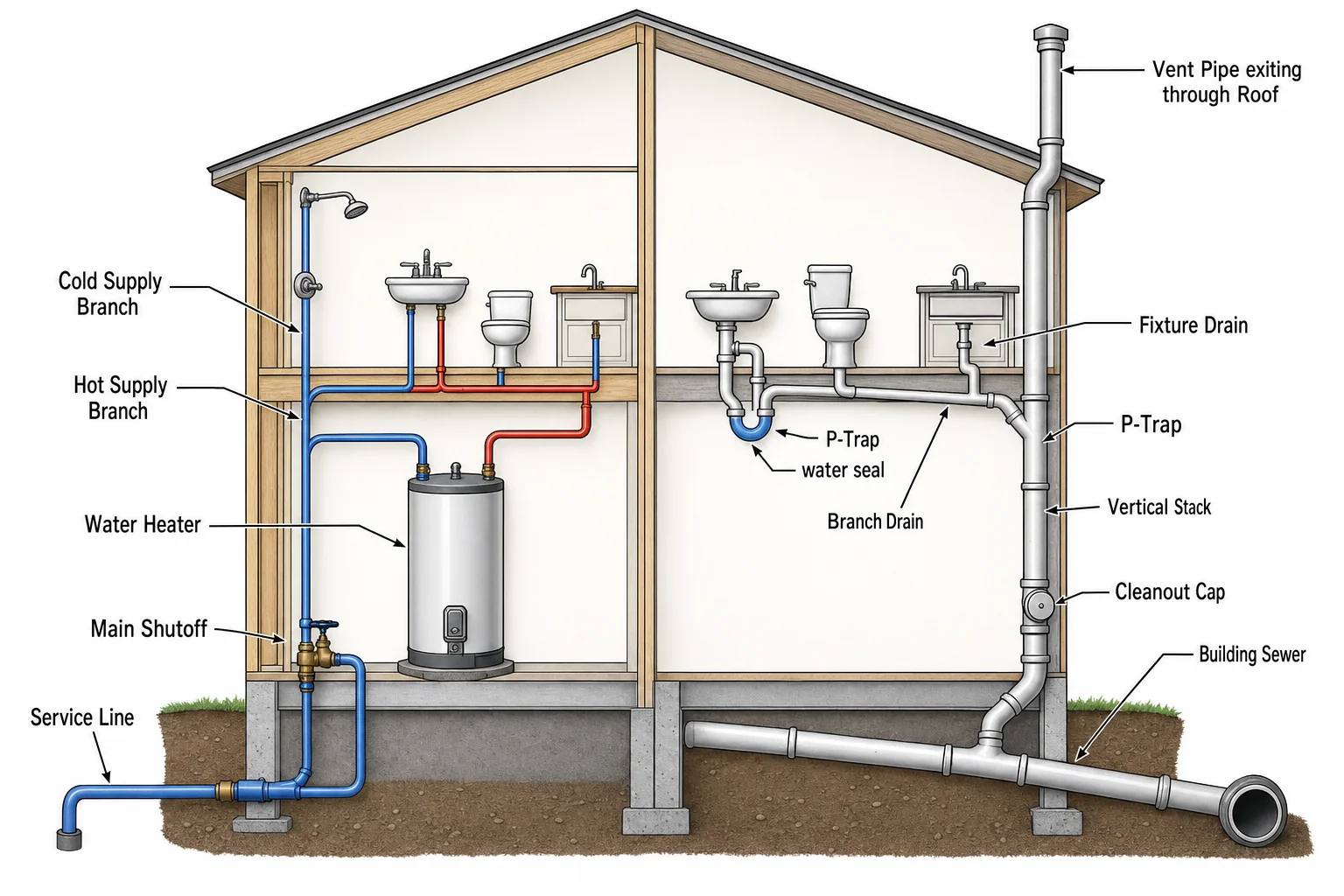
The piece most homeowners overlook is the vent system. Every drain stack exits through the roof as a vent pipe. Vents admit air behind moving wastewater so the flowing drain doesn’t suck trap water out by siphon action; they also give sewer gases a safe exit path above the roofline. When a vent is partially blocked — by a bird nest, leaves, or ice in northern climates — drains slow down, traps gurgle, and a faint sewage odor appears at multiple fixtures simultaneously. A single slow drain is almost never a venting issue; multiple gurgling drains at the same time almost always is.
Pipe material gives you a rough age map of your home. InterNACHI estimates ABS and PVC waste pipes at 50–80 years, above-ground cast iron at about 60 years, and below-ground cast iron at 50–60 years. Older galvanized steel supply lines corrode internally — if the water pressure at every fixture in your home is low and the house is older, that’s a material-replacement conversation with a plumber, not a repair.
The 10 Most Common Drain and Pipe Problems (Ranked by Frequency)
This ranking is an editorial synthesis from EPA leak data, national repair-cost surveys, and homeowner repair resources — a practical guide to what actually sends homeowners searching for help, not a statistically exact national incident table.
| Rank | Problem | Quick “is this me?” check |
|---|---|---|
| 1 | Slow bathroom sink, tub, or shower (hair + soap) | One fixture drains slowly; all others work fine → local hair or soap clog |
| 2 | Kitchen sink slow or backing up | Slow or smells after cooking; backs up with disposal use → grease or food buildup |
| 3 | Toilet clog or overflow | Bowl water rises instead of dropping after flush → toilet trap or downstream block |
| 4 | Running toilet or silent tank leak | Refilling sound between flushes, or food coloring in tank reaches bowl → flapper, fill valve, or water level |
| 5 | Dripping faucet or clogged aerator | Drips when fixture is off, or weak flow at one faucet only → cartridge, washer, or aerator |
| 6 | Under-sink leak | Cabinet base wet, stained, swollen, or musty → P-trap slip nuts, supply line, or disposal connection |
| 7 | Disposal jam, leak, or slow drain after use | Disposal hums but doesn’t grind → jammed flywheel; reset button or Allen wrench fix |
| 8 | Multiple drains backing up at once | Toilets, tubs, AND lower-floor drains acting up together → main sewer line, not a fixture problem |
| 9 | Sewer gas smell or gurgling | Odor from a drain rarely used, or gurgling when another fixture runs → dry trap or vent problem |
| 10 | Aging, corroded, or root-invaded pipes | Recurring clogs after clearing, stains near old pipe, or camera shows cracks → evaluate pipe replacement |
One of the core lessons in any drains and pipes guide: small leaks ignored become big repairs. The EPA’s Fix a Leak Week data shows average household leaks waste more than 9,300 gallons per year, and 9% of US homes waste 50 or more gallons per day through leaks alone. A faucet dripping once per second wastes over 3,000 gallons per year. A showerhead leaking at 10 drips per minute wastes more than 500 gallons annually. If you suspect a running toilet is behind an unexplained water bill spike, use our Water-Waste Calculator to see the monthly cost before you commit to a repair.
Repair Difficulty Ladder: What You Can Handle Yourself and What Requires a Pro
Not every problem in this drains and pipes guide needs a plumber. But not every DIY attempt is safe. Here’s how to place yourself on the ladder.
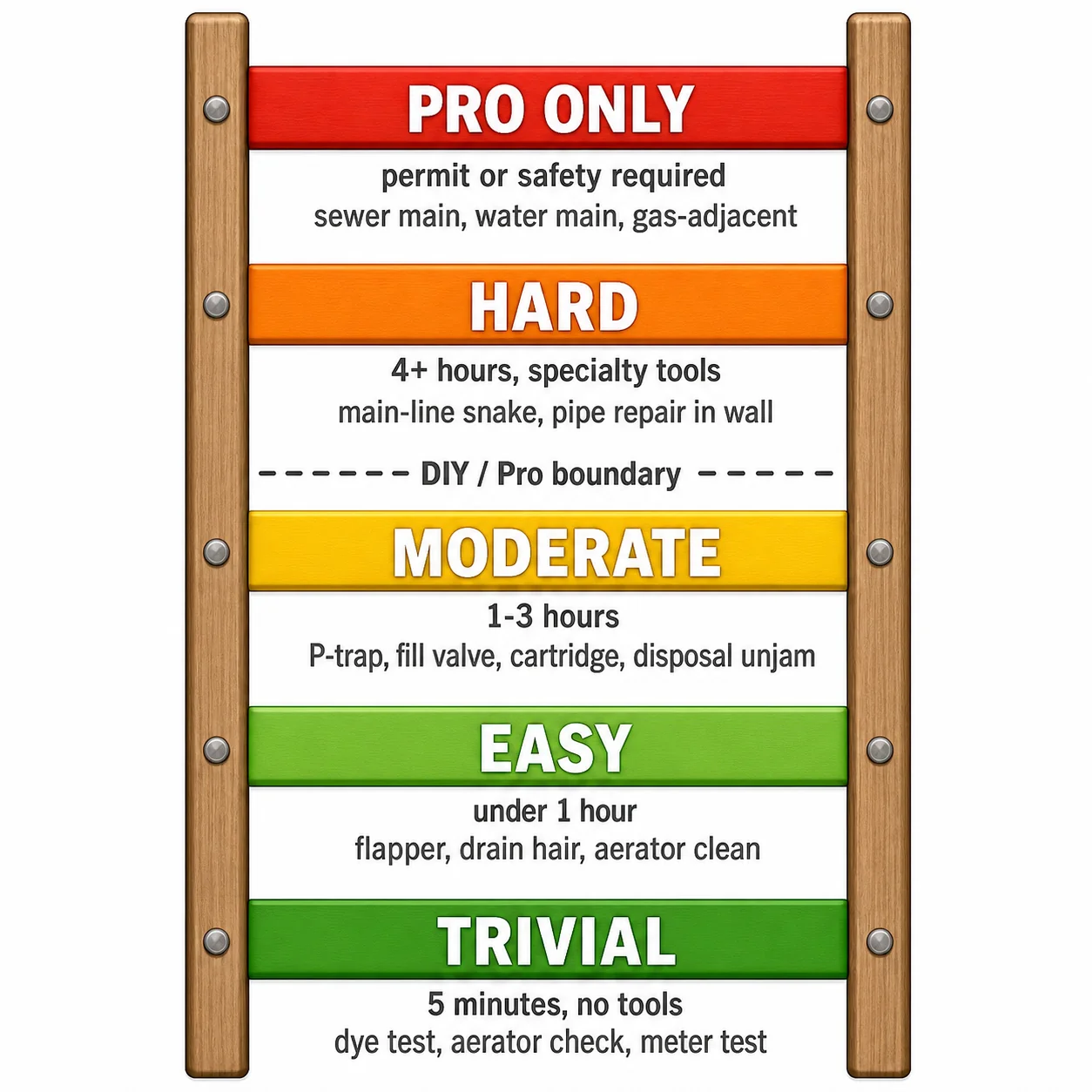
Trivial — 5 minutes, no real tools needed: – Drop food coloring in the toilet tank and watch for color in the bowl within 15 minutes — the EPA’s recommended test for a silent flapper leak – Check the water meter before and after a two-hour window of zero water use — a moving meter needle means a leak somewhere in the system – Visually inspect the kitchen faucet aerator for visible mineral deposits or debris (unscrew it by hand and look)
Easy — under an hour, basic tools: – Replacing a toilet flapper ($5–$15 for Korky or Fluidmaster; snaps on in under 10 minutes with no tools) – Removing hair from a shower or bathroom sink drain with a plastic barbed drain tool ($5–$10) – Cleaning a clogged faucet aerator by unscrewing, rinsing, and soaking in white vinegar for 30 minutes
Moderate — 1–3 hours, basic tools plus some judgment: – Clearing a blocked P-trap under the sink (bucket + tongue-and-groove pliers; water in the trap will spill when the slip nut loosens) – Replacing a toilet fill valve (the Fluidmaster 400A is the near-universal replacement, $15–$20, fits most tank configurations) – Replacing a faucet cartridge (brand-specific part; identify the brand and model first — see How to Identify Your Faucet Brand and Model) – Unjamming a garbage disposal (Allen wrench in the hex port on the bottom of the unit; disconnect power at the wall switch first, never put hands inside the drain opening)
Hard — 4+ hours, specialty knowledge or tools: – Main-line snaking when multiple fixtures are slow simultaneously – Interpreting sewer camera footage – Replacing drain sections inside a wall or under the floor
Professional-only — call a licensed plumber: – Sewer main excavation, repair, or trenchless rehabilitation – Water main repair or replacement (in most US jurisdictions this requires a permit and a licensed contractor) – Any work requiring a permit — which typically includes adding or relocating drain and supply lines, replacing a water heater, and anything gas-adjacent – Repeated backups involving sewage exposure
The professional-only line matters most when symptoms span multiple fixtures. A single slow kitchen sink is almost always a local P-trap or grease clog. Two bathrooms and the kitchen all slow at the same time — especially if the toilet gurgles when you run the shower upstairs — means the blockage is downstream of where all those branch lines meet. That’s main-line territory, and trying to snake it without the right equipment and experience can damage old cast-iron or clay pipe.
What Drain and Pipe Repairs Cost in 2026
The Spruce’s national plumbing cost table puts average plumbing repairs at $325, with plumber hourly rates running $35–$170 and averaging about $105. Emergency plumbing adds a trip fee averaging $225 on top of the hourly rate.
| Problem | DIY parts only | Pro repair (mid-range) | Pro repair (high-end/emergency) |
|---|---|---|---|
| Hair clog — sink, tub, or shower | $5–$20 (barbed tool, strainer, enzyme cleaner) | ~$275 | Up to $425 |
| Kitchen sink clog | $5–$25 (plunger, bucket) | ~$275 | $425+ for deep or grease-packed clogs |
| Toilet clog | $10–$25 (flange plunger) | ~$285 | Up to $470 |
| Running toilet | $5–$35 (flapper + fill valve) | ~$285–$340 | Up to $525 for leak diagnosis |
| Dripping faucet or clogged aerator | $3–$40 (aerator, cartridge, or washer kit) | ~$340 | Up to $535 |
| Under-sink leak (P-trap or supply line) | $5–$30 | ~$340 | Up to $525 for hard-to-locate leaks |
| Garbage disposal jam | $0 (reset button) to $10–$40 (Allen key) | $75–$100 for a simple jam | Motor failure may require unit replacement |
| Main sewer clog | Not recommended as DIY | ~$600 | Up to $875 for a deep-line clog |
| Drain-line repair (pipe section) | $10–$75 for exposed parts only | ~$700 | Up to $1,175 for limited-access repairs |
| Sewer main repair | Not DIY | ~$3,075 | $4,900+ with excavation |
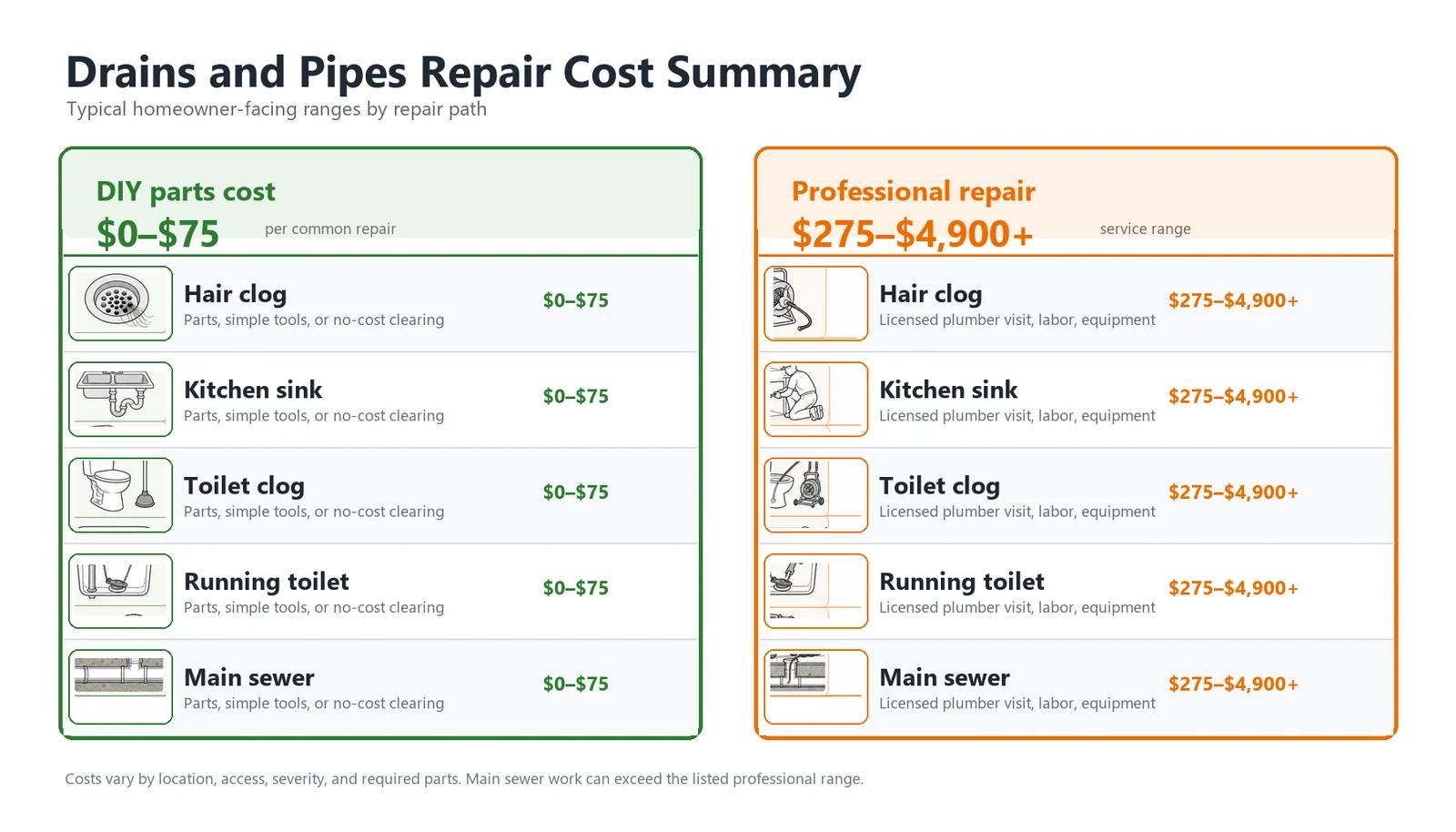
Regional variation is real and predictable. Labor-heavy repairs in high-wage metros with permit requirements, difficult parking, or wall/floor access run toward the upper end. Open-access repairs in lower-cost regions will be closer to the mid-range benchmarks. These are national averages — get local estimates for anything in the moderate or hard tier before committing.
When to Repair vs. Replace: The Threshold Decisions
Drains and pipes: Start with repair. A single slow drain should start with visible debris removal, a plunger, a barbed drain tool, and trap cleaning. The replacement conversation begins when the same line clogs repeatedly after proper cleaning, when a camera inspection shows root intrusion or broken pipe, or when the pipe material is near the end of its expected service life per InterNACHI’s chart.
Toilet internals: Repair first; replace the porcelain almost never. EPA data confirms that most toilet leaks are due to old or worn flappers. InterNACHI estimates toilet tank components — flappers and fill valves — at around 5 years of service life, while the toilet porcelain itself can last 100+ years. Replace the whole toilet only when the porcelain is cracked, the trapway chronically clogs with normal use, or you’re running a pre-1994 model using 3.5–6 gallons per flush and want to switch to a WaterSense-labeled toilet at 1.28 gallons per flush — a 20% improvement over the current 1.6-gallon federal standard.
Faucets: Repair cartridges, washers, and aerators before replacing the fixture. EPA identifies worn washers and gaskets as frequent leak causes; Better Homes & Gardens names aerator or cartridge debris as the most common reason for pressure loss at a single sink. Replace the faucet body only when it’s badly corroded, manufacturer parts are discontinued, or the fixture is past its estimated 15–20 year service life per InterNACHI.
Garbage disposals: Repair a jam once or twice; replace the unit when jams, reset trips, body leaks, or motor sounds recur. InterNACHI estimates food waste disposal life at about 12 years.
The total-cost-of-ownership rule: If a single professional repair costs less than one-third to one-half of replacement cost and the rest of the system is in good shape, repair is usually the right call. When the same repair recurs, requires demolition access, or involves material at the end of its service life — replacement becomes easier to justify. Use this as a practical heuristic, not a warranty standard: life spans vary considerably with usage, water chemistry, installation quality, and maintenance history.
Tools Every Homeowner Needs for Drain and Pipe Work
$30 starter kit — handles the majority of fixture-level problems: – Flange toilet plunger (the rubber skirt folds out to seal the toilet bowl opening; the flat cup version is for sinks) – Flat cup plunger (for sinks, tubs, and shower drains) – Plastic barbed drain snake / drain claw ($5–$10; indispensable for bathroom hair clogs) – Nitrile gloves and a small bucket – Flashlight
$75–$100 practical homeowner set: – Tongue-and-groove pliers (Channellock 440 is the standard reference) – Adjustable wrench – Basin wrench (reaches faucet nuts in tight under-sink spaces no other tool can access) – 15–25 foot hand drum auger (Cobra or RIDGID — for clogs that a plunger can’t reach) – Closet auger (designed for toilet trapways; safer for the bowl than a standard drum snake) – Replacement Korky or Fluidmaster flapper and fill valve (keep one of each on hand) – PTFE (Teflon) tape and assorted slip-joint washers
$200 mid-tier upgrade: – Compact wet/dry vacuum (pulls standing water out of under-sink cabinets before disassembly) – Tubing cutter and small hacksaw – Non-contact moisture meter (finds hidden wet spots in drywall or cabinet floors before mold sets in) – PVC cutter – Replacement braided stainless steel supply lines (½-in. and ¾-in. sizes)
EPA links directly to Korky and Fluidmaster as the flapper brands homeowners can consult for toilet-specific troubleshooting. For augers: RIDGID and Cobra lead the hand-tool tier; Milwaukee leads for powered drain equipment. For drain fittings and solvent cement: Oatey. For push-to-connect copper repair fittings: SharkBite.
The tools above — from the $30 starter kit to the $200 mid-tier upgrade — cover the vast majority of problems in this drains and pipes guide. The professional boundary is equipment you shouldn’t rent casually: sectional motorized drain machines, sewer cameras with locating transmitters, hydro-jetters, and pipe-freezing gear. A homeowner who rents a motorized auger for an unknown main-line obstruction risks kickback, pipe damage, and sewage exposure if the blockage involves roots or a cracked section.
Drains and Pipes Guide: Which Article Do You Need?
This drains and pipes guide hub is the overview. Each Pillar 4 article goes deep on one specific problem. Use this table to get to the right fix faster:
| Symptom | Likely cause | Where to go |
|---|---|---|
| One bathroom sink drains slowly | Hair, soap scum, stopper, or P-trap clog | How to Unclog a Bathroom Sink |
| Shower water pools around your feet | Hair and product buildup in shower drain | How to Unclog a Shower Drain |
| Kitchen sink backs up after cooking | Grease, food debris, disposal discharge, or P-trap | Why Your Kitchen Sink Won’t Drain |
| Disposal hums but won’t grind | Jammed flywheel or tripped reset button | How to Fix a Garbage Disposal |
| Toilet bowl rises after flush | Toilet trap clog or downstream blockage | How to Unclog a Toilet |
| Toilet runs or refills between flushes | Flapper, fill valve, water level, or float | Why Is My Toilet Running? |
| Water appears under the sink cabinet | P-trap, supply line, disposal, or shutoff leak | Drain Repair Guide |
| Sewer smell from a drain | Dry trap, blocked vent, or drain biofilm | Why Does My Drain Smell? |
| Gurgling when another fixture drains | Partial venting blockage or branch obstruction | Drain Repair Guide |
| Multiple drains slow at the same time | Main sewer clog, roots, grease, wipes, or septic | Drain Repair Guide |
For anyone tackling a clog past the trap: How to Use a Drain Snake walks through the technique, how far to feed the cable, and when to stop and call a plumber. This drains and pipes guide maps the system — the linked articles above give you the step-by-step repairs.
How do I tell if my slow drain is a clog or a venting problem?
If one fixture drains slowly and everything else in the house works fine, it’s almost always a local clog — hair or soap at the trap or just inside the branch line. If two or more fixtures drain slowly at the same time, or if you hear a gurgling sound from a second drain when you run the first one, that pattern points to a venting issue or a blockage downstream where the branch lines merge. Single fixture: local clog. Multiple fixtures with gurgling: vent or main line.
What is the life expectancy of my home’s drain pipes?
According to InterNACHI’s life expectancy chart, ABS and PVC waste pipes are estimated at 50–80 years, above-ground cast iron at about 60 years, and below-ground cast iron at 50–60 years. These are averages — a 40-year-old PVC pipe with no cracking is fine; a 35-year-old cast-iron line with recurring slow drains after professional cleaning may need camera evaluation. InterNACHI notes that life spans vary with usage, water chemistry, climate, and installation quality.
Should I use Drano or a chemical drain cleaner?
Most plumbing professionals recommend starting with mechanical methods — a barbed plastic drain tool for hair clogs, a plunger for kitchen and toilet clogs, and a hand auger for deeper stoppages — before reaching for chemical cleaners. Caustic chemicals can soften PVC fittings and P-trap washers over repeated use, and they rarely dissolve hair clogs fully; they just thin them temporarily. Chemical cleaners also damage older metal pipes and are ineffective against grease that has solidified deep in the line. Use them as a last resort before calling a plumber, not as a first response.
When do I actually need a permit for plumbing work?
In most US jurisdictions, permits are required for adding or relocating drain or supply lines, replacing a water heater, and any work adjacent to gas lines. Typical homeowner repairs — replacing a faucet cartridge, swapping a toilet flapper or fill valve, unclogging a drain, or replacing an aerator — do not require permits anywhere I’m aware of. When you’re unsure, a quick call to your local building department takes less time than the fine for unpermitted work that causes water damage.
What’s the most common cause of a running toilet?
EPA identifies worn toilet flappers as the leading cause of running toilets. The flapper is a rubber seal at the bottom of the tank that holds water until you flush; when it ages, warps, or collects mineral deposits, it stops sealing fully and water seeps continuously into the bowl. A Korky or Fluidmaster replacement flapper costs $5–$10 and takes about 10 minutes to install with no tools. If the toilet still runs after a new flapper, check the fill valve and the water level in the tank — the water should sit about one inch below the top of the overflow tube.
How do I find my home’s main water shutoff?
In homes with a basement or crawl space, the main shutoff is usually on the wall nearest the street, close to where the service line comes through the foundation. In slab-foundation homes, check the garage, a utility closet, or an exterior wall near the front of the house. In warm climates without basements, look for a covered access box in the front yard near the water meter. Locating this valve before any plumbing emergency is genuinely important — a burst supply line can flood a room in minutes.
Sources
- EPA WaterSense: Fix a Leak Week — household leak waste statistics, dye-test method, flapper replacement guidance
- EPA WaterSense: Residential Toilets — 1.28 gpf WaterSense standard, efficiency data vs. older 3.5–6 gpf toilets
- EPA WaterSense: Bathroom Faucets — 1.5 gpm maximum flow standard
- EPA WaterSense: Showerheads — 2.0 gpm WaterSense standard vs. 2.5 gpm conventional
- InterNACHI Home Inspection Life Expectancy Chart — pipe material lifespans, toilet tank component estimates, disposal life expectancy
- The Spruce: House Drain System — Parts and Diagram — DWV anatomy overview
- The Spruce: How Much Does a Plumber Cost? (2026) — national repair cost benchmarks and hourly rate data
- The Spruce: How Much Does Water Line Repair Cost? — supply-side repair cost data and permit notes
- The Spruce: 6 Reasons Your Sewer Drain Is Clogged — main-line clog signs and escalation criteria
- Better Homes & Gardens: Plumbing Vent Diagram — vent system anatomy
- Better Homes & Gardens: 8 Common Causes of Household Leaks — failure-point identification
- Architectural Digest: How to Fix a Running Toilet — toilet component diagnostic sequence
- Wikipedia: Drain-waste-vent system — DWV system overview
- Wikipedia: Trap (plumbing) — P-trap mechanism and sewer gas seal explanation
Educational content only. Not a substitute for licensed professional advice. Local plumbing codes vary by jurisdiction. Use of any guidance from this guide is at your own risk.
Get the homeowner’s plumbing repair toolkit checklist — the tools, parts, and decisions every homeowner should have on hand. [Free download — enter your email]
Parts for this repair
As an Amazon Associate, plumbingbythebook earns from qualifying purchases. Links below are affiliate links — they cost you nothing extra.
- Korky Universal 2-Inch Toilet Flapper — The $5–$10 flapper that fixes most running toilets in under 10 minutes — Korky is one of two brands the EPA links to directly for flapper replacement.
- Fluidmaster 400A Universal Fill Valve — Near-universal toilet fill valve at $15–$20 — the repair to try when a new flapper alone didn’t stop the running toilet.
- Cobra 15-Foot Drum Auger (Hand Snake) — Reaches past the P-trap into the branch drain for clogs a plunger can’t clear — the mechanical tool that belongs in every homeowner’s kit.
- FlexiSnake Drain Weasel (Barbed Hair Clog Tool) — Plastic barbed drain tool for bathroom sink and shower hair clogs — the first tool to reach for before any chemical cleaner.
- Channellock 440 Tongue-and-Groove Pliers — The workhorse pliers for P-trap slip nuts, supply line connections, and under-sink fixture work — worth buying over a cheap substitute.
Related guides
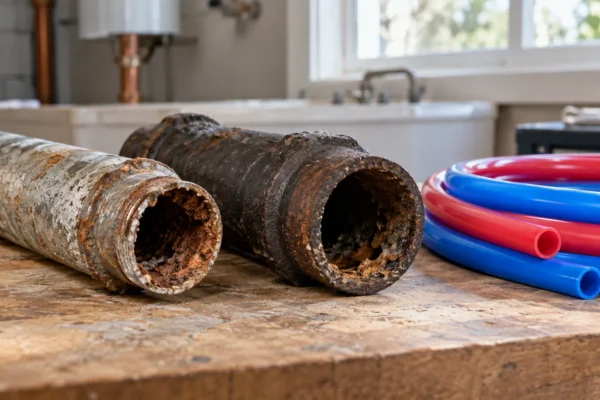
When to Repipe vs Repair Galvanized, Polybutylene, and Cast Iron [2026]
Knowing when to repipe vs repair is a big-ticket decision, and the honest answer depends on which pipe…
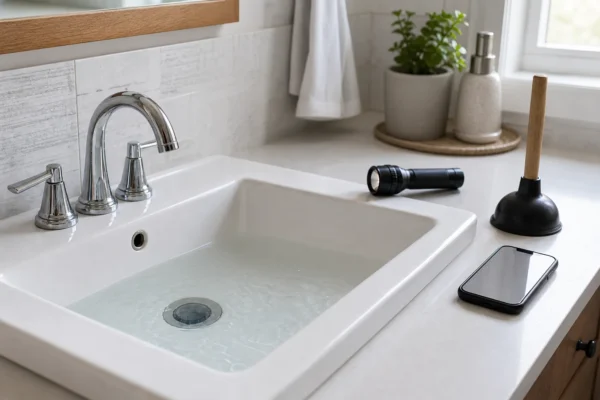
When to Call a Plumber for Drain Problems [2026]
Knowing when to call a plumber for drain problems comes down to a short checklist: is it one…
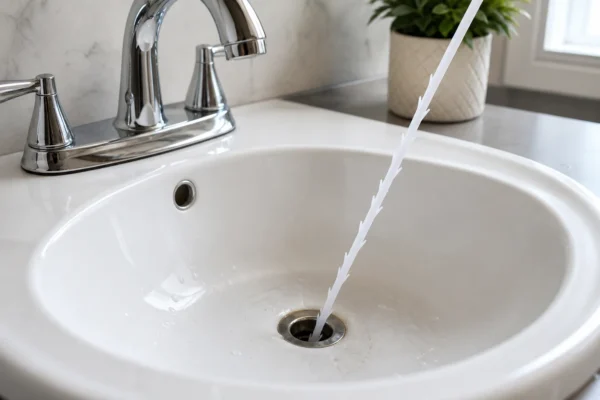
Why Are My Drains Slow? Causes, Diagnosis, and 3 DIY Fixes [2026]
If you’re asking why are my drains slow, the answer almost always starts with one question: is it…