
A shower that drips, runs lukewarm, or trickles instead of sprays is one of the most common bathroom complaints – and most of the time the fix is a single part behind the handle, not a wall demolition. This shower repair guide is built around the question that decides everything: where is the water wrong? A drip from the head, a weak spray, a temperature that will not settle, water escaping at the base of the tub spout – each points at a different part. We will start with how a shower system actually works, rank the problems by how often they happen, walk the fix for each in plain steps, and draw the honest line at the repairs that belong to a licensed plumber.
How a Shower System Actually Works
Behind the handle and the showerhead is a compact pressure, temperature, diversion, drainage, and waterproofing system, most of it hidden in the wall. Understanding the five parts makes every later diagnosis obvious.
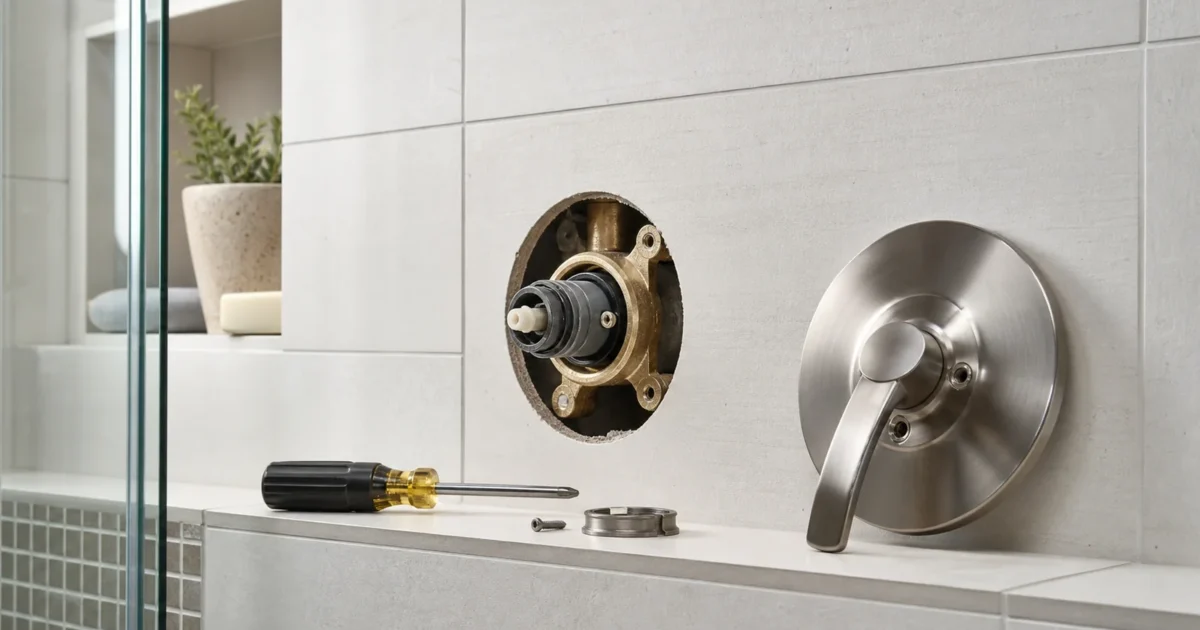
The valve and cartridge. Water enters a valve body from the hot and cold supply lines, and a cartridge (or stem assembly) inside meters the flow and mixes the temperature (Angi). Most modern single-handle showers are pressure-balancing, anti-scald valves – Moen’s Posi-Temp and Kohler’s Rite-Temp are the common families – which hold your set temperature steady when someone flushes a toilet or runs a tap elsewhere (Moen, Kohler). This is not optional: the International Plumbing Code requires shower valves to be balanced-pressure, thermostatic, or a combination, field-set to a maximum of 120 degrees F (ICC 2018 IPC 412.3). The cartridge is the single most failure-prone part of the system.
The diverter. On a tub-shower, mixed water normally exits down through the tub spout; pulling the diverter blocks that path and pushes water up to the showerhead (Danco). When the diverter wears, water keeps pouring from the spout and the shower goes weak.
The showerhead. Both a spray device and a regulated one: federal rules cap showerheads at 2.5 gallons per minute (post-1994), and EPA WaterSense heads at 2.0 GPM while still meeting spray-performance criteria (DOE, EPA WaterSense). Its small passages clog with mineral scale.
The drain. Separate from the pressure side: a drain opening, stopper and linkage, waste shoe, overflow tube, and the P-trap below. Most tub and shower clogs are hair and soap scum collecting near the strainer or in the trap (This Old House).
The waterproofing. The caulk joint where the tub meets the wall, the grout and tile, the shower-door sweeps and gaskets, and the drain flange seal. Bathroom leaks frequently trace to cracked tile, a worn door seal, a bad drain assembly, or failed caulk (This Old House).
The Most Common Shower Problems, by Frequency
There is no single national ranking of shower failures, so this is a practical synthesis of cost guides, retailer repair libraries, and manufacturer support data. Roughly in order of how often homeowners hit them:
- Slow or clogged drain – water pools at your feet; hair and soap near the opening. (Often the easiest fix.)
- Drip from the head or spout when off – almost always a worn cartridge, stem, washer, or O-ring; cartridges last anywhere from 10 to 30 years (Angi).
- Weak shower because the diverter leaks – water keeps running from the tub spout after you pull the diverter; a faulty diverter is the most common reason water will not stay at the head (Angi).
- Temperature swings or a stuck handle – the pressure-balance cartridge is worn or scaled; temperature will not dial in, or the handle is hard to turn.
- Low flow or a bad spray pattern – mineral scale in the showerhead; often fixed by cleaning or replacing the head.
- A tub stopper that won’t hold or won’t drain – worn stopper or corroded linkage.
- A leak at the caulk, grout, or tile – water shows up outside the tub or on the ceiling below.
- A shower-door leak – a worn sweep or gasket lets water escape under the glass.
- A loose or wrong-style tub spout – it wiggles or leaks at the wall.
- Chips or cracks in a fiberglass/acrylic pan – surface damage, sometimes age-related.
Symptom Triage: Where Is the Water Wrong?
- Drips from the showerhead when everything is off -> the cartridge is not sealing. Replace it (below).
- Water runs from the tub spout while the shower is on -> the diverter is worn. Replace the diverter or the spout.
- Temperature drifts hot/cold or the handle is stiff -> the pressure-balance cartridge is failing. Replace it.
- Weak or uneven spray, but temperature is fine -> the showerhead is scaled. Clean or replace it first – the cheapest fix, and do this before you touch the valve.
- Water on the floor or the ceiling below, away from the fixtures -> a waterproofing leak (caulk, grout, door, or drain seal), or a behind-the-wall valve leak – the one to take seriously.
Drips and Temperature: The Cartridge (and Why You ID It First)
When a single-handle shower drips when off or will not hold temperature, the cartridge is the usual cause – and the single biggest mistake is buying the wrong one. Shower valves are brand-locked: a Moen Posi-Temp 1222, a Delta Monitor/MultiChoice, and a Kohler Rite-Temp are not interchangeable, and even within a brand there are look-alikes. Identify the valve before you buy anything.
That identification step is exactly what our faucet cartridge finder is built for – answer a few questions about your handle and trim and it routes you to the likely cartridge and the correct removal tool. It matters here because the removal tool has hard compatibility cliffs (the standard Moen puller, for instance, is a poor fit for some cartridges and an aftermarket puller is needed), and a seized cartridge forced out the wrong way can damage the in-wall valve body – turning a small repair into a big one.
The replacement itself is a moderate DIY job: shut off the water (at the shower’s stops if it has them, or the house main), remove the handle and trim, pull the retainer clip, extract the old cartridge, and seat the new one in the same orientation. Confirm your exact valve model first; the brand-specific step-by-step guides in this cluster cover Moen and Delta in detail as they publish.
The Diverter, the Showerhead, and the Drain
Diverter (weak shower). If water keeps pouring from the tub spout when the shower is on, the diverter has worn out. On many tubs the diverter is built into the spout, so replacing the spout (matched to your stub-out style and length) fixes it (Home Depot). Others use a separate diverter valve.
Showerhead (low pressure / bad spray). Before blaming the valve, clean the head – mineral scale in the spray passages is the most common low-flow cause. Unthread it, soak it in vinegar, clear the nozzles, and re-tape the threads with PTFE tape on the way back. If it is old or cracked, replacing a threaded showerhead is a five-minute, no-special-tools job.
Drain (slow/clogged). Hair and soap near the strainer or in the P-trap cause most shower drainage problems. Pull the strainer or stopper, remove the visible hair, and clear the trap mechanically – skip the chemical drain cleaner. Because a slow shower drain is really a drain problem, our drain repair guide covers the full clear-it-mechanically method and how to tell a fixture clog from a main-line one.
Tools You’ll Actually Need
A short kit covers most shower work:
- An Allen/hex key set and a Phillips screwdriver – for handle set-screws and trim.
- A cartridge puller – the brand-correct one for your valve (this is the tool buyers most often get wrong).
- Channel-lock pliers and an adjustable wrench – for spouts and connections.
- PTFE (plumber’s) tape – for showerhead and threaded-spout connections.
- Vinegar and an old toothbrush – for descaling the head.
- A drain hair tool – for the strainer/trap.
DIY vs. Call a Pro
Most shower repairs – cartridge, showerhead, diverter, spout, stopper, caulk – are within DIY range. Call a licensed plumber when the problem is behind the wall:
- A leak inside the wall (water on the ceiling below, persistent dampness, no access panel). This is where shower leaks do real, expensive damage, and finding the source often means opening the wall (This Old House).
- A soldered-in or built-in valve body that has failed – replacing the valve itself (not just the cartridge) is plumbing-trade work.
- A seized cartridge that will not come out even with the correct puller. Forcing it risks cracking the valve body in the wall.
- No shutoffs and a valve you cannot isolate without killing the whole house and still cannot service confidently.
There is no prize for forcing a valve in the wall. The cartridge, head, diverter, and drain are yours; the valve body buried in the wall is the plumber’s.
What It Costs (2026, Rough Ranges)
- DIY cartridge / showerhead / diverter: the part ($15-$70 for a cartridge, $10-$40 for a head or spout) plus a one-time puller.
- Professional shower cartridge replacement: commonly in the low-to-mid hundreds depending on access and brand.
- In-wall valve replacement or a behind-the-wall leak: the serious end – often many hundreds to low thousands once a wall is opened, which is why catching a hidden leak early matters.
Treat these as directional; get a local quote for anything in the wall.
Why does my shower drip after I shut it off?
A worn cartridge that no longer seals. Identify your valve brand/model, then replace the cartridge – the most common shower repair.
Why is my shower weak but the tub spout runs strong?
The diverter is worn and not sending water up to the head. Replace the diverter (often the whole tub spout).
Why won’t my shower get hot (or it swings hot and cold)?
The pressure-balance cartridge is failing or scaled, or the valve’s temperature limit stop needs adjustment. Start with the cartridge.
How do I know which shower cartridge I need?
Match it to your valve brand and model – they are not universal. Our faucet cartridge finder walks you from your handle/trim to the likely cartridge and the right removal tool.
Will a low-flow showerhead fix weak pressure?
If the cause is mineral scale, cleaning or replacing the head fixes it. If the cause is the valve or supply, a new head won’t help – diagnose first.
Is a leaking shower an emergency?
A drip is not, but water appearing on the ceiling below or persistent dampness behind the wall is – that causes structural damage; call a plumber.
Can I replace a shower cartridge myself?
Usually yes, for an accessible single-handle valve: shut off the water, pull the handle/trim and retainer clip, swap the cartridge. The hard cases are seized cartridges and in-wall valve bodies.
Where to Go From Here
This hub is the map; the per-problem guides below go step by step on each fixture and brand. They publish over the coming weeks as part of the showers cluster:
- How to Identify Your Shower Valve and Cartridge (Moen, Delta, Kohler)
- Why Is My Shower Dripping? Causes and the Cartridge Fix
- Why Is My Shower Pressure So Low?
- How to Replace a Moen Shower Cartridge (Posi-Temp)
- How to Replace a Delta Shower Cartridge (Monitor / MultiChoice)
- How to Clean or Replace a Clogged Shower Head
- How to Fix a Shower Diverter That Won’t Divert
- Shower Too Hot or Cold? Adjusting the Anti-Scald Valve
- How to Re-Caulk a Shower or Tub Surround
- Shower Valve Leaking Behind the Wall? When It’s a Pro Job
- The Homeowner’s Shower-Repair Tool Kit
In the meantime: to identify your valve before buying a cartridge, use the faucet cartridge finder; for a slow shower drain, see the drain repair guide; and for other fixtures, the toilet repair guide and faucet repair guide round out the set.
Valve and cartridge identification
- How to Identify Your Shower Valve and Cartridge (Moen, Delta, Kohler) [2026]
- How to Identify Your Delta Shower Valve: Series, Cartridge, and Generation [2026]
- How to Identify Your Moen Shower Valve: Cartridge Family and Series [2026]
- How to Identify Your Kohler Shower Valve: Rite-Temp, MasterShower, and Cartridge Family [2026]
- How to Identify Your Pfister Shower Valve: Model Number, Cartridge, and Valve Family [2026]
- How to Identify Your American Standard Shower Valve: Trim, Cartridge, and Rough-In Valve [2026]
- How to Identify Your Symmons Shower Valve: Temptrol, Safetymix, Symmetrix, and More [2026]
- How to Identify Your Grohe Shower Valve [2026]
- How to Identify Your Gerber Shower Valve [2026]
- Shower Cartridge Identification Chart: Every Major Brand in One Table [2026]
- Which Shower Trim Kits Fit Your Valve? How to Tell by Brand
Step-by-step shower repair walkthroughs
- How to Replace a Delta Shower Cartridge in 7 Steps (Without Damaging the Valve)
- How to Replace Moen 1222 Posi-Temp Shower Cartridge [2026]
Tools and replacement parts
Coming soon.
Troubleshooting and diagnostics
Costs and when to hire a pro
- How Much Does It Cost to Replace a Shower Valve? [2026]
- Should I Repair or Replace My Shower Valve? [2026]
This shower repair guide is for general homeowner education and is not a substitute for licensed professional advice. Local plumbing codes vary by jurisdiction; when a repair involves an in-wall valve body, a leak inside the wall, or anything you are unsure about, consult a licensed plumber.
Parts for this repair
As an Amazon Associate, plumbingbythebook earns from qualifying purchases. Links below are affiliate links — they cost you nothing extra.
- Moen 1222 Posi-Temp Shower Cartridge — The replacement cartridge for single-handle Moen Posi-Temp shower valves — the fix for a dripping head or drifting temperature on the most common shower valve in U.S. homes.
- Kohler GP500520 Rite-Temp Shower Cartridge — OEM cartridge for Kohler Rite-Temp pressure-balancing shower valves — stops drips and restores stable temperature.
- Delta RP46074 MultiChoice Universal Shower Cartridge — The MultiChoice Universal cartridge assembly for Delta MultiChoice 13/14 Series tub and shower valves produced after March 2006 — match your valve's production date before you buy.
- Speakman S-2005-HB Anystream High-Pressure Shower Head — Brass hotel-grade head with strong perceived pressure — the upgrade when low flow or a scaled spray pattern is the problem.